I have visited a lot of coffee shops over the years.
Some were large chains. Many were not.
The ones I remember most clearly are often small places where, after spending a little time inside, I felt I understood something about the person who made them.
Maybe the owner loved music.
Maybe they collected old furniture.
Maybe they liked making things by hand.
Maybe roasting was the centre of everything they did.
The best places did not feel as though somebody had searched for “beautiful coffee shop design,” collected the current trends, and assembled the results in one room.
They felt like somebody.
That distinction has become important to me as I think about Filgap.
Because visiting good cafés is one of the easiest ways to get ideas.
And one of the easiest ways to lose your own.
The cafés I remember usually have an owner inside them
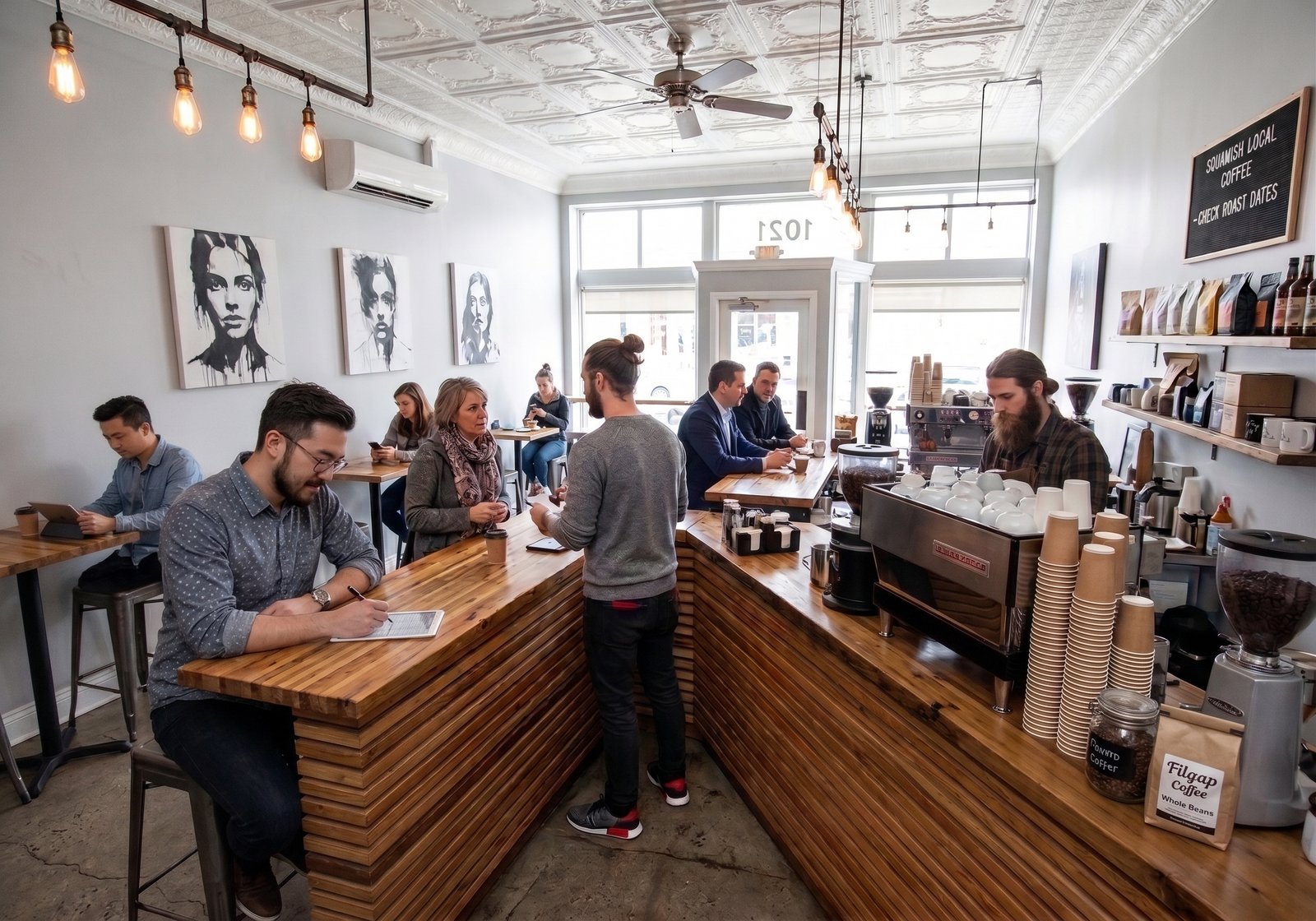
I remember a small coffee shop I visited in Chicago.
The owner loved music and art, and he roasted coffee.
You could feel all three in the space.
They were not three marketing themes attached to the walls. They seemed to belong there because they belonged to him.
That made the café difficult to separate from the person behind it.
I have seen the same thing in very different forms elsewhere.
One owner may be extremely organized, and the whole shop reflects that.
Another may love antiques.
Someone else may build furniture or fixtures themselves.
Another person may strip almost everything away so that the roasting machine, the coffee and the work around them become the visual centre of the room.
Those cafés can look completely different from one another.
That is the point.
Their individuality does not come from searching for something nobody else has ever done.
It comes from doing something that feels natural to the people operating the place.
The people who like that character begin to gather around it.
Over time, that can become a brand.
Maybe even a small community.
That is much harder to copy than furniture.
I learned that the beautiful thing is not always the right thing
I did not always think about competitor research this way.
Years ago, I visited a café in Europe and saw a pair of standing outdoor heaters.
They were unusual. The heat came from above, beneath a wide canopy-like top. In that particular outdoor setting they looked beautiful.
I could immediately picture them at a new shop I was preparing.
So I imported two.
I still remember liking them.
But bringing those objects into my shop did not bring the original place with them.
That sounds obvious now.
It was useful to learn it by doing it.
The heaters were only one piece of a much larger environment. The architecture was different. The weather was different. The customers were different. The surrounding street was different. Most importantly, the story of that other place was not mine.
Something can be excellent where it is and still be wrong when moved somewhere else.
That experience changed the way I look at cafés.
When I see something I like now, I try not to begin with:
How could I put this in my shop?
A better question is:
Why does this work here?
I want to know why the customer chose this place
There is one question I keep coming back to when I visit another coffee business:
Why did this customer choose this place, at this time?
That question opens up much more than a traditional competitor table.
Maybe someone came because the coffee is particularly good.
Maybe they came because parking is easy.
Maybe the café sits between home and the trail.
Maybe the doughnut is really the reason and the coffee comes with it.
Maybe their bike is being serviced next door.
Maybe this is simply where their friends meet.
Maybe they like the staff.
Maybe they can get in and out in three minutes.
Maybe they have been coming for ten years and no longer think about the decision at all.
Those are very different reasons to buy coffee.
If I understand the reason, I can learn something about the market.
If I only copy what is visible, I may learn almost nothing.
My old competitor table was useful, but incomplete
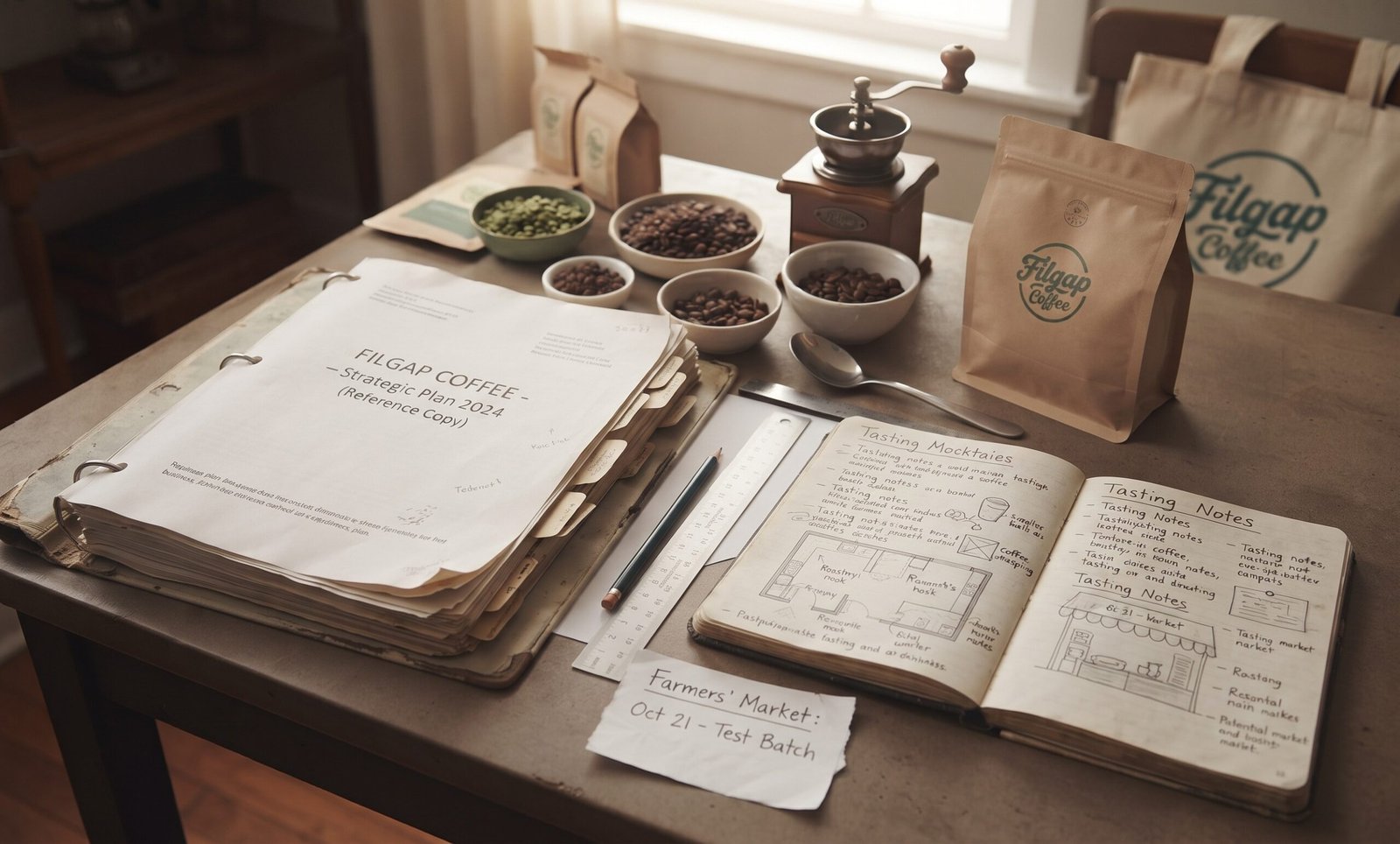
When I prepared an earlier business plan for Filgap, I did what business plans normally do.
I compared local businesses.
Location.
Hours.
Google ratings.
Menu.
Prices.
Seats.
Whole-bean offerings.
Strengths and weaknesses.
I even included my own judgments about coffee quality.
That exercise was useful.
I would still collect much of that information today.
But I would be more careful with the conclusions.
A number in a table can make two businesses appear directly comparable even when customers choose them for completely different reasons.
And my judgment that one coffee is better than another does not automatically explain why people go back.
The question I would add now is:
What job does this business do particularly well for its customers?
That is harder to put in a spreadsheet.
It is probably more useful.
Hospitality is part of the product
When I think a coffee shop is really good, one thing usually stands out before I leave.
Hospitality.
Of course the coffee has to be good.
The space matters.
The operation has to work.
But somebody still has to connect all of those things to the customer.
That person may be the owner or a barista.
I think of what the customer receives as more than the drink in the cup.
It is something closer to:
coffee + space + hospitality
The last part can increase the value of everything before it.
It can also destroy it.
An excellent coffee served without care can leave a surprisingly weak impression.
A warm interaction can make someone curious, comfortable enough to ask questions, or happy to return.
I have a simple test for this.
If I would not be comfortable serving something that way to someone I care about in my own family, I should not serve it that way to a customer.
Fresh food should be fresh.
The space should be clean.
The product should be handled properly.
The customer should be treated like a person.
It is a simple standard.
Keeping it every day is harder.
The visible idea is only the surface
Suppose I visit another coffee shop and notice that a particular food item seems popular.
The easiest conclusion is:
We should sell that too.
But there are many questions underneath it.
Why does it sell?
Does it increase the average purchase?
Does it work especially well with that café’s coffee?
Does the kitchen already have the equipment required to make it?
How much labour does it add?
How much space?
How much waste?
Does the owner have experience making it?
Would the same item work if the surrounding customer base were different?
The same applies to design.
Or seating.
Or retail products.
Or events.
Or a roasting machine placed in the middle of the room.
The visible feature is the answer another business reached.
Competitor research should help me understand the question behind it.
Then Filgap has to find its own answer.
A competitor does not need to disappear for Filgap to succeed
I do not think about Squamish coffee as a competition where one café has to win and another has to lose.
It is a growing community, and the coffee businesses here already have their own personalities.
That is a good thing.
There should be room for different reasons to choose different places.
Current Tourism Squamish listings also remind me why I need to keep checking my own assumptions. I had thought of local roasting combined with customer-facing coffee service as largely absent from the market, but current official listings already describe a local coffee house serving house-roasted coffee. So I should not build Filgap’s case around a claim that nobody else locally roasts coffee for café customers.
That actually makes the Filgap question better.
What combination can I do in my own way?
For now, I keep coming back to freshness, consistency and a serious focus on coffee.
Whole beans are at the centre.
I am also interested in convenient forms of coffee that can still be managed closer to the freshness I want, including capsules and eventually espresso concentrate.
And one day I still like the idea of a small space where roasting and customers are not completely separated.
None of those individual elements belongs only to Filgap.
The combination, the standards behind it, and the way they are carried out have to become ours.
That is a more honest form of differentiation.
Sometimes competitor research should change my mind
There is another possibility I have to leave open.
Someone else may solve the problem first.
If a business opened in Squamish tomorrow with a thoughtful roasting operation, consistently excellent fresh coffee, a customer-facing espresso bar, and a model that addressed much of what I am trying to solve, I would pay close attention.
I would have to.
Perhaps part of my original gap would no longer exist.
That would not necessarily mean Filgap should disappear.
The name itself comes from a larger idea: finding meaningful gaps and filling the ones we genuinely can. The first gap is coffee, but I do not expect it to be the last question Filgap ever asks.
So competitor research also has to be capable of delivering an uncomfortable answer:
Someone is already doing this well.
If that happens, the next question is not automatically:
How do I beat them?
It may be:
What still needs doing?
I think that is a healthier way to build in a small community.
A strong market can support difference
This is also why I do not interpret every new café as bad news.
Squamish is still changing.
New people arrive.
Coffee habits change.
Businesses change.
If there is enough demand, several good businesses can coexist because they are not identical.
One may be known for baking.
Another for a neighbourhood atmosphere.
Another for convenience.
Another may be closely connected to outdoor activities.
Another can take coffee itself particularly seriously.
I do not need every customer to choose Filgap every time.
I need enough people to have a reason to choose it when what Filgap does fits what they want.
That is different from winning.
It is earning a place in the market.
The competitor table I would use today
If I made another competitor table now, I would still record prices, hours and products.
But I would add different columns.
I would want to know:
- Who seems to choose this business?
- What occasion brings them here?
- What appears to be the main reason to visit?
- What makes buying convenient?
- Is coffee the hero of the business, an equal partner, or a supporting product?
- What role does the space play: takeaway, meeting, working, eating or retail?
- What does the business seem especially good at?
- What operational complexity probably comes with that model?
- What part of its success depends on this particular location or owner?
- What does this teach me about the market?
- Does the customer I am building for actually have the same need?
And when I find an idea I particularly like, I would ask five more questions before doing anything with it:
- What problem is it solving?
- Who is it solving it for?
- Why does it work there?
- What does it cost the business to provide it?
- Does Filgap need to solve the same problem?
If the last answer is no, admiration can be enough.
Not every good idea needs to become mine.
Come home with questions, not a shopping list
I still expect to keep visiting coffee shops.
In Squamish and elsewhere.
There is too much to learn not to.
Some places will teach me about coffee.
Some about space.
Some about operations.
Some about hospitality.
And occasionally I will walk into a small café that feels so completely like the person behind it that I will remember it years later.
Those are probably the places that teach me the most.
Not because I can reproduce them.
Because I cannot.
The best competitor research should not send me home with a longer list of furniture, drinks and ideas to add to Filgap.
It should send me home with better questions.
And if I had room for only one line in my notebook after visiting another café, I think I know what I would write:
Why did the customer choose this place, at this time?