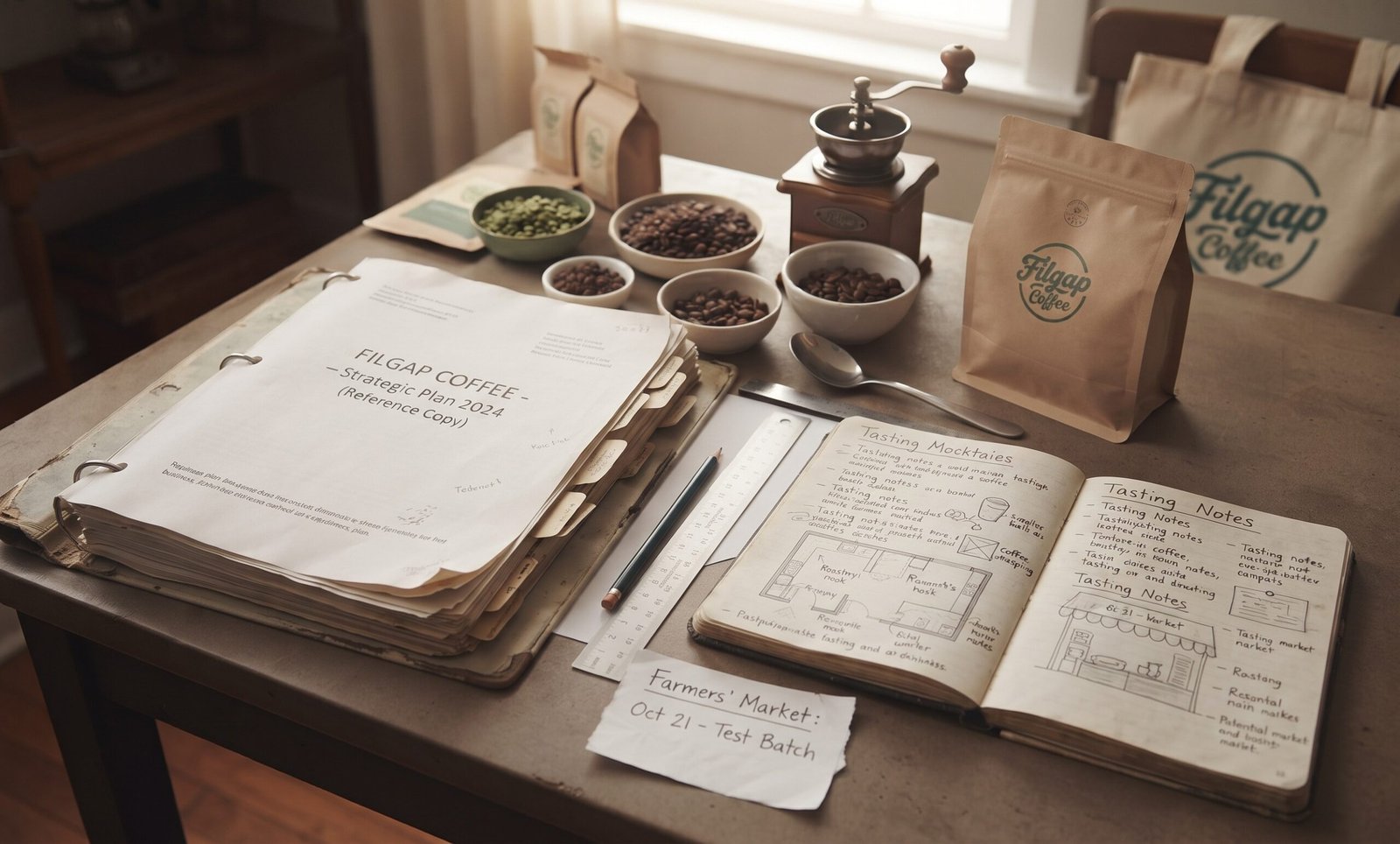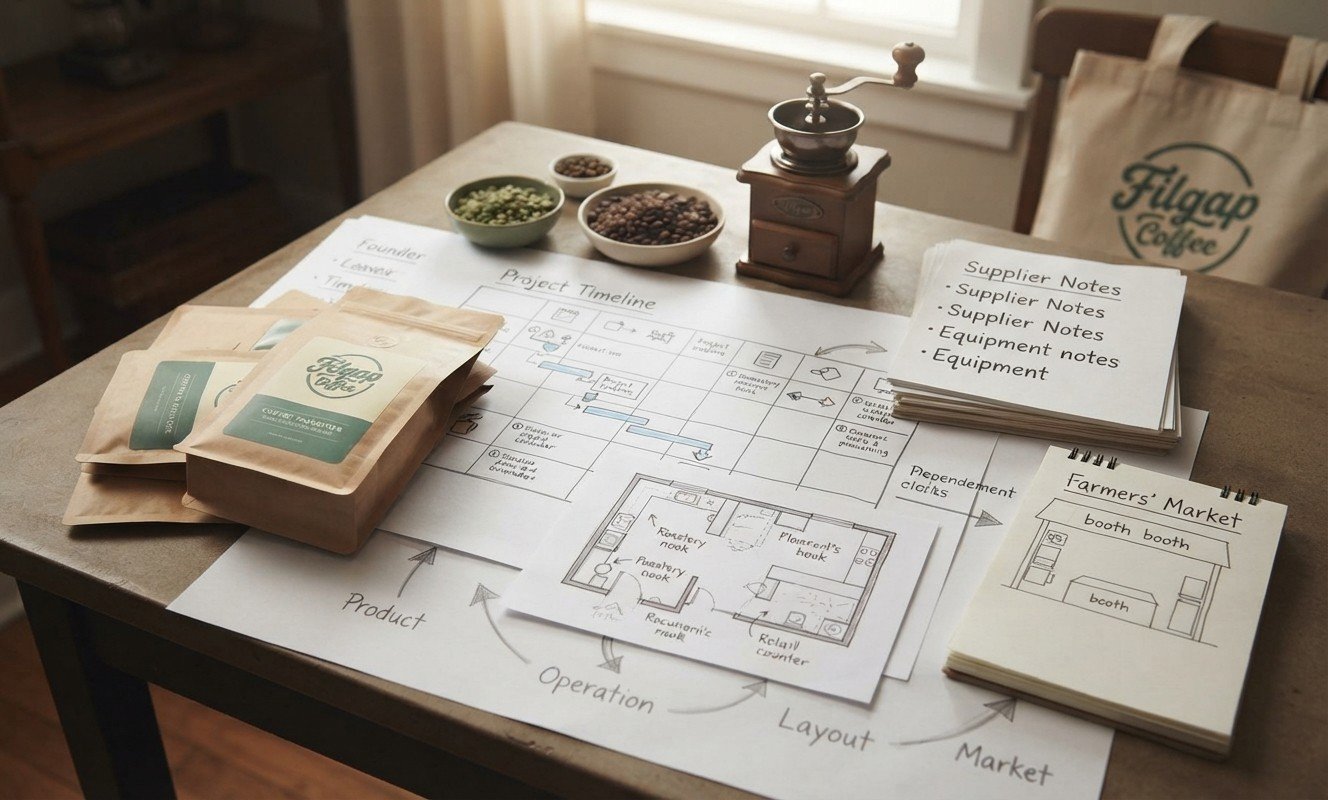
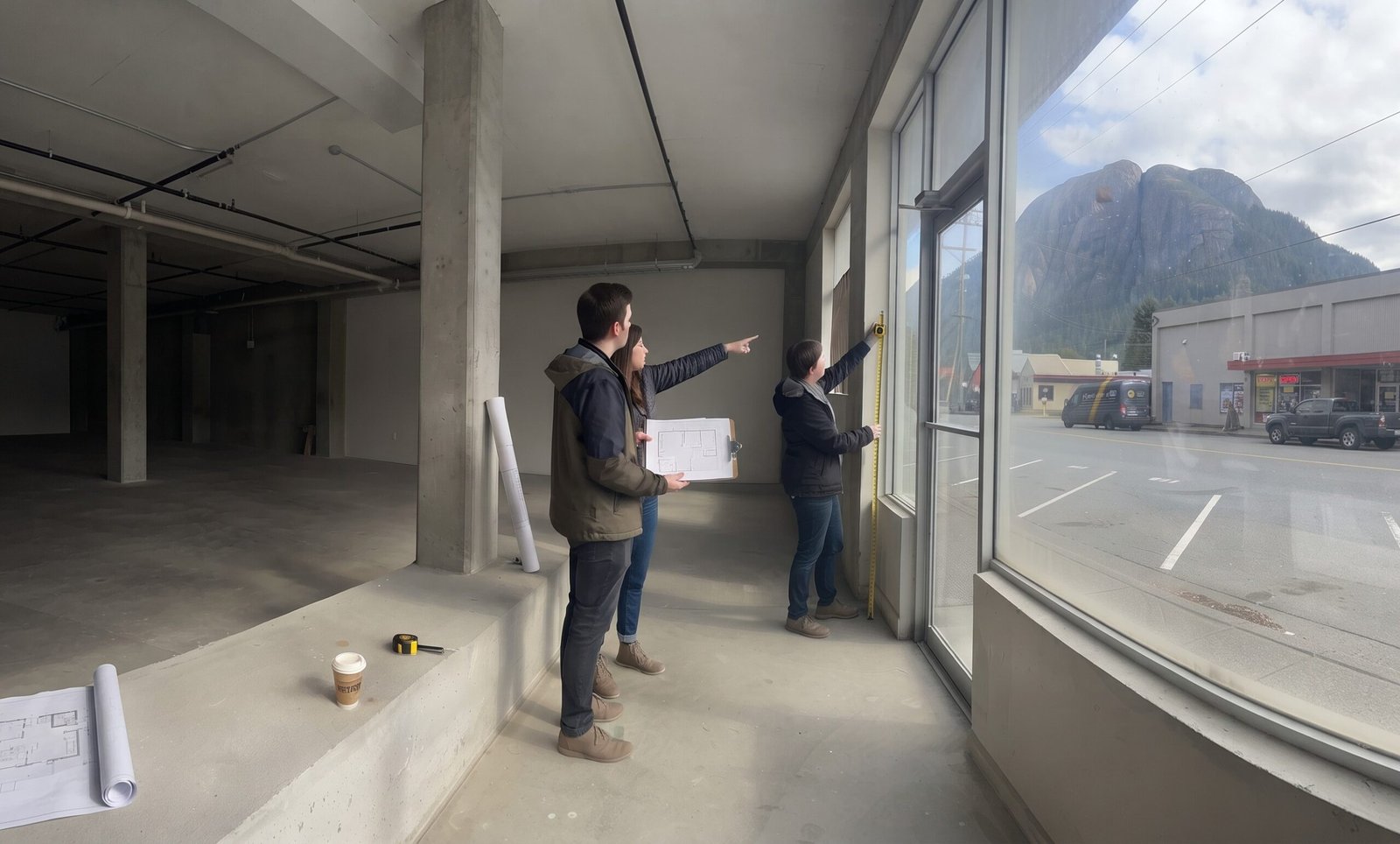
A few years ago, I probably would have chosen the busy downtown location.
Today, I think I would choose the other one.
Imagine two spaces.
- One is in a very visible part of town, with plenty of people passing every day. The rent is high and parking is not especially convenient.
- The other is outside the busiest area. Fewer people pass the door, but the rent is lower, parking is easy, and the building is much better suited to roasting coffee.
For the kind of coffee business I used to operate, the first location could have been the obvious choice.
For Filgap, I would look harder at the second one.
A good coffee shop location still needs customers to find it easily. But for me now, it also has to fit the way the business actually needs to work.
Filgap is being built around roasting, whole-bean coffee, espresso and freshness. I want the coffee itself to become part of the reason people come.
That changes the location question.
Visibility still matters to me
I have always taken visibility seriously in coffee.
Coffee is an everyday purchase, and a lot of it is connected to routine and convenience. People notice a place on the way somewhere else. They know where it is. One morning they stop.
That behaviour matters.
In my previous coffee business, I looked at many locations with that in mind, and I have not changed my mind about the value of being easy to see.
What has changed is how much I am willing to pay for it.
If somebody likes a particular coffee enough, or trusts the way it is roasted, they may be willing to make a small trip for it.
That gives Filgap a little more freedom than a business that depends almost entirely on people walking past the door.
A little more freedom does not mean I want to hide.
Even if Filgap is outside the main commercial flow, I would still want reasonable visibility. It should be easy to find, easy to explain where it is, and not so far to one side of Squamish that a simple coffee purchase starts to feel like an expedition.
That is one reason I keep thinking about places outside Downtown as possibilities without deciding that one of them is the answer.
Moving away from traffic makes parking more important
If I ask someone to drive specifically to Filgap, I want the arrival to be easy.
Park the car and go in.
That is roughly what I have in mind.
I live here, and driving is part of many normal trips around Squamish. If a future Filgap space sits outside the busiest pedestrian area, convenient parking becomes much more important to me.
This is especially true for whole-bean coffee.
Someone may only be coming in to pick up a bag, ask a question and leave. I would rather not add unnecessary friction to a trip like that.
A downtown location works differently. Someone may already be walking between several businesses, meeting somebody or spending time in the area. In that situation, parking directly outside one particular shop matters less.
So I do not think parking has one value everywhere.
It changes with the kind of location I choose.
I also look at why people come to the area
Neighbouring businesses matter too.
A bakery feels useful.
A gym caught my attention too.
People go to a gym repeatedly, often as part of a routine. That seems interesting for a business that also hopes to build repeat local habits.
Residential buildings nearby can help for the same reason.
Some food businesses may create a place where people already expect to spend a little time.
Then I thought about a post office.
There are people there too, but the feeling is different. Usually there is a task: go in, do it, leave.
Maybe some of those people would still buy coffee. I am not trying to turn this into a rule about post offices.
It just reminded me that traffic numbers by themselves do not tell me why people are in a place.
I care about that.
The building can change my mind very quickly
Then there is the building itself.
This is where a beautiful storefront can lose me.
Once a location becomes serious, I start thinking about what needs to happen behind the surfaces.
Can the roasting exhaust be handled reasonably?
Are the basic plumbing and electrical services somewhere close to what the business needs?
How much would have to be rebuilt before I can even start spending money on the part customers will see?
I covered much more of this when thinking about how I would research a market before signing a lease. At the final location stage, I am less interested in making another checklist.
I mainly want to know how much of the investment is going into adapting the space, and how much is going into rescuing the building.
There is a difference.
I expect to spend money fitting out a roastery. That is unavoidable.
What worries me is discovering that a seemingly affordable location needs a large amount of work just to become usable.
Some of the most expensive work may end up hidden in the ceiling, behind walls or under the floor.
It still has to be done properly.
I would just rather choose a building where less of the starting capital disappears before Filgap itself begins to take shape.
I am more cautious about an old building than I used to be
Older buildings can be attractive.
They can also be in some of the best-established parts of town.
But now I find myself thinking about something else quite early:
How long can I stay here?
If I put significant money into a roastery and tasting room, moving it five years later would not be a small inconvenience.
The roaster, ventilation, electrical work and other improvements are one part of that.
The customers are another.
Over time, people learn where the business is. Staff learn the room. The operation becomes fitted to the building. Things gradually get better.
That takes time.
So if I see a serious possibility that an older property may be redeveloped, or that I cannot reasonably expect long-term stability there, I become much less interested even if I like the street.
This is probably why newer buildings appeal to me more now than they once did.
Not because new is automatically better.
A new building can have its own problems.
But starting from a relatively stable physical base has value when the business itself requires a lot of investment.
Mixed-use space interests me, until I imagine the roaster
I keep noticing newer mixed-use developments in Squamish.
Ground-floor commercial space with people living above or nearby has obvious appeal.
There is a neighbourhood around the business from the beginning.
The building may also require less basic reconstruction.
Then I imagine putting the roaster in.
That immediately creates questions.
Can the exhaust work?
Can production and residential use coexist comfortably?
Does the building actually support what I want to do, or does it just look ideal from outside?
The Business Park has almost the opposite attraction for me.
It is easier to imagine production there.
But then I have to ask whether the customer side of Filgap works.
Can people see it?
Can they get there easily?
Does it feel like somewhere they would naturally return to?
I do not know the answers yet.
This is probably why choosing the neighbourhood before seeing the building feels backwards to me.
The actual property may change the answer.
Rent can push the business somewhere I do not want it to go
The expensive location creates another kind of pressure.
Suppose I find a very visible space and love it.
Then I calculate what the rent requires.
Maybe I need more daily sales.
That could mean more seats, more food, more equipment and more staff.
None of those things is automatically bad.
I used to operate stores in very different kinds of neighbourhoods, and we adjusted the store model to fit each market. I think that is normal.
I would expect to do some of that with Filgap too.
Maybe the number of seats changes.
Maybe the hours change.
The exact menu will certainly respond to the real location and the people using it.
I think of that as fine-tuning, and I still think that is the right idea.
The difficulty is knowing when the adjustment has gone too far.
If I need a much larger café and a much broader food operation simply to carry the rent, I may have chosen a strong retail location for somebody else’s business.
That does not make the location bad.
It tells me something about Filgap.
I think I would still start with B
If the two imaginary spaces were actually offered to me tomorrow, I think the second one would get my attention first.
I would still worry about whether enough people could see it.
I would still want to know what was nearby and whether customers would really make the trip.
But if I could roast there properly, keep the fixed cost under control, make parking easy and stay for a long time, I would take those advantages seriously.
The real decision will probably be messier than this.
A downtown building may turn out to have exactly the infrastructure I need.
A Business Park unit may be inexpensive and completely wrong for customers.
A new mixed-use building may surprise me in either direction.
I do not want to decide before I see the choices.
What has become clearer to me is how much I care about stability.
If I spend heavily building a permanent Filgap space, I want enough time there for the business to become something.
Five years does not feel like the horizon in my head.
I found myself saying twenty.
I do not mean that every lease has to guarantee me twenty years.
I mean I want to be able to stand in an empty room and reasonably imagine that I could still be working there a long time from now.
If I cannot, the visibility outside the window may not be enough to convince me.