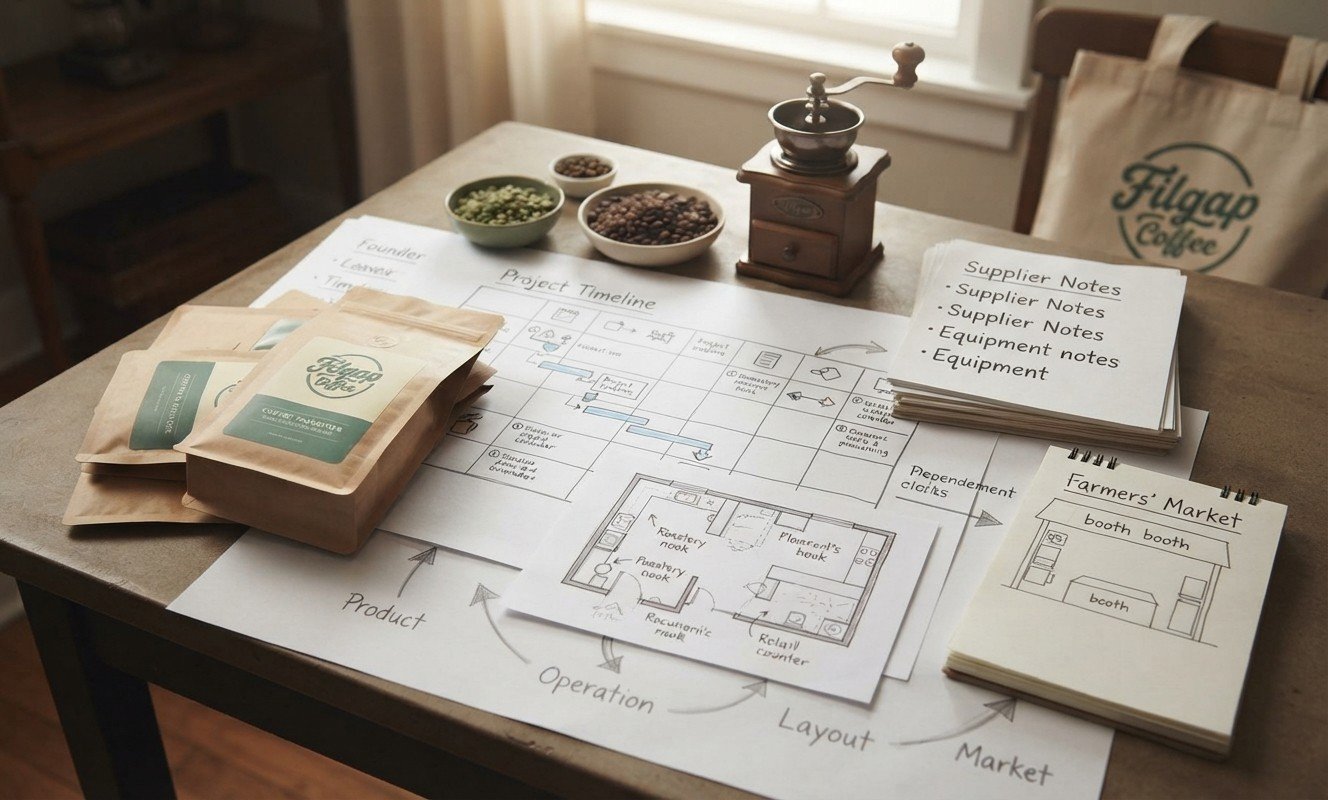
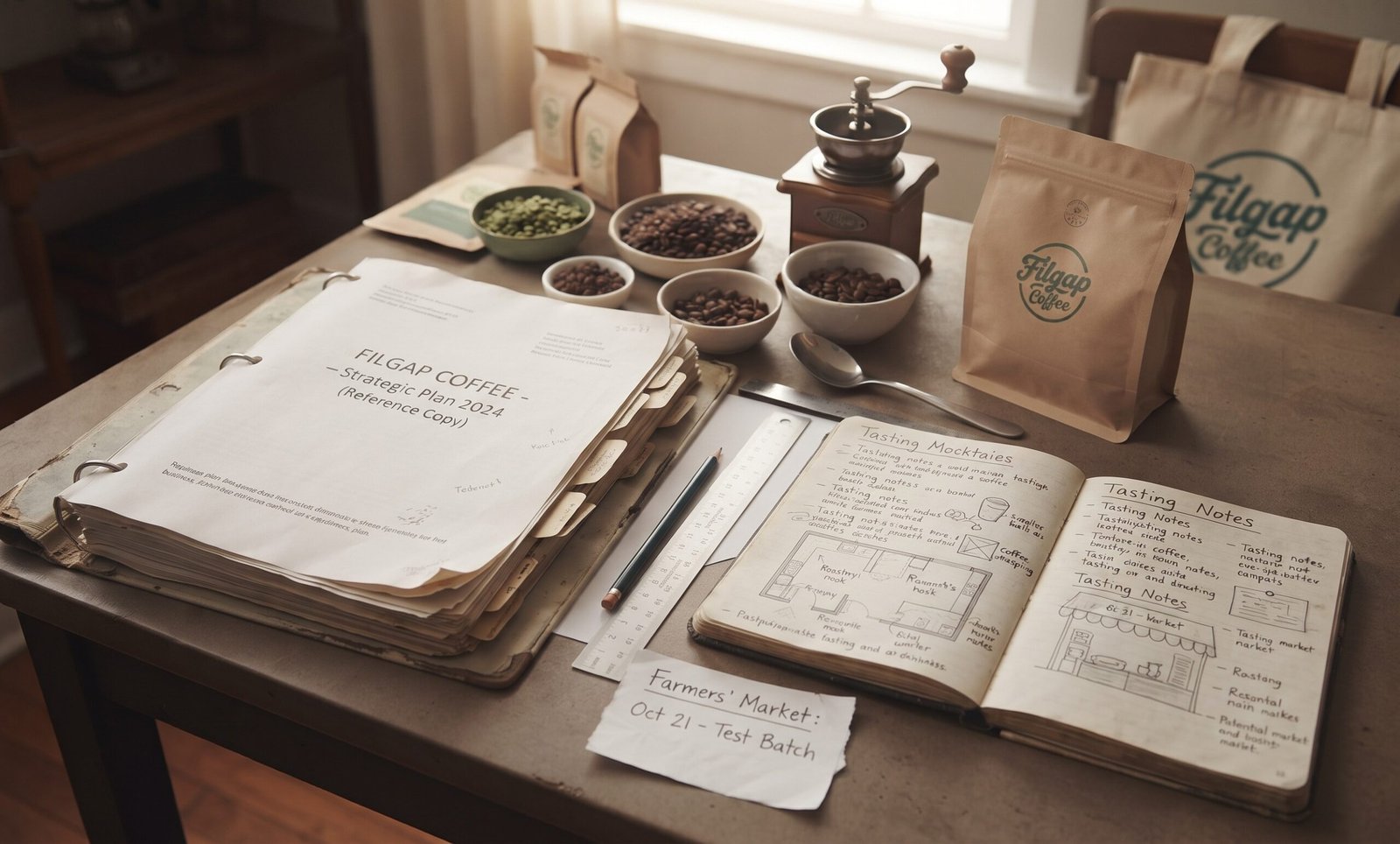
When I read the business plan I finished in 2024, I do not feel embarrassed by it.
I do not look at it and think, I got everything wrong.
I actually still think it was a good plan for the business I was imagining then.
I put a lot into it. But when I say that, I do not mean the hours spent formatting a document. Most of the work happened before the document.
I was studying.
Coffee had changed a lot since the earlier years when I had worked in the industry. Equipment had changed. Roasting technology had changed. There were machines and ideas I had not worked with before.
So I spent time catching up.
I researched. I spoke with potential partners. I asked for quotations. I compared equipment and operating ideas. I tried to understand what things would really cost instead of putting convenient numbers into a spreadsheet.
The plan became detailed because I was trying to make the thinking detailed.
That part still feels valuable to me.
The strange thing is that the business I am preparing now looks quite different from the one in that document.
The machine changed the timing, not the reason
In the 2024 plan, the roaster was not just another item on an equipment list.
It was the centre.
If my reason for building Filgap was to make freshly roasted coffee easier to get in Squamish, then the roasting machine had to work properly. The future café, the menu and the room around it mattered, but none of those things replaced the roaster.
I spent a lot of time looking at machines.
I was particularly interested in electric roasting. I liked the direction of using electricity in BC and thinking differently about the energy used in roasting. I also wanted to understand the newer technology that had appeared since my earlier coffee career.
Eventually I found a machine I really liked.
I reviewed it carefully and ordered it.
Looking back, there was a risk inside that decision. The model was still relatively new. There had been an earlier version, but from what I could see at the time, the version I ordered did not yet have the kind of operating history I would normally prefer for something so important.
Then delivery started moving.
It kept moving.
What was supposed to be part of a business launch became a delay of roughly two years.
The machine eventually arrived, but after it arrived I found issues that were serious enough that I did not feel comfortable using it for the coffee I wanted to produce. I returned it.
That was not a small scheduling problem.
The business I had planned was built around roasting.
For a while, the plan simply stopped there.
And now, strangely, I am grateful that it stopped before the rest of the business was committed around it.
If I had already signed a lease, built the space, hired people and started selling, I would have had a very different problem.
I had time to ask a question I probably would not have asked
If the machine had arrived on time and worked exactly as expected, maybe I would have followed the 2024 plan.
I cannot know.
What actually happened was that I had time.
Not time I asked for. Not time I was happy to receive at the beginning.
But time.
And during that delay I began to think differently about how Filgap should enter Squamish.
The 2024 plan was closer to a full launch: find the right commercial space, build a café around roasting, create enough of a menu and experience to support the investment, hire the people needed to run it and open the whole thing.
That model still makes sense to me as a model.
If I invest at that scale, I need a business capable of supporting that scale. I cannot take on a commercial lease, a broader operation and a larger team and then pretend the revenue requirements do not come with them.
What changed was that I stopped assuming I had to begin there.
I started liking the idea of Filgap becoming familiar more gradually.
Write about the coffee and the thinking behind it.
Use the website partly to explain Filgap and partly to force myself to organize what I believe.
Share samples.
Listen.
Then go into the Farmers’ Market with a smaller operation and see what happens when the products meet real customers.
Whole bean is still the centre for me. Keurig-compatible capsules are another product I want to test. Espresso concentrate is another. I can see the usefulness of those products, but that does not mean customers will see them the same way I do.
I need to find out.
A smaller beginning gives me a way to do that without building the whole future business first.
That was not the route I wrote down in 2024.
I am increasingly comfortable with it now.
The model changed. Most of the reason did not.
This is probably why I resist saying the old plan was wrong.
The 2024 model was a coffee shop with roasting inside it.
The model I am working toward now is much more coffee-first: get the products right, start through the Farmers’ Market, build familiarity and repeat demand, and then see whether a small roasting space and tasting room make sense.
That is a substantial change.
But most of the things that made me want to do this in the first place are still there.
Fresh coffee.
Roasting.
Quality.
Squamish.
The flavour direction I want to build.
And the simple frustration that started the idea.
I make coffee at home. I found it harder than I thought it should be to buy the kind of fresh specialty coffee I wanted, in the way I wanted to buy it.
That was a gap for me.
I thought there might be other people around me who felt something similar.
That is still the first gap I want Filgap to fill.
If the business grows and becomes profitable, there may be other gaps I can work on later. I do not need to know all of them now.
But if I changed the first reason for the business just because another model looked easier, I think I would lose a lot of my motivation to do it.
The format can change much more easily than the reason.
And if one day Filgap becomes much larger and the numbers support something closer to the original café model, maybe I will look at parts of that 2024 plan again.
I do not know.
That possibility is another reason I do not want to call the old plan a failure.
I still believe in detailed planning
Someone could look at this story and come to the opposite conclusion.
The business changed, so why make such a detailed plan in the first place?
I do not agree with that.
I am a planning person. My work experience probably made me that way.
Over many years in business, I kept seeing that good results usually had a lot of preparation underneath them. You decide what you want to accomplish, then work out what has to happen for it to become possible.
If the planning is detailed enough, a surprising amount does go according to plan.
Not everything.
Obviously not the roaster.
But enough that I still think the work is worth doing.
The 2024 Business Plan made me study the market, equipment, costs, operations, staffing, suppliers, risks and timing much more seriously than I would have if I had only kept the business in my head.
I had to ask for real quotations.
I had to compare alternatives.
I had to make assumptions visible.
That is useful even when an assumption later changes.
The document itself is not the important part for me.
The important part is that I had to do the work before I could write the document with any confidence.
Changing the plan still needs a reason
I also do not want to turn “plans change” into an excuse.
A difficult week is not automatically a reason to change the business.
At the Farmers’ Market, I will have numbers I expect to see and a range around them. There will be a better case and a worse case.
If the actual result falls below even the lower side of what I thought was reasonable, I have to pay attention.
But I also need to understand what is behind the number.
Are people tasting and not buying?
Are they buying once and not returning?
Do they like the coffee but not understand another product?
Is the price the problem? The package? The way I am explaining it?
I do not think a few market days can answer all of that.
I expect I will need months of customer response before I start making larger conclusions, and more operating history before I use those conclusions to justify a commercial space.
That is different from waiting forever because I do not like the answer.
At some point the actual numbers and the customer response have to be allowed to disagree with me.
Some things should be easier to change than others
At the size Filgap is now, I do not need to rewrite a giant business-plan document every time I learn something.
Some things can move quickly.
The way I explain a product can change.
Website content can change.
Social content can change.
Sampling can change.
If people are confused, I can try a clearer explanation.
Other things should not move every time I hear a comment.
I do not want to lower the product standard next week because one Saturday was slow.
I do not want price moving up and down without understanding the cost and value behind it.
I do not want to keep changing the core customer just because another group seems easier to reach.
There has to be a reason for the change.
For me, the first question is still: does this change help me do the thing I started Filgap to do, or am I slowly turning it into a different business because something became difficult?
I may not always know immediately.
That is probably why I want both a plan and some time to observe it.
Past success can make this harder
There is another reason I have to be careful.
I have experience with being stubborn.
In an earlier business, I made plans and pushed them forward for years. I was persistent. Sometimes probably more persistent than reasonable.
And it worked.
That is a very useful experience to have.
It can also create the wrong confidence.
I can easily think: I pushed through before, so if I just push hard enough again, this will work too.
But this is not the same business.
It is not the same market.
I am not in the same organization.
The customers are different, and I am starting from a very different position.
A past success does not prove that my current assumption is right.
That may be one of the most important things the delay gave me time to remember.
I do not want to lose the persistence.
I will probably need it.
But this time I want the numbers and the customer response to be able to tell me that I am wrong.
These 28 articles did not give me a new business
I thought about this as I finished the article.
Writing the DREAM series did not suddenly give me a different mission.
The Farmers’ Market direction was already there.
The reason for Filgap was already there.
A lot of the major thinking was already there.
What the writing did was show me the places where I was still saying, I have not decided that yet.
That happened more than once.
The questions forced me to go back and make something clearer, or at least admit that it was still open.
I think that has been useful.
And there is another part I like.
These articles exist before I know what happens.
They record the dream while it is still a dream.
Later, if Filgap looks very different, I can come back and see what I was thinking before the outcome was obvious.
Customers can read it too.
Some decisions may look smart later.
Some may look naive.
I am fine with that.
That is probably more interesting than rewriting the story after everything works.
What I would tell myself in 2024
If I could speak to myself just after finishing the 2024 Business Plan, I do not think I would give myself a business lesson.
I would probably say something much simpler.
You worked hard.
Good job.
Keep going.
The next two years are not going to happen the way you think they will.
But those two years are not going to disappear.
You will learn.
Pay attention to that.
Then decide what to do next.
That is where I am now.
The 2024 plan is still valuable to me. I am just not following it page by page.
The plan changed.
I expect parts of it will change again.
The two years did not disappear.
I learned. Now the important part is what I do next.