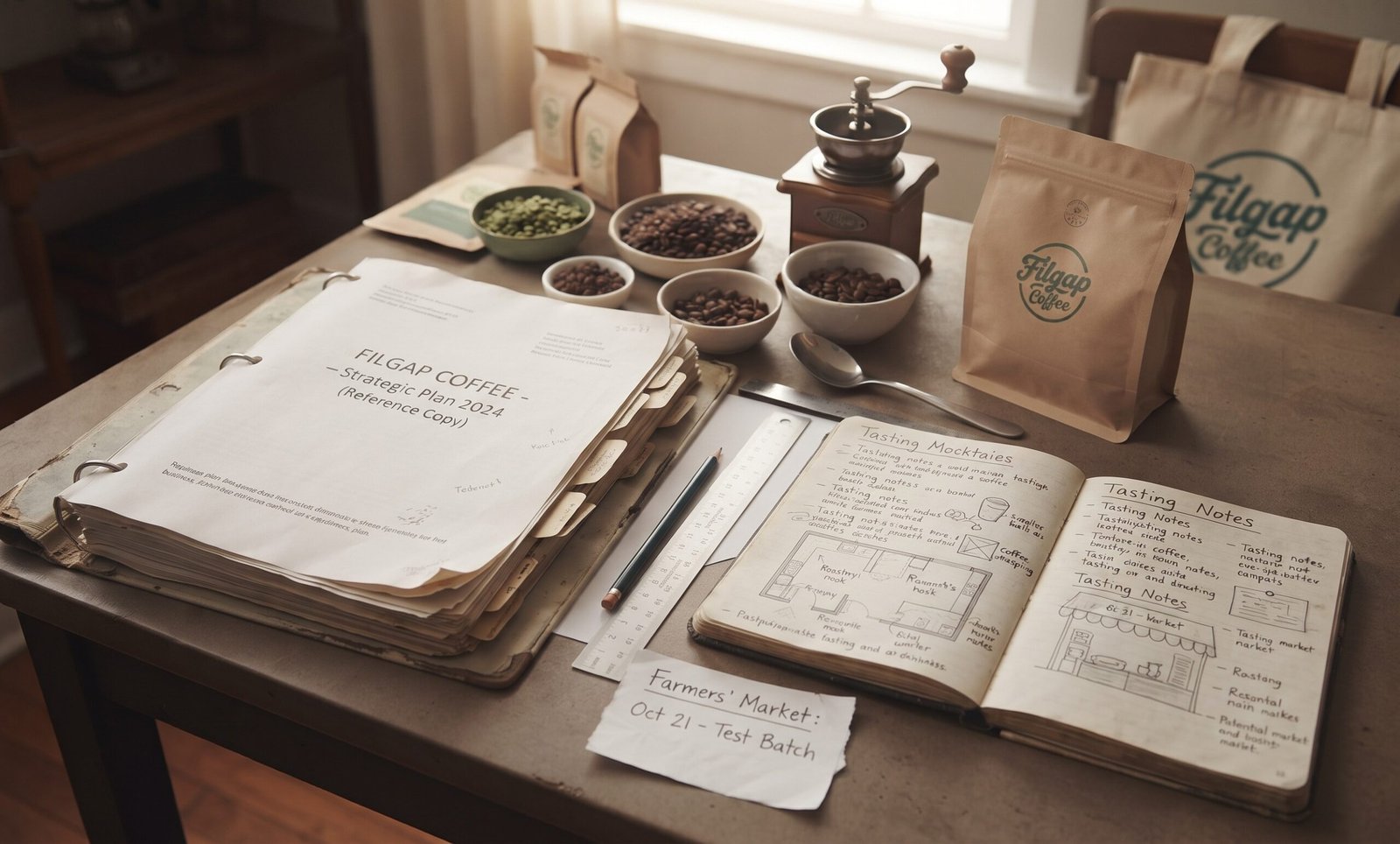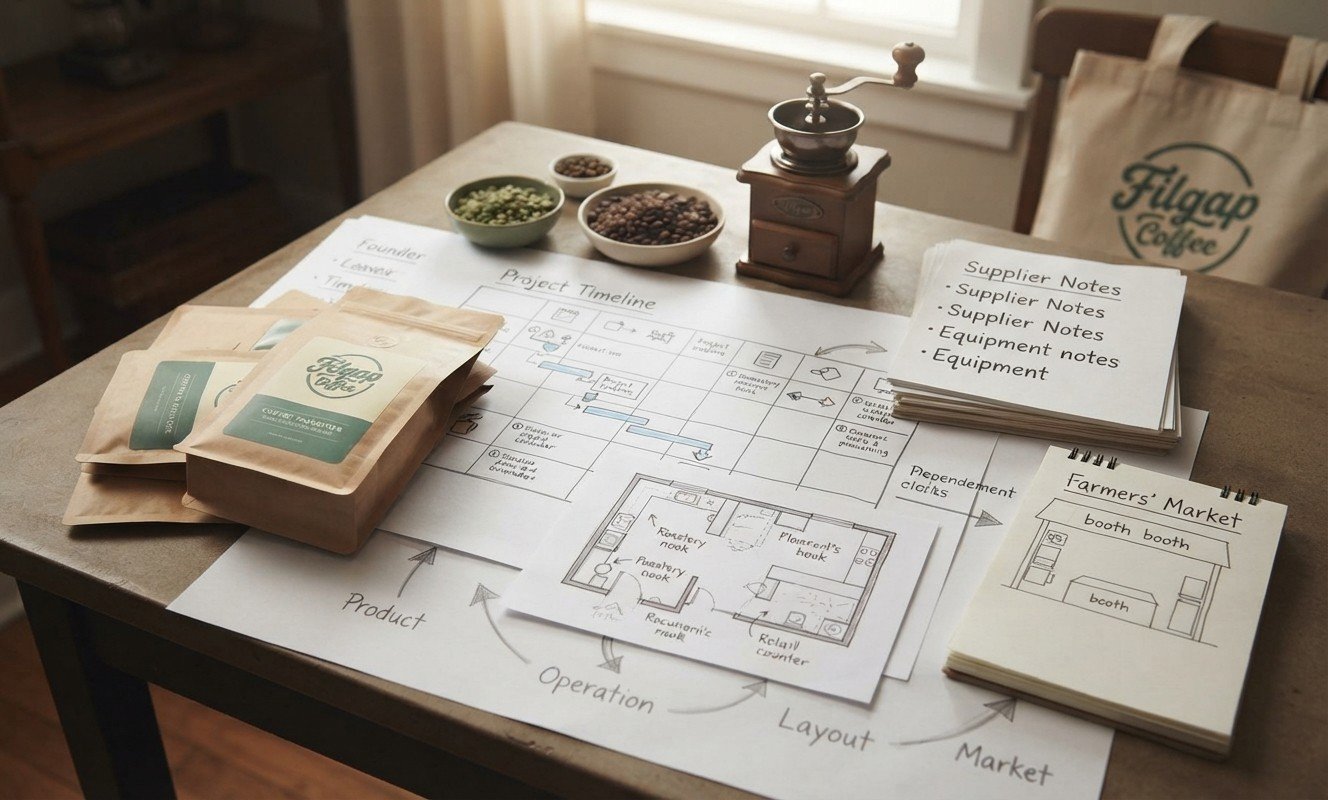
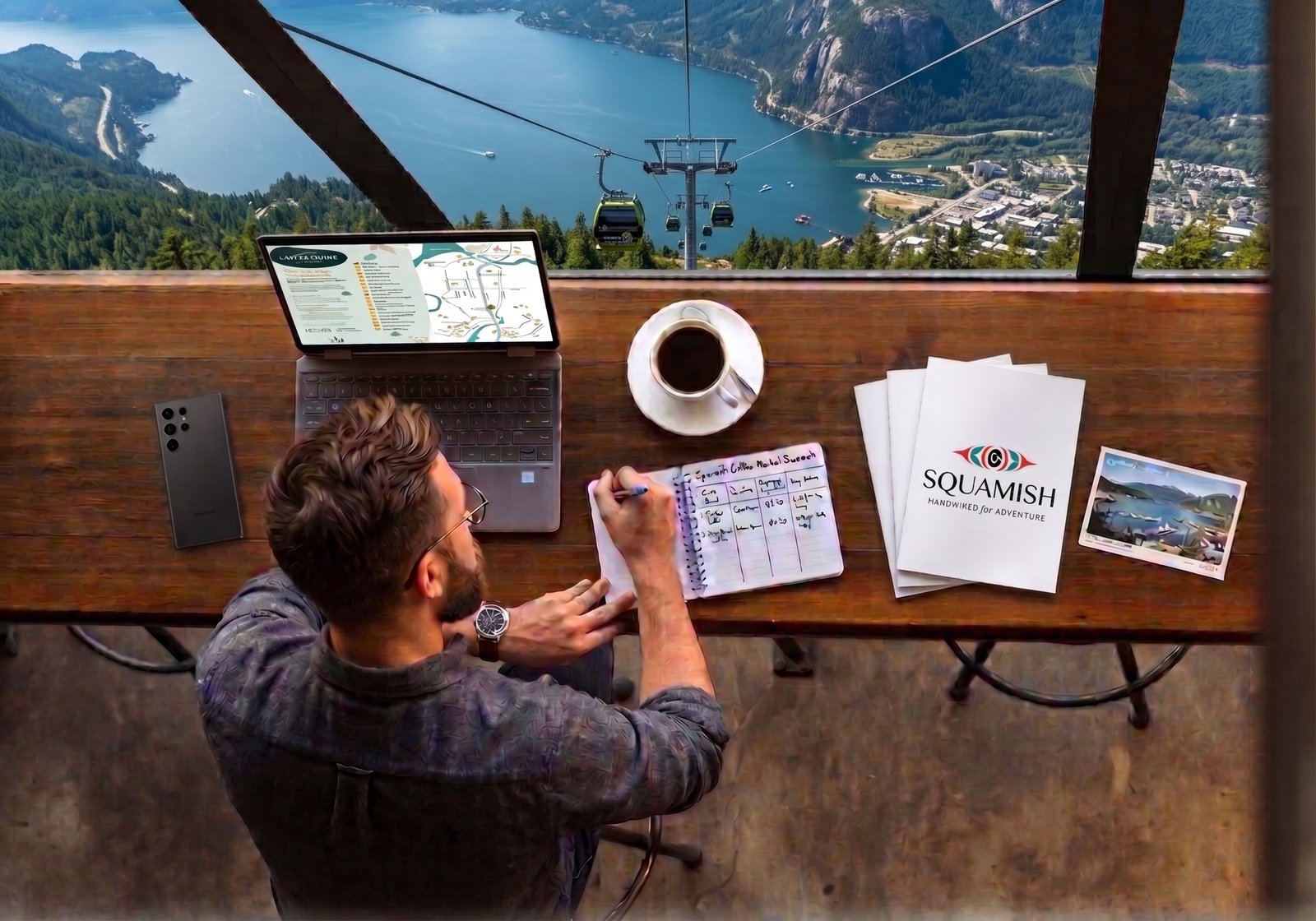
I have been visiting coffee shops in Squamish since I moved here in 2018.
At first, I was not doing it with a clipboard or a business plan.
I already had a long interest in coffee, so I wanted to try the cafés around town. I drank Americanos and lattes. I looked at menus. I noticed how the bar was set up and how the operation worked.
Later, when I started preparing a business plan for Filgap, I went back with different questions.
The coffee still mattered.
But now I was also looking at the room, the workflow, the location, the products on the shelves and the way people were using the place.
A spreadsheet can organize all of that.
It cannot replace being there.
I would start with a map
The first step is still online.
If I were researching Squamish again today, I would build as complete a list of coffee businesses as I reasonably could.
I would not rely on one source.
Tourism Squamish currently has 21 participating stops on its Coffee Crawl. The District of Squamish also requires businesses operating in town to hold a business licence and provides a business-licence lookup. Google Maps, business websites and social accounts add another layer.
Each source answers a slightly different question.
A tourism guide tells me what is being presented to visitors.
Google tells me what people are likely to find when they search.
A business website tells me how the company describes itself.
The District records tell me whether a business is actually operating under a local licence.
I would use those sources to decide where to look.
Then I would get out of the chair.
I still want to taste the coffee
This sounds obvious, but I would not research a coffee market without drinking the coffee.
When I visited cafés while preparing the earlier Filgap plan, I often tried an Americano or a latte. Those drinks gave me a practical way to experience the espresso, milk work and general consistency of the shop.
I looked at what was on the menu too.
Was coffee clearly the centre of the business?
Was food doing most of the work?
Were there whole beans for sale?
How were they displayed?
Could I find a roast date?
What kinds of coffee were customers being offered?
I am not trying to decide publicly which café is “better.”
That is not particularly useful.
What I want to understand is:
What is this business doing well for the people who choose it?
That question teaches me much more.
The last layer of the interior is the people
I pay a lot of attention to café interiors.
But there is something I think is easy to miss when people study coffee-shop design.
The final layer of the interior is the people using it.
A beautifully designed room can feel completely different depending on who actually comes through the door.
Are people meeting friends?
Are they sitting alone?
Are they opening laptops?
Are they eating a meal?
Are they picking up coffee and leaving immediately?
Do they seem comfortable?
How long does the room seem designed to let them stay?
I do not mean watching individual customers or recording anything personal about them. I am interested in how the space is being used as a whole.
That matters because a floor plan is only a hypothesis until people start moving through it.
The customers finish the room.
I watch the operation too
My eyes also tend to move behind the counter.
How many people are working?
How far does a barista have to move to make a drink?
Where does the queue form?
Does ordering interfere with pickup?
How quickly are drinks moving?
Where are beans, cups and milk stored?
How does the space look during a busy period rather than when it is empty?
And I notice cleaning.
That comes partly from my background. I spent years working around food manufacturing before returning seriously to coffee, so cleanliness and food-safety habits tend to catch my attention quickly.
A beautiful coffee bar that is difficult to keep clean is still a poorly solved workspace.
The same is true of an attractive layout that forces employees to make unnecessary movements hundreds of times a day.
Interior design and operations are not separate subjects.
Eventually, one has to work inside the other.
One visit gives an impression. Several visits show a pattern
I would be careful about drawing conclusions from one visit.
A café at 8 a.m. can be a different business from the same café at 2 p.m.
Tuesday is not Saturday.
Rain changes things in Squamish.
So does summer.
So does ski season.
If a location were important enough to influence a lease decision, I would want to see it repeatedly.
Morning.
Lunch.
Afternoon.
Weekday.
Weekend.
I would want to know when the customers appear and, just as importantly, when they do not.
That difference becomes important when estimating what a location can realistically sell.
Foot traffic is not all the same
When I used to assess locations in a larger coffee business, visibility was always important.
It still is.
A storefront should be easy to notice.
But the number of people passing in front of it does not tell me everything.
I tend to think about two different kinds of places.
There are places people flow through.
And there are places where people stay.
A busy transportation route can put a lot of people in front of a business without giving many of them a reason to stop.
A smaller commercial cluster may have fewer people passing through, but those people may already be there to shop, meet somebody, eat or spend time.
That can create a very different opportunity.
Coffee makes this particularly interesting.
A restaurant can be a strong destination. People decide in advance that they are going there for dinner.
Coffee can certainly become a destination too, but many coffee purchases happen because the café fits conveniently into something else a person was already doing.
That makes surrounding businesses important.
So does parking.
In Squamish, where many daily trips still involve a vehicle, convenient access can make a significant difference. Downtown provides short-term parking in its core business area specifically to encourage turnover for customers and clients, which is a useful reminder that access and intended length of stay are part of location economics.
The right question is not:
Is this a busy location?
It is:
Is it busy in a way that fits this business?
Expensive rent is not automatically bad rent
Rent deserves more nuance too.
Cheap rent is not automatically good.
Expensive rent is not automatically bad.
The useful relationship is between the rent and the sales the location can reasonably support.
A very expensive location that produces exceptional sales can work.
A cheap location where few customers come can be far more expensive in practice.
That is why I would estimate the sales potential first and then ask how much of those sales the business can reasonably afford to devote to occupancy.
The percentage will depend on the business model. I would not use one universal number.
What matters is whether the economics still leave enough room to operate the business properly.
That last part is important to me.
If rent is too heavy, pressure begins to spread through the rest of the business.
Maybe I add more menu items because I need higher sales.
Maybe I put in more seats than I wanted.
Maybe I start chasing transactions that have little to do with the original idea.
It becomes easier to compromise when the fixed costs are waiting every month.
A location should support the concept.
I do not want the concept spending every day trying to support an unsuitable location.
The building can be more expensive than the rent
This is one lesson I would be especially careful about in Squamish.
Some attractive commercial spaces are in older buildings.
The lease rate may look manageable.
Then the construction begins.
Drainage may need work.
Electrical capacity may not suit the equipment.
Walls may need to be opened.
Ventilation for roasting may need to be added.
Plumbing may need to move.
And older buildings can contain hazardous materials that completely change the renovation process.
In British Columbia, WorkSafeBC warns that asbestos was widely used in building materials until the early 1990s and may still be present in older buildings. Renovation work that could disturb it requires proper identification and, where asbestos is involved, qualified and licensed professionals.
Electrical capacity also deserves checking before assuming a site can support a particular operation. BC Hydro notes that connection costs and timelines depend on the load requirements and existing capacity of a selected site.
Those are not small details after the lease.
They can be part of deciding whether to sign it.
A space with affordable rent can become very expensive if it needs major work before the first coffee is sold.
A great old location can have another problem
Downtown Squamish is naturally interesting to me.
It has activity, visibility and the kind of commercial clustering that can help a coffee business.
It also creates some difficult questions.
Older buildings may need substantial investment.
And if I spend heavily improving a location, I need enough confidence that I can stay long enough to recover that investment.
The possibility of future redevelopment matters.
Newer commercial space can solve some building problems, but it often comes with higher rents, and landlords may naturally prefer tenants they see as financially predictable.
A new independent coffee company does not necessarily look like the safest tenant.
That is another reason I do not want the permanent space to be Filgap’s first proof of concept.
Reviews are useful when I stop treating them like a scoreboard
I read Google reviews.
Quite a lot, actually.
But I do not only look at the average rating.
I like separating the reviews by rating and asking why people gave the score they did.
Why did someone give five stars?
Why did another person give two?
Are several people praising the same thing?
Are several complaints describing the same problem?
That is more useful to me than saying one café has 4.7 stars and another has 4.5.
Reviews are not a representative survey of every customer.
They are still useful evidence of what was memorable enough for someone to write about.
I look for patterns.
- Service.
- Speed.
- Taste.
- Parking.
- Value.
- Food.
- Noise.
- Atmosphere.
Sometimes what customers repeatedly talk about is different from what the business itself seems to emphasize.
That difference can be worth understanding.
I would pay particular attention to what changed
If I repeated my Squamish research now, I would not simply visit all the same businesses and fill in the old table again.
I would pay special attention to newer businesses.
Then I would revisit established cafés and ask:
What changed?
Did the menu get smaller?
Did it get larger?
Did the seating change?
Did whole-bean retail become more prominent?
Did hours change?
Did the business add food?
Online ordering?
Different coffee?
And then I would try to understand why.
Not every change means the previous model failed.
Markets change.
Costs change.
Customers change.
Owners learn.
That is exactly why an old competitor analysis becomes less useful with time.
The business plan sits still.
The businesses inside the market do not.
I would research the neighbourhood, not just the café
The café itself is only part of the location.
I would walk the area.
What else is nearby?
What brings people there?
Where do they park?
Where do they walk from?
Is the street comfortable in winter?
Is the location visible from the route people actually use?
Is the commercial area established, or is it still developing?
Squamish has locations with very different characteristics.
Downtown has more established activity but can bring higher occupancy and renovation challenges.
The Business Park has continued to develop and interests me too, but I see it as a market that may need more time before some retail concepts reach their potential.
There is no single “best part of Squamish” for a coffee business.
There is only a location that fits a particular business model better or worse.
I would keep a research notebook
If I were helping someone research a small coffee market, I would suggest recording more than business names and menu prices.
For each visit, I would note:
- the day and time;
- what the surrounding area was doing;
- whether the café was quiet, moderate or busy;
- takeaway versus sit-down use;
- how the space seemed to be used;
- the coffee and food offer;
- retail whole-bean options;
- pricing;
- visible roast-date information;
- ordering and pickup flow;
- staff movement;
- parking and access;
- cleanliness and general upkeep;
- online ordering or delivery options;
- repeated themes in customer reviews;
- and, finally, what customer need the business appeared to serve particularly well.
I would also leave room for a question that cannot be reduced to a checkbox:
What did I learn here that changes the way I think about my own business?
That is probably the most valuable column.
Observation does not require intrusion
There is no need to interrogate staff or try to obtain private information.
I do not need to know another café’s sales, wages, margins or supplier contracts.
I can learn a great deal from what is already public and what any normal customer can see.
I can buy coffee.
I can look at the menu.
I can experience the service.
I can see the space.
I can read public reviews.
I can walk the neighbourhood.
The goal is not to reverse-engineer someone else’s business.
It is to understand the market I am considering joining.
I do not want a lease to be the experiment
Eventually, all of this research has to lead to a decision.
Suppose I found an excellent space tomorrow.
Good visibility.
Good parking.
A layout I like.
And expensive rent.
What would make me comfortable signing?
A nice floor plan would not be enough.
Neither would population growth.
I would want some evidence from Filgap itself.
That is where the Farmers’ Market becomes especially important.
If people have already tasted the coffee, bought it, returned for it and begun ordering ahead, I have much better information for estimating future sales.
If Filgap earns a strong local reputation for its coffee and operation, that may create other advantages too. The right property owner might see value in having a stable local brand in a building, which can sometimes create room for a more useful conversation about lease terms.
I cannot assume that will happen.
But it is a better negotiating position than arriving with nothing except a business plan.
This is why I keep coming back to the same order:
test first, learn second, commit later.
A lease is one of the most consequential decisions a small coffee business can make.
I do not want to use it to answer a question I could have answered while the cost of being wrong was still small.