I have used the word “gap” a lot while thinking about Filgap Coffee.
That probably comes with the name.
But there is a problem with looking for gaps when you already have a business idea you want to build.
You can start finding exactly what you hoped to find.
Years ago, when I wrote an earlier business plan for Filgap, I saw several things in Squamish that looked like opportunities.
I wanted a larger coffee house where people could meet naturally and spend time together. I thought there was room for a stronger coffee-focused business. I saw opportunities around food, freshness and community space.
Some of those ideas still make sense to me.
I am less certain now that all of them were proven market gaps.
There is a difference.
Something missing is not necessarily something people want
The community-space idea is a good example.
I still like it.
I would still love a place in Squamish where people can meet over coffee, talk, spend time together and feel comfortable being there.
The problem is not that I stopped believing in the idea.
The problem is the space required to deliver it.
A large room needs enough commercial square footage. In Squamish, that can mean substantial rent. A cheaper space may be less accessible. An older space may need expensive work before it can operate properly.
Eventually the question changes.
It is no longer:
Would it be nice to have this?
It becomes:
Would enough people value it enough to support what it costs to provide?
Those are very different questions.
A thing can be desirable and still not be a viable business opportunity.
That has made me more cautious about calling something a gap simply because I would like it to exist.
My own frustration is useful, but it is only the beginning
The freshness question feels different to me.
It began with something I repeatedly experienced myself.
I make coffee at home. I buy whole beans. I check roast dates. I have often wanted more control over when a coffee was roasted and when I begin drinking it.
That is real.
But it proves only one thing:
I care about it.
It does not prove that Squamish needs a business built around it.
Many people already buy coffee successfully in ways that work perfectly well for them.
Walk into a supermarket and look at the amount of packaged coffee on the shelves.
Someone is buying it.
Probably a lot of people.
They may enjoy the coffee. They may value the price. They may like being able to put it in the cart with everything else they are buying.
They may simply not care about roast date as much as I do.
And even someone who agrees that fresher coffee sounds better may not care enough to change where they shop.
That distinction matters.
Good ideas often ask customers to change behaviour
I learned something about this in an earlier coffee business.
Whole-bean coffee can sound very attractive.
Fresh coffee. Better aroma. Grind it just before brewing.
But then the customer has to do something.
They need beans.
They need a grinder.
They need to grind the coffee.
They need a brewing method.
They need a little time.
For somebody who already enjoys that process, none of this feels difficult.
For someone who does not already behave that way, it can be a surprisingly large change.
I learned that changing customer behaviour takes longer than I sometimes expected.
That lesson matters to Filgap.
It may be much easier, at least initially, to offer something better to people who already buy whole beans than to convince someone who has never ground coffee at home to completely change their morning routine.
The first customer may already be doing most of the work.
I just need to give them a reason to change where they buy the beans.
Convenience may reveal a different gap
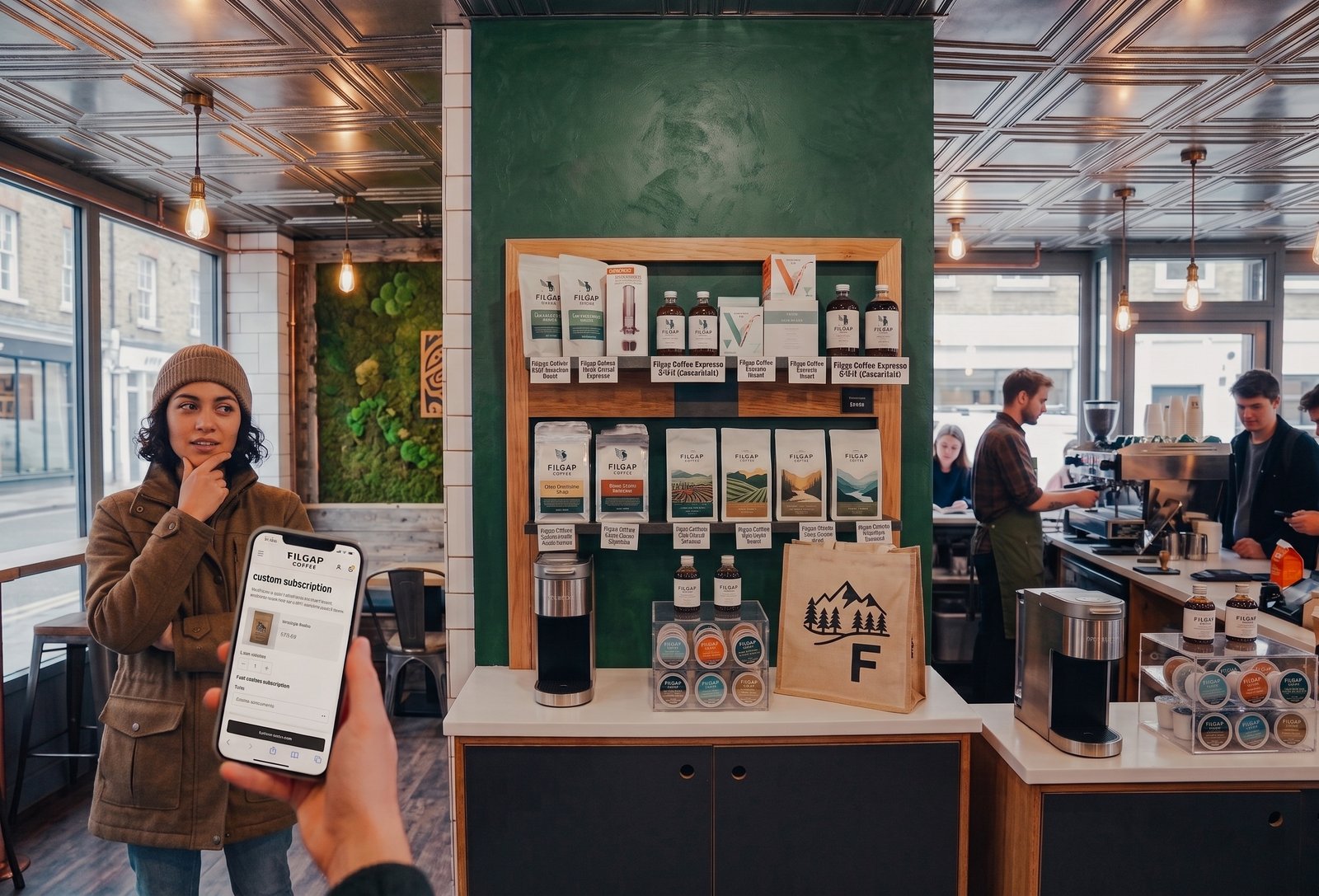
This is one reason I keep thinking about capsules.
Nespresso and Keurig did not become large businesses because people suddenly stopped liking good coffee.
They solved another problem.
Convenience.
Press a button.
Coffee appears.
That value is difficult to ignore.
I do not think the interesting question for Filgap is whether convenience is good or bad.
It is whether some of the convenience people already value can be combined with a different approach to coffee.
Could a locally roasted capsule be produced in smaller quantities and managed differently from a product designed for a long conventional retail chain?
Could someone have a whole-bean coffee on mornings when the process is enjoyable and a capsule on the morning when there are only two minutes?
I do not know yet how strong that opportunity is.
But it interests me because it starts with behaviour that already exists.
The customer does not need to learn an entirely new morning routine.
The product has to give them a reason to choose a different version of it.
Espresso concentrate is a different kind of test
Concentrate is more uncertain.
I like the idea.
Squamish is an outdoor town. People camp, hike, ride, ski and drive to places where making coffee normally is not always convenient.
A concentrated coffee that can be mixed quickly with hot or cold water could make sense.
It could also work on a busy morning at home.
But this is where I have to separate my enthusiasm from the maturity of the market.
Whole beans are familiar.
Capsules are familiar.
Coffee concentrate is still a less familiar format for many customers.
That means weak early sales would not necessarily prove the idea is bad.
Maybe the product needs improvement.
Maybe people need to understand how to use it.
Maybe the occasion is wrong.
Maybe the packaging is wrong.
Or maybe, after enough testing, the answer really is that people do not want it enough.
An early-stage product sometimes needs patience.
It still needs evidence eventually.
I would rather watch what people do than ask what sounds good
Suppose I ask someone:
Would you like fresher locally roasted coffee?
It is an easy question to answer yes to.
Fresh sounds good.
Local sounds good.
Specialty sounds good.
The answer tells me something.
It does not tell me what the person will actually buy next Tuesday.
I would rather know:
Where did you buy your last bag?
How much did you pay?
How often do you buy coffee?
Do you order it online?
Do you normally buy whatever is convenient at the grocery store?
Do you already own a grinder?
When you are late in the morning, what coffee do you actually drink?
Past behaviour is often less flattering to a business idea than future intention.
That makes it more useful.
Free enthusiasm is not the same as demand
This will matter when Filgap begins sampling.
Imagine I give coffee to one hundred people.
All one hundred say:
This is good.
That would make me happy.
Now imagine none of them later buys it.
I would have a problem to investigate.
Maybe the coffee is simply too expensive.
Maybe getting it is inconvenient.
Maybe people like it but do not see enough difference to change what they already buy.
Maybe I am solving something they do not consider a real problem.
I should not respond by saying:
But everyone loved the sample.
The market has already given me another piece of information.
The opposite situation might be even more interesting.
Perhaps the sampling response is not dramatic.
Nobody tells me it changed their life.
But several people ask:
Where can I buy this?
Then they buy it.
Later they buy it again.
I would pay far more attention to that.
Compliments are useful.
Behaviour is stronger.
The evidence becomes stronger as the customer gives something up
I think about market validation almost like a ladder.
At the bottom is my own experience.
I have the problem.
That is enough to start asking questions.
Then I notice other people doing something similar.
Other people may have it too.
Then they tell me they are interested.
Useful.
Then they try the product.
More useful.
Then they spend their own money.
Now the evidence is much stronger.
Then they come back and spend it again.
That is different.
At each step the customer gives something more:
attention,
time,
money,
and eventually a place in their routine.
That is why repeat purchase keeps appearing in these articles.
It is difficult evidence to fake.
I also need to look for reasons the gap may not exist
This may be the harder part.
If I believe freshness matters, it is easy to collect evidence supporting freshness.
I also need to notice the evidence against me.
Maybe customers are completely satisfied with supermarket coffee.
Maybe they value price much more than roast date.
Maybe online ordering already solves the access problem.
Maybe they like a fresher coffee but not enough to make another stop.
Maybe the flavour difference I care about is much smaller to them than it is to me.
Those answers do not become less true because they are inconvenient for Filgap.
A market gap becomes more believable to me when the idea survives some of the reasons it might not exist.
What if customers do not care about freshness as much as I do?
This is one question I have thought about.
My answer is not that I would simply abandon freshness.
I think it is a good way to handle coffee.
It is part of the standard I want for Filgap.
So even if customers eventually tell me that freshness is not the first thing they think about, I may continue to manage the coffee that way.
What might change is how I understand the customer’s reason for choosing it.
Perhaps they come primarily for taste.
Perhaps convenience matters more.
Perhaps they like the local relationship.
Freshness may remain part of how Filgap works without always being the first word a customer uses to describe why they buy it.
And if the market teaches me that another meaningful gap exists beside it, I want to be able to see that too.
The purpose behind Filgap is broader than proving one hypothesis correct.
It is to notice meaningful gaps and work on the ones I can genuinely fill.
Not every gap belongs to me
This is another filter I need.
A genuine opportunity can exist and still be the wrong business for me.
Maybe it requires an investment I am no longer willing to make.
Maybe the operation becomes so complicated that I would not enjoy running it.
Maybe it would demand a scale that conflicts with the life I want.
Maybe somebody else is simply much better equipped to solve it.
That does not make the need less real.
It only means:
Not this one. Not for me.
I think this matters because entrepreneurs can become attached not only to their ideas but to the idea that they personally need to solve every problem they discover.
I do not.
The gap and the founder have to fit each other too.
A small gap can still be enough
I do not need to prove that everyone in Squamish wants Filgap.
That would be an impossible standard anyway.
There are already many ways to buy coffee here.
What interests me is whether, among all those existing choices, a meaningful group of people responds differently when Filgap enters the picture.
They read what I have been building.
They understand what I care about.
They taste the coffee.
They buy it.
Then some of them buy it again.
If that behaviour becomes visible despite all the other coffee options already available, that would tell me something.
There may be room for this particular version of coffee after all.
Not because nothing else exists.
Because enough people still chose it.
The gap test I would use now
If I were starting another business idea, I would be slower to write the word “opportunity” in the business plan.
Before calling something a market gap, I would ask:
- Can I describe the problem without mentioning the product I want to sell?
- Who experiences it often enough for it to matter?
- What are they doing to solve it now?
- What do those existing solutions already do well?
- Am I relying on what people say they would do, or what they actually do?
- Why might nobody have solved this in the way I imagine?
- Is the problem large enough to justify what the solution costs?
- Can I test a smaller version before building the full solution?
- Will people eventually pay for it?
- After buying it once, will any of them come back?
- And if the gap is real, am I genuinely capable of filling it well?
I would also add one uncomfortable question at the end:
What evidence would make me admit that I was wrong?
If I cannot answer that, I am probably not testing the idea.
I am defending it.
I have a hypothesis. The market gets the final vote.
I still believe there is a freshness opportunity in Squamish.
I think there may also be an interesting space between coffee quality and convenience.
Whole beans come first.
Capsules interest me.
Concentrate is earlier and will require more learning.
The future coffee space is still part of the dream, although I now imagine it smaller and more efficient than I once did.
Those are my current beliefs.
They are not market facts yet.
That distinction makes me more comfortable, not less.
It means I do not have to pretend that the business plan already knows the answer.
Filgap can communicate what it cares about.
I can roast.
I can sample.
People can respond.
Eventually they can choose whether to spend their money.
And later, whether to choose Filgap again.
That is when I will feel more comfortable using the word gap.
Not when I notice something missing.
When enough people show me that its absence mattered.