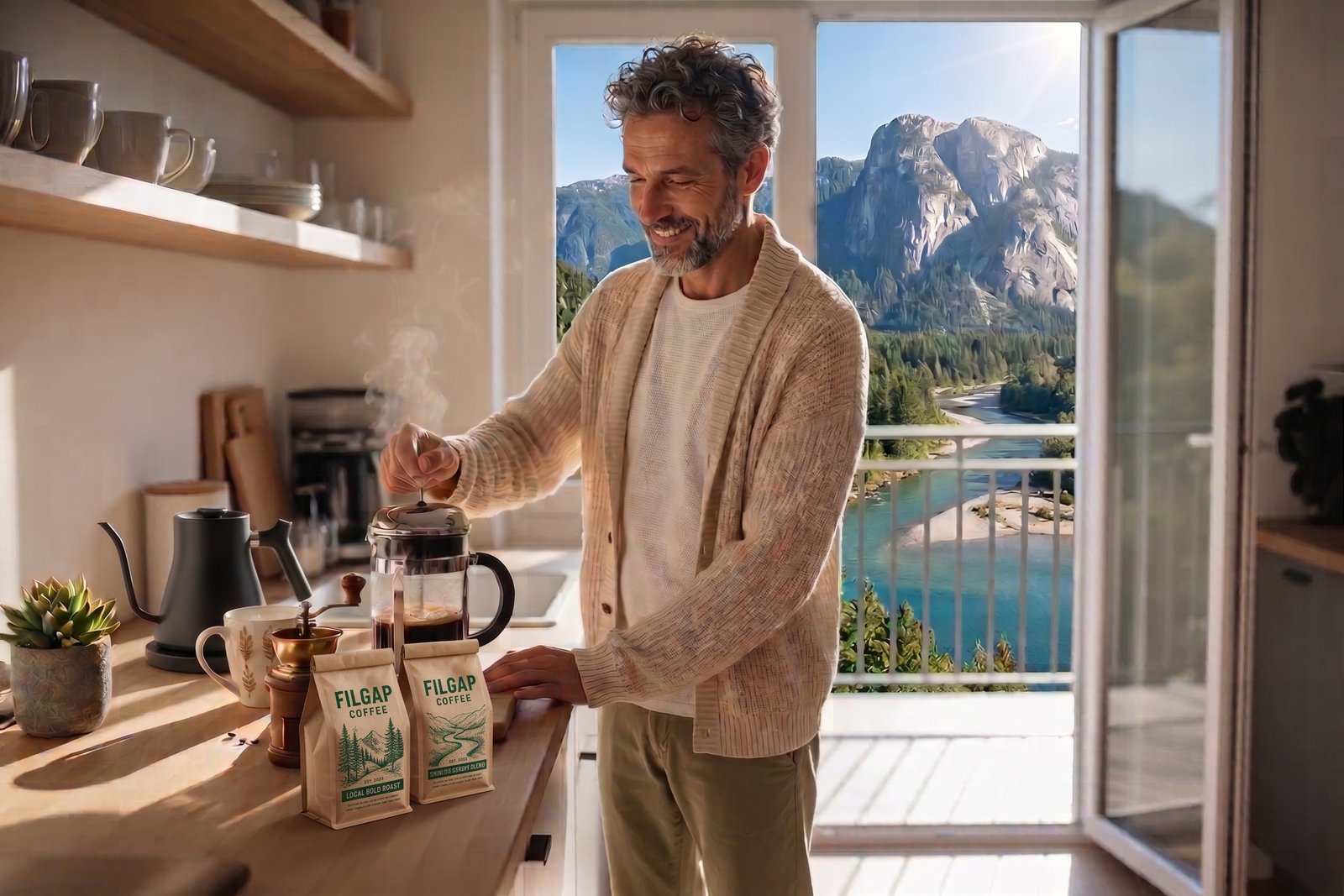
I have another coffee habit besides checking roast dates.
I ask people how they make coffee at home.
It comes up fairly naturally. If someone tells me they make coffee themselves, I want to know how. A regular coffee maker? French press? Pour-over? Chemex? Espresso machine?
Then I usually ask the next question.
Where do you buy your coffee?
The answers vary.
Among people I have talked with around Squamish, quite a few make coffee at home, although they do it in very different ways. Some buy beans at Costco. Some order online. Some care more about the brewing process than others.
These are casual conversations, not market research with a statistically representative sample.
But they have made me think differently about one of the most basic questions in building Filgap:
Who am I actually building this for?
A customer profile needs more than age and income
It is easy to describe a customer on paper.
Age.
Income.
Education.
Occupation.
Where they live.
Those things can be useful. They help estimate how large a market might be, what people may be able to spend, and where a business should operate.
But they do not necessarily tell me what coffee to roast tomorrow.
Two people can be the same age, live in the same neighbourhood and earn similar incomes while having completely different coffee routines.
One buys a large bag because price and convenience matter most.
Another buys smaller bags from different roasters because trying new coffees is part of the fun.
One presses a button on a machine before leaving for work.
Another weighs beans, grinds them and spends a few minutes making a pour-over.
Both are coffee drinkers.
They are not necessarily looking for the same thing.
The more useful question for me has become:
What does this person actually do?
The routine tells me more
The customer I understand most easily is someone who makes coffee at home regularly.
They buy whole beans.
They grind them themselves.
They have a way of brewing coffee that works for them. It does not have to be elaborate. A basic coffee maker is just as real a routine as a Chemex or an espresso machine.
Eventually, the bag gets empty.
Then they need to decide what to buy next.
That cycle matters to me much more than whether the person fits a neat demographic profile.
It tells me there is a recurring need.
It also raises practical questions.
- Do they want the same coffee again?
- Do they feel like trying something different?
- Do they buy based on price?
- How far are they willing to travel?
- Would local pickup make things easier?
- Would they rather have it delivered?
- How much does freshness matter compared with convenience?
Those questions start shaping the business.
A fictional customer profile cannot answer them very well.
Real behaviour can.
What matters to me may not matter most to them
This is one place where I have to be careful.
Freshness matters a lot to me.
I check roast dates. I think about how long a bag will take us to finish. I like having some control over when I start drinking a coffee.
It would be very easy for me to assume that everyone buying Filgap Coffee will care about exactly the same things.
I do not think that is realistic.
From the conversations I have had and the behaviour I see around town, I suspect convenience and price may be more important to many people than a coffee person sometimes wants to admit.
Every morning, there can be long lines of cars at familiar drive-through coffee shops.
I cannot look at those lines and know exactly why each person is there. Some may be buying breakfast. Some may simply love that particular coffee.
But one thing is difficult to ignore.
Getting something quickly has value.
Price has value too.
Taste obviously matters, but familiar taste can matter just as much as novelty or complexity.
That creates a useful challenge for Filgap.
I do not just need to ask:
How can I make coffee I think is good?
I also have to ask:
Can I make good, fresh coffee fit naturally enough into someone’s life that buying it again does not feel difficult?
Those are different questions.
I need both.
Coffee should be good enough to become ordinary
I would like Filgap to make very good coffee.
I am less interested in making it expensive simply because it is specialty coffee.
Coffee is something people may drink every day.
If someone buys a bag this week and needs another one soon, price becomes part of the experience whether a coffee company likes it or not.
The ideal, of course, is easy to say:
Make a genuinely good product and sell it at a reasonable price.
The difficult part is making the numbers work.
Green coffee costs money. Packaging costs money. Roasting has losses. Equipment, labour, rent, payment fees and distribution all eventually have to be paid for.
I have not finished those calculations, so I do not want to promise a price before I know what the business can actually sustain.
But I know the direction I prefer.
I want Filgap coffee to be something a person can consider part of normal life, not something that only makes sense as an occasional luxury.
The same customer can have different mornings
There is another problem with putting people into neat customer categories.
The same person does not necessarily make coffee the same way every day.
I know I would not.
On a morning when there is time, grinding whole beans can be part of enjoying the coffee itself.
Boil the water.
Grind the beans.
Make the coffee.
Wait a few minutes.
The process is part of the experience.
Then there are mornings when none of that sounds practical.
You are late.
Someone needs to leave.
There is somewhere to be.
Pressing a button starts to make a lot of sense.
And in Squamish, there is another kind of coffee moment: leaving home.
Camping. Hiking. Driving somewhere. Spending the day outdoors.
That has made me question whether Filgap should think about its first customers by product category.
Perhaps a whole-bean customer, a capsule customer and a coffee-concentrate customer are not necessarily three different people.
They might be the same person on three different mornings.
That changes how I think about the product line.
Whole beans could serve the moment when making coffee is part of the pleasure.
A capsule could serve the morning when convenience wins.
I am also interested in testing an espresso-style coffee concentrate that could be mixed with hot or cold water when making coffee normally is impractical.
These products are still ideas that need testing. I do not yet know what the final capsule format should be, how concentrate will perform over time, or what either product would cost to make properly.
But the customer logic interests me.
Instead of asking three different groups of people to adopt three unrelated products, perhaps Filgap can help the same person keep drinking coffee they enjoy as their circumstances change.
Same person. Different mornings.
That is a more realistic picture of a customer to me.
Repeat does not have to mean exclusive
There is another assumption I do not want to make.
A good customer does not have to drink Filgap Coffee every day for the rest of their life.
Coffee is food.
Someone can love steak and still want pulled pork next week.
Coffee can work the same way.
A customer might finish a Filgap bag and decide to try something from another roaster. A month later, they might come back and try a different Filgap coffee.
I would still consider that meaningful.
Subscription would be great for people who want it.
Buying another bag immediately would be a strong signal.
Coming back to the Farmers’ Market a few weeks later would be a signal too.
There is no single rule yet.
What matters more to me is that the first purchase was good enough for Filgap to remain one of the choices the next time coffee is needed.
I do not need to stop someone from enjoying other coffee.
I need to give them a reason to come back.
Locals first
Travellers will always be part of Squamish.
Someone driving the Sea-to-Sky Highway may eventually stop at a Filgap tasting room, enjoy the coffee and take a bag home.
I would be happy if that happens.
But that is not the customer I want to understand first.
The first mission is closer to home.
I want to understand people in Squamish who make coffee as part of their regular lives.
A visitor telling me the coffee was good would be encouraging.
A local customer finishing a bag and coming back for another one tells me something different.
It suggests that the coffee has found a place in a routine.
For an early Filgap, that matters more.
A customer profile I can actually use
If I were defining a customer for a small coffee business now, I would still look at demographics.
I just would not start there.
I would start with behaviour.
- What does this person already buy?
- How do they make coffee now?
- How often do they need more?
- Where do they currently buy it?
- What matters most when they choose: price, taste, freshness, convenience, or something else?
- What changes when they are in a hurry?
- What changes when they have time?
- What makes them curious enough to try something new?
- And after trying it once, what would make them come back?
I would also ask a question I did not think enough about before:
Could several of my products be solving different moments for the same person?
That may be more useful than creating another detailed imaginary persona.
When the bag is empty
I still have a lot to learn about Filgap’s customer.
Talking with people around me is useful, but it is not enough to tell me how the wider Squamish market will behave.
That is why sampling matters.
The Farmers’ Market will matter.
Actual purchases will matter.
And what happens after the first purchase may matter most.
The customer I am building for does not need to be a coffee expert.
They do not need a certain job title or income on a profile sheet.
They may use a French press one morning and a coffee maker the next. They may enjoy grinding whole beans on Sunday and want something much faster on Monday.
What connects those moments is simpler.
Coffee is part of their life.
And when the bag is empty, sooner or later they need to decide what comes next.
I want Filgap to be one of the choices they are happy to make again.