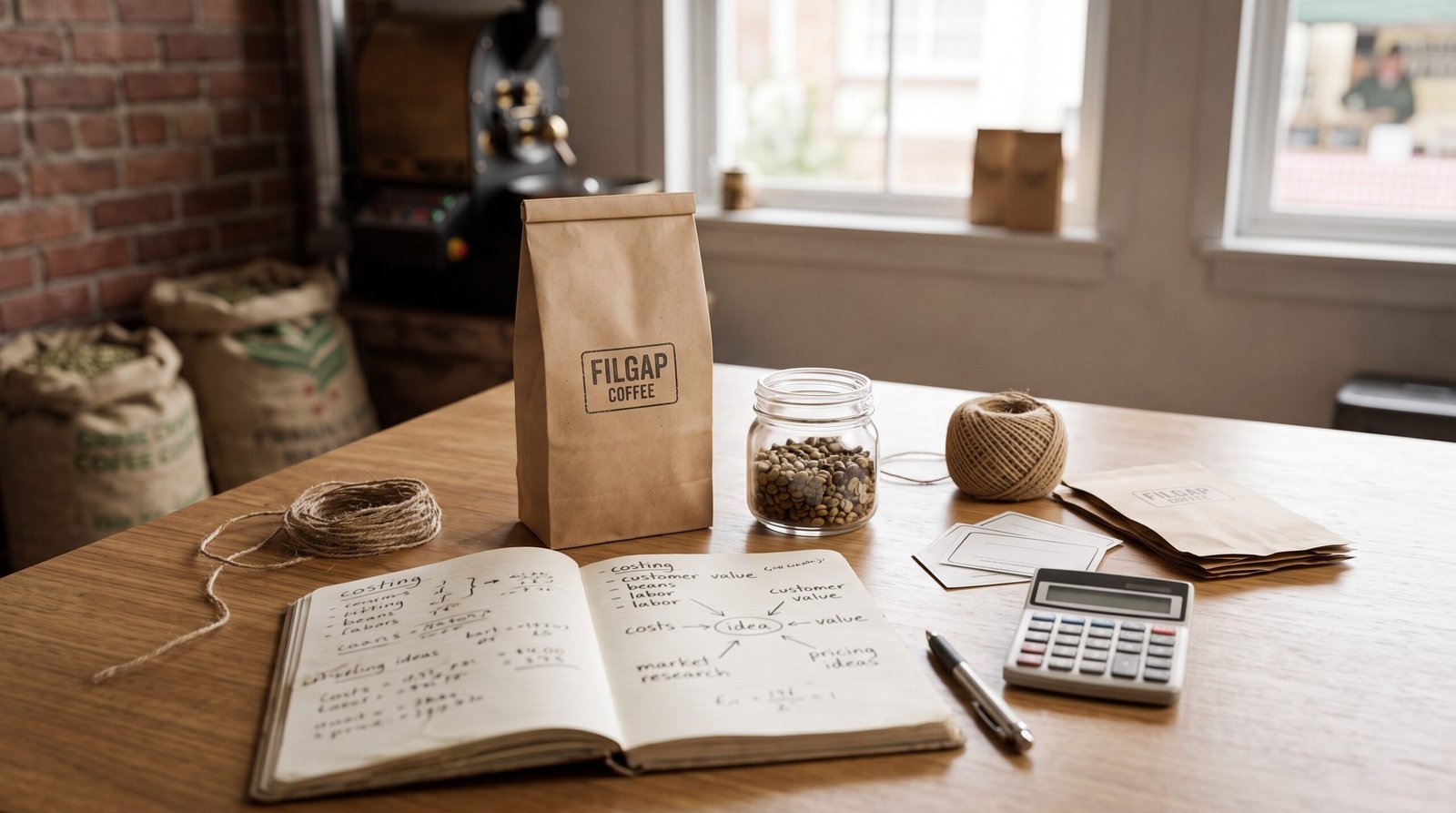
I have not decided what a bag of Filgap coffee will cost.
I could probably make a spreadsheet today and produce a number. Green coffee cost, packaging, roasting loss, labour, a margin, and there it is.
But I do not think that would be enough.
Before setting the price, I need to understand what it really costs to make the coffee, what people around Squamish are already paying, and whether the price still leaves enough room for the business to operate properly as it grows.
Most of all, I want the price to make sense more than once.
If somebody buys one bag because they are curious, that is useful. The business I am imagining depends much more on whether they are comfortable buying the next bag.
I would start by looking around Squamish
Price does not exist by itself.
Someone buying whole beans in Squamish can compare a Filgap bag with coffee from the supermarket, a local café or roaster, Costco, or a specialty roaster online. Those are very different products in some ways, but they still become reference points in the customer’s mind.
I cannot ignore that.
At the same time, I do not think the answer is to collect every local price, calculate the average and put Filgap somewhere in the middle.
I thought about this on a road trip through British Columbia. We stopped in a number of smaller towns, and I noticed that prepared coffee was often cheaper than what I was used to around Squamish.
I did not do a formal price survey, so I would not make a broad claim from that. It just made me think.
Why is the same cup of coffee priced differently from one town to another?
Rent may be lower. Labour may be different. The local market may simply be used to another price. There are probably several reasons at once.
It reminded me that a price that looks normal to me in Squamish might feel quite different somewhere else.
So competitor pricing matters to me mainly as context.
I need to know where Filgap is entering the market before I decide whether a price is reasonable.
“Fair” is probably the word I keep coming back to
I want to make good coffee and sell it at a fair price.
The word fair is difficult because everybody can mean something different by it.
For me, it does not mean cheap.
Good green coffee costs money. Small-batch roasting has costs. Packaging has a cost. If I want to manage freshness carefully rather than keeping old inventory around until it eventually sells, that affects the business too.
I do not want to solve the pricing problem by buying poorer coffee or making the product worse.
But I also do not want to say, “This is specialty coffee,” and assume that any premium is justified.
I have worked in a premium coffee business before. We deliberately positioned that brand above many of the competitors around us. The stores, the product and the overall experience were designed to support it.
For a while that worked very well.
As the business expanded into more regions, though, I learned that the same pricing gap was not equally comfortable everywhere.
The brand was still premium. We did not suddenly become a different business.
But the market around each store mattered more than I had appreciated when the footprint was smaller and concentrated in major cities.
That experience makes me cautious about pricing Filgap from the inside out.
I may know why I think the coffee is worth something. The customer still has to agree.
Starting small creates an odd pricing problem
Filgap’s first commercial stage is planned around the Farmers’ Market.
That means the cost structure will be unusual.
I will not yet have the rent of the future commercial roastery and tasting room I hope to build. I will not have the same staffing or operating costs either.
On paper, that gives me room to charge less.
I am not sure I should use all of that room.
Suppose I introduce the coffee at a price that works very well because I am roasting small and there is no commercial rent. People get used to that price. Later the business moves into a permanent space, and suddenly rent, utilities and more labour have to be supported.
Then I have created a problem for myself.
The coffee did not suddenly become better because the business signed a lease. From the customer’s side, they may simply see a large price increase.
I do not want to overprice the coffee today based on costs that do not yet exist. That would make no sense either.
What I am trying to avoid is using a temporary low-cost stage to create a price that has no chance of surviving the next stage of the business.
I will need real numbers before I know where that balance is.
I still need to know exactly where the money goes
When I worked in a larger coffee business, we paid very close attention to product economics.
At the product level, we looked at things like incoming quantity, inventory, sales, food cost or beverage cost, and margin. Then there were operating costs and overhead beyond that.
A small Filgap operation will obviously not need the same system at the beginning.
But I still want to know the numbers as accurately as is reasonable.
- For a bag of coffee, green coffee is the first obvious cost.
- Then roasting changes the weight. There is energy. Packaging and labels. The work involved in roasting, checking and preparing the coffee.
- After that come costs that are not really part of the beans themselves but still have to be paid somewhere: market fees, payment processing, equipment maintenance, labour, and eventually the overhead of a permanent operation.
I find it useful to keep those layers separate.
Otherwise it becomes too easy to say, “The coffee costs this much, so this margin looks excellent,” without noticing what the rest of the business is doing.
I have seen products that looked fine at the product-margin level and were much less attractive once the actual work around them was considered.
Soup is one example I remember.
It made sense on a winter menu. It gave customers another choice and paired naturally with other food. But if the volume was low, the work and operating burden made the economics less interesting than the selling price suggested.
Other products worked better partly because ingredients or preparation were already being used elsewhere in the operation.
That is why I do not have much confidence in one universal margin percentage for every coffee business.
A percentage is useful.
It just does not finish the analysis.
Whole bean will probably not have one price
I expect the signature blend and single origins to behave differently.
The signature blend is the coffee I would like people to buy regularly. Ideally, I would keep both the coffee and the price fairly stable.
That does not mean the components can never change. Coffee is agricultural, and availability changes.
But I would like the customer’s experience of that core product to be predictable.
Single origins are different.
The cost of green coffee can vary a lot depending on what I buy. If I find a coffee that I think is genuinely special and the green cost is much higher, I do not want to force it into the same retail price by lowering the quality somewhere else.
It may simply need to cost more.
At the same time, I do not want a shelf where every coffee is expensive.
That would make it difficult for the kind of regular whole-bean business I am hoping to build.
I would rather have a core range that feels approachable, and then sometimes have coffees that cost more because the coffee itself really costs more or offers something different.
Explaining that will be part of the work.
People who work in coffee may understand immediately why two green coffees have very different prices.
Most customers have no reason to know that.
They may just see two bags and wonder why one costs more.
If I cannot explain the difference in a way that makes sense to a normal customer, then simply putting a higher number on the bag is not much of an explanation.
I do want to give regular customers a reason to keep buying
I think a lot about repeat purchasing because whole bean is at the centre of the business I am planning.
Someone who buys coffee every week or every two weeks is much more important to the long-term business than somebody who makes one interesting purchase and disappears.
That probably means there should eventually be some benefit for regular customers.
It could be a subscription.
It could be a loyalty system.
It could be connected to quantity.
There may be a future benefit involving the tasting room, a brewing session, or something else that makes sense around coffee.
I have not decided.
In my previous work, I came to think of customer attraction almost like putting out different nets. Different people respond to different things.
One person notices the package.
Another person is interested in the price.
Someone cares almost entirely about taste.
Another person values service, convenience or being recognized when they come back.
You do not catch everybody with the same net.
I still think there is something useful in that idea.
Filgap cannot depend on one reason for people to return.
Price is one of the reasons, but it should not be the only one.
This is also why I am careful about discounts.
Discounts work. I am not against them in principle.
What worries me is teaching people that the regular price is something they should avoid.
Once a customer starts waiting for the next promotion, it can be difficult to make the normal price feel normal again.
I would rather give regular customers a useful reason to stay connected than keep cutting the price.
Exactly what that looks like is something I expect to test rather than decide now.
Coffee costs will move whether I like it or not
Green coffee prices change.
So do packaging, transportation and other operating costs.
If I calculate the retail price so tightly that a small change in one input immediately creates a problem, then the original price was probably too fragile.
I would like some room to absorb ordinary movement without changing the customer’s price every time something moves.
That might mean taking a little less margin for a while.
It might mean buying or operating more efficiently.
At some point, a retail price may still need to change.
I have no principle that says Filgap prices should never go up.
What I do not want is to react to every cost increase by quietly making the product worse.
If green coffee gets expensive, there are several things I could look at. Maybe the price changes. Maybe I accept a lower margin for a period. Maybe I choose a different coffee later. Maybe there is an operating cost I can improve.
I cannot know the right answer until I am actually in that situation.
Quality and freshness, though, are not where I want to begin cutting.
If a customer was buying the coffee because it tasted good and because it was fresh, maintaining the old sticker price by weakening those things would be a strange kind of success.
I will probably learn the real price only after selling
This is the part no spreadsheet can answer in advance.
I can calculate the cost.
I can look at local competitors.
I can build a sensible margin.
I can think about future overhead.
But eventually somebody has to stand in front of the coffee and decide whether to buy it.
Then, more importantly, they have to decide whether to buy it again.
I may discover that a price I thought was completely reasonable feels expensive to customers.
Or I may discover that people care enough about freshness and the coffee itself that price is less of a barrier than I expected.
Maybe the signature blend behaves differently from the single origins.
Maybe a subscription changes buying habits.
Maybe none of my assumptions about that are quite right.
I do not know yet.
The first price will be a decision, but it will also be a test.
What I hope is that I can find a level where I do not have to apologize for the quality, the customer does not feel taken advantage of, and the business still has enough room to keep doing the work properly.
That is probably as close as I can get to defining a fair price before Filgap has real sales data.