Freshness is one of the main reasons I am building Filgap Coffee.
That sounds simple when it is written on a website.
Freshly roasted coffee.
But somebody still has to make it fresh.
Roasting is the part where I actually make the product. Green coffee comes in, it is roasted, rested, checked, packed and eventually taken home by somebody.
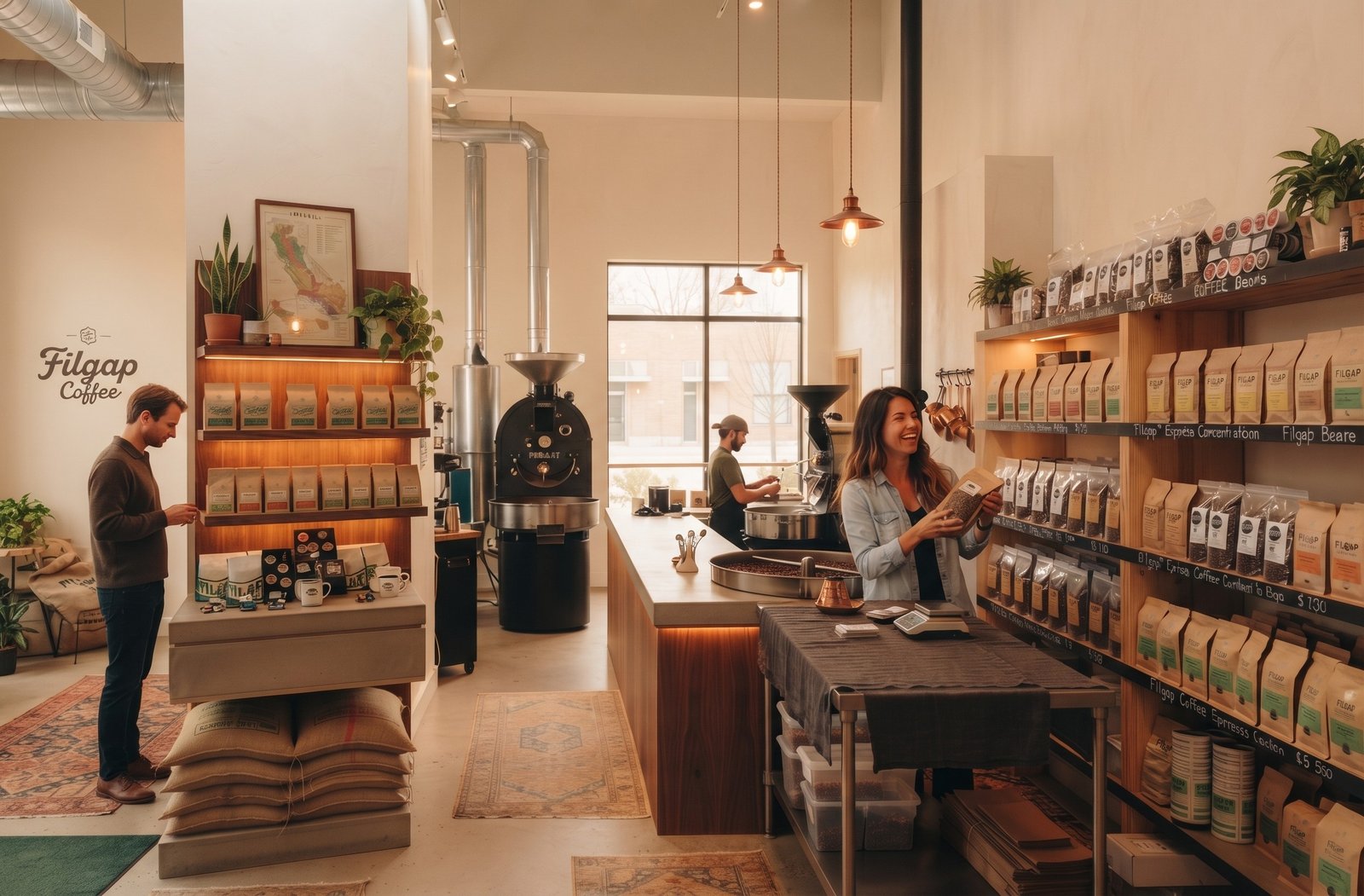
When I think about a future Filgap space, I do not really want that part of the business hidden somewhere completely separate from the customer.
If I am going to say that freshly roasted coffee matters, I think it makes sense for people to be able to see some of the work that makes that possible.
I remember seeing this often in Japanese department-store food halls. Products were being made where customers could see the work, and that always made the idea of freshness feel more tangible to me.
You see somebody making something, and the finished product beside them makes more sense.
I think coffee can work in a similar way.
A roaster sitting still is different
In an earlier coffee business, we had stores where roasting was visible and other stores that received coffee from a central roasting facility.
The stores were not identical, so I would not claim that one factor explains all of the difference.
But the locations with roasting generally sold more whole-bean coffee.
What stayed with me was not only that there was a roaster in the store.
It mattered whether the machine was actually being used.
A roaster can become decoration very easily.
It is a large, interesting machine. It looks professional. People associate it with coffee.
But if it sits in the corner all day and never runs while customers are there, eventually it is just part of the furniture.
When roasting was happening, the room felt different.
There was activity around the machine. Customers could see that the coffee was actually being produced there. Sometimes they became curious. The staff had something natural to talk about.
That is probably why, if I put a roaster in a future Filgap space, I would want it to operate while customers are there whenever possible.
That creates another problem immediately.
Somebody still has to run it
A small business cannot pretend staffing does not matter.
If I am working alone, I cannot properly roast a batch of coffee and serve several customers at the same time.
Roasting needs attention.
Customers need attention too.
So the idea sounds easy until I imagine the actual day.
Do I roast before opening and let customers see the machine afterwards?
That is efficient, but they miss the part I wanted them to see.
Do I roast during business hours?
Then perhaps I need another person.
Now a design idea has become a labour-cost decision.
I do not know yet what the right balance will be.
Maybe certain roasting periods can happen during customer hours and other production happens when the tasting room is closed.
Maybe the volume eventually supports dedicated roasting time and another person on the customer side.
The final answer will depend on the size of the business.
But I would rather solve that question honestly than put a roaster in the room only to create the appearance that something is happening.
How much of the work should be visible?
Once I start thinking this way, I do not see a strong reason to hide every other part of the process either.
- Weighing green coffee.
- Loading the roaster.
- Watching the roast.
- Cooling the coffee.
- Some packaging.
Those are all normal parts of the work.
It reminds me of the difference between an open kitchen and a closed kitchen.
An open kitchen can be interesting because you can see food being prepared.
But you cannot simply remove the wall from any kitchen and expect it to work.
The operation has to be ready to be seen.
Things have to be organised.
Cleaning has to happen properly.
Equipment has to have a place.
Staff behaviour becomes more visible too.
I think the same would be true for an open roastery.
If customers can see the production area, then the production area cannot depend on hiding the difficult parts behind a door.
That does not mean every part of the business needs to become a display.
Green coffee is a good example.
Coffee sacks beside a roaster look attractive. They immediately give a room a roastery feeling.
But green coffee is an agricultural product, and the actual inventory needs to be stored properly.
I would not want to keep valuable coffee in a hot or unsuitable part of the room just because the sacks look good there.
Maybe the green coffee for the day can be visible.
Maybe a small amount can help explain what I am roasting.
The rest may need to live somewhere less interesting but better for the coffee.
That is fine with me.
I do not want the room to look authentic at the expense of actually doing the work properly.
I would prefer fewer barriers, if the space allows it
I am attracted to the idea of an open roasting area.
If there is less between the customer and the work, people can get closer. They can see more easily. A question can start naturally.
That feels right for the kind of tasting room I imagine.
But this is one of those ideas that cannot be decided by preference alone.
There may be building, fire, health or workplace requirements that affect how the roasting area has to be separated.
If glass separation is necessary, I do not think that ruins the idea.
You can still see the work through glass.
In some cases it may solve other problems too.
The bigger question for me is how much separation is actually needed once I understand the real location, equipment and requirements.
If an open arrangement is possible, I would like to explore it.
Then I would have to deal seriously with what comes with it.
Especially air and sound.
Roasting does not smell the way people sometimes imagine
People often talk about the smell of roasting coffee as if it is automatically one of the nicest smells you could put into a coffee space.
I understand that idea.
When roasted coffee has rested, or when you grind good coffee, the aroma can be wonderful.
The smell during roasting is different.
A little of it may be interesting.
If it fills the whole room continuously, I am not sure customers would enjoy it in the same way.
I have spent enough time around roasting to know that I would want the ventilation to work well.
The purpose would not be to remove every sign that coffee is being roasted.
If somebody is standing nearby and can notice that something is happening, that can be part of the experience.
I just would not want the smell to dominate the tasting room.
The same thing applies to sound.
A roaster makes noise.
There are motors, fans and the cooling tray. The rest of a coffee operation is already producing sound from grinders, espresso equipment, dishes and conversation.
I already know I want a room where people can talk comfortably.
I do not want to abandon that because I also like visible roasting.
So this will probably become a design problem.
Maybe acoustics can handle enough of it.
Maybe the roasting area needs some separation.
Maybe the production schedule matters.
Perhaps glass ends up being a good compromise even if my first preference is more open.
I do not know yet.
That is something I would rather solve with the real equipment and the real room in front of me.
I do not need every customer to understand everything
If someone watches a roast for a few minutes, people will take different things from it.
Someone who already knows coffee may understand quite a lot.
Someone else may simply think:
They actually roast the coffee here.
That is enough.
I do not think every customer needs a lesson about roasting.
I also do not think the roaster needs to become a performance where the staff stop what they are doing and explain every batch.
The work itself can communicate something.
If the green coffee is handled carefully, people can see that.
If the production area is clean and organised, they can see that too.
If the staff are tasting the coffee, checking things and treating the process seriously, some customers will notice.
Others may not consciously think about it at all.
I am still interested in doing it properly either way.
This is where the idea becomes bigger than simply deciding where to put the roasting machine.
In a business, repeated ways of working eventually become an operating system.
How I store the coffee.
How I prepare a batch.
How I roast it.
How I clean the equipment.
How I talk to a customer who asks a question.
How I handle something when it does not go according to plan.
At first those are operating decisions.
After enough repetition, they become part of what people understand the business to be.
Maybe they do not know the manual.
They see the behaviour.
That is probably the reason I keep wanting the roaster close to the customer.
I want the work behind the coffee to have a place in the room.
And if I am going to let people see that work, then I have to be willing to do it in a way that is worth seeing.