I have opened coffee stores before.
I have never opened one in Canada.
That makes this part of planning Filgap more uncomfortable for me than some of the other things I have been writing about.
The general ideas are familiar. A business has to be allowed to operate. The building has to be suitable. Food service has health requirements. Construction, fire safety and equipment all bring their own rules.
I understand those categories.
What I have not done is take one coffee business through the whole process in British Columbia.
I can read the District of Squamish website. I can study Vancouver Coastal Health requirements. I can look at Technical Safety BC and start making a list of questions.
I have already done some of that.
But knowing where the information is and actually getting a real space approved are not the same experience.
This is probably the part of the future Filgap space that makes my head hurt the most.
I do not want permits to become an after-the-lease problem
It is easy to hear the word permit and imagine paperwork near the end.
Fill out an application. Pay a fee. Have an inspection. Open.
There will be paperwork.
The part that concerns me more comes earlier.
Can the business I want to operate actually work in this property?
Suppose I find a unit I like and the landlord tells me:
Yes, a coffee shop should be fine here.
The realtor says the same thing.
That is useful information.
I still would not want to sign based only on that.
Filgap is not only a place where I want to serve espresso. I also want to roast coffee, package it and sell whole beans.
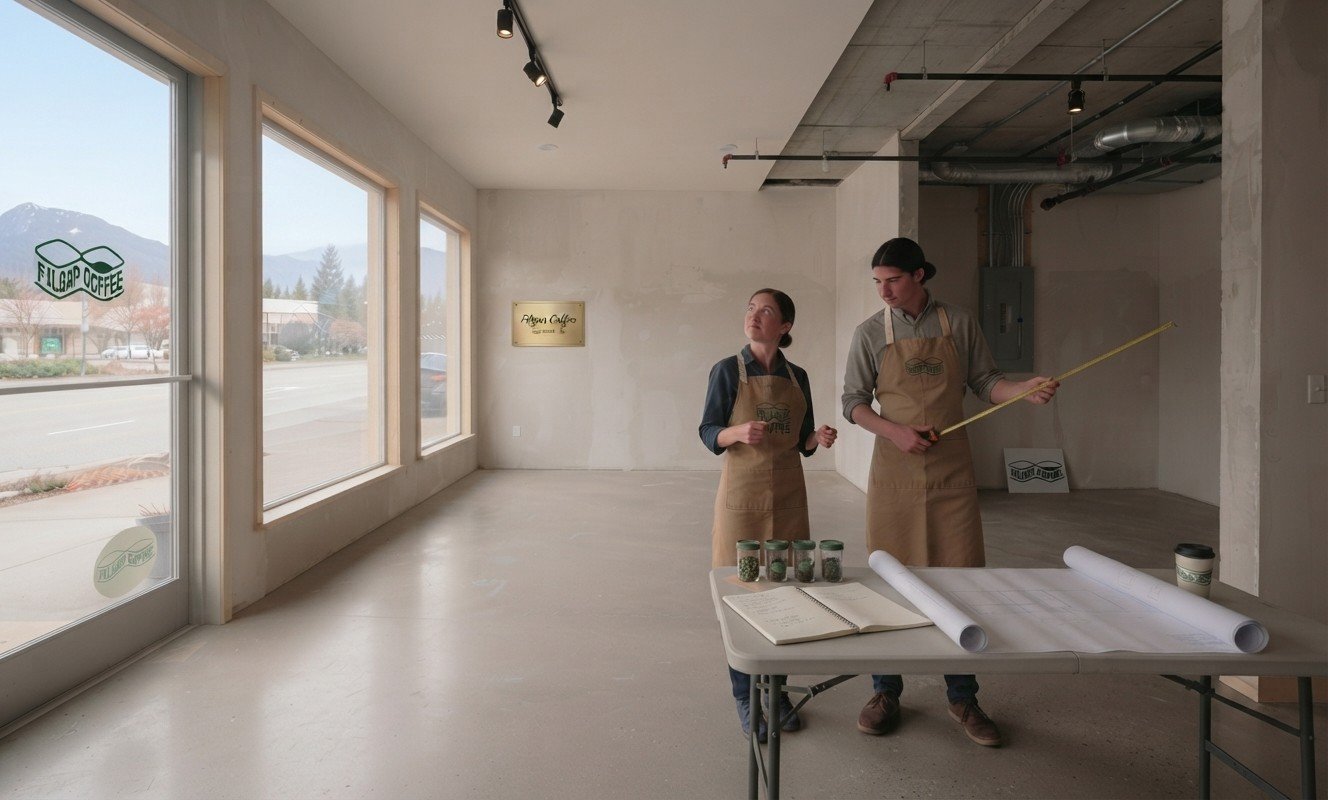
So I need to know what the property is actually allowed to do.
The District of Squamish requires businesses operating in Squamish to hold a business licence, and the application process can involve approvals from other departments or agencies such as Vancouver Coastal Health and Squamish Fire Rescue. The zoning of the actual property also determines permitted uses, while renovations or other commercial building work may create a separate building-permit process.
I would rather discover those things while I can still walk away from the property. After I sign a long lease, every surprise becomes my problem.
Serving coffee and roasting coffee are not the same question
A space could work perfectly well for a small café and still be awkward for a roastery.
That is one of the things I would want to establish early.
I am currently leaning toward an electric roaster for a future Filgap space.
Part of the reason is the electricity available here. BC Hydro says more than 98% of the power it generates comes from clean renewable sources, with hydroelectricity making up the vast majority, and 91% of the power it delivers to customers comes from B.C. hydroelectric facilities.
If an electric machine can give me the roasting performance I want, that direction makes sense to me.
It also changes the building question.
Instead of gas service, electrical capacity becomes even more important.
Can the building actually supply the machine?
What installation work would be required?
Is the equipment itself approved for use in B.C.?
Technical Safety BC requires electrical installation permits for regulated installation work within its jurisdiction, and B.C. electrical equipment generally needs recognized certification or other accepted approval evidence.
Those are the kinds of things I would rather know before purchasing an expensive roaster and certainly before designing a room around it.
Then there is exhaust.
Electric roasting does not mean there is nothing coming out of the roasting process.
There is still hot exhaust air, smoke, particles and odour to think about.
I am already paying attention to smoke control in my current testing because I do not want roasting to become somebody else’s problem.
A commercial operation raises the question at a different scale.
How can the exhaust leave the building?
What does the fire-safety side of the installation require?
What happens if there are residences nearby?
Could odour become a problem even if the installation itself is technically allowed?
There may be equipment that helps control smoke or particles, but that adds cost and maintenance too.
So I would prefer a building where roasting works naturally enough rather than one where I have to keep adding systems just to make an unsuitable space usable.
I have not found one simple Squamish “coffee-roaster exhaust permit” that answers all of this for me.
I do not think that means the issue disappears.
It means the real answer will depend on the property, the machine, the installation and the authorities involved.
The menu is part of the approval question too
I have already come to one conclusion: I do not want to buy kitchen equipment before deciding what food Filgap actually needs.
The health-approval side gives me another reason to keep that order straight.
Vancouver Coastal Health looks at what food and beverages will actually be prepared, packaged and served. For new, renovated or altered food premises, VCH requires floor plans to be reviewed and approved before construction begins, and its application process also asks for the menu and food processes.
That immediately connects the menu to the room.
If I keep the tasting-room offer simple, the facilities I need may be relatively simple too.
If I add more food preparation, storage and handling, the requirements can change.
I do not take that to mean I should avoid food because approvals are inconvenient.
If a future Filgap space genuinely needs a certain food offer and the economics make sense, then I should understand what is required and decide whether it is worth doing properly.
What I do not want is to build first and ask later.
I would rather know what the menu requires while the drawings can still change.
There is another wrinkle for Filgap because roasting and packaging coffee is production, while serving drinks to customers is food service.
VCH distinguishes permitted food-service establishments from non-permitted premises such as food processors or manufacturers, which still require health approval to operate.
I do not yet know exactly how the future Filgap operation will be handled because the final menu and production setup do not exist.
That is a question for the Environmental Health Officer when the project becomes real, not something I want to guess now.
Fire worries me more after opening than before it
Fire approval matters to me.
Squamish Fire Rescue conducts fire inspections connected with new or changed business licences, and business owners remain responsible for complying with the BC Fire Code.
But when I think about fire and coffee roasting, my mind goes somewhere else quite quickly.
Cleaning.
A roaster produces chaff and residue. Exhaust components need attention. Things accumulate if nobody takes responsibility for them.
Passing an inspection does not clean the machine six months later.
That part is ours.
So when I eventually choose roasting equipment and design the exhaust system, I want to think about whether we can reach the parts that need cleaning and whether the maintenance routine is realistic.
I can write procedures.
I can assign responsibility.
I can train people.
If the system is so difficult to maintain that cleaning is constantly postponed, then I have created another problem for myself.
That is not really a permit question.
It is still part of what I mean when I ask whether a roastery can operate safely in a particular space.
I cannot hire an engineer for every empty unit I look at
There is a practical limit to how much professional work I can buy before I even have a location.
If I look at several possible properties, I am not going to hire a complete design and engineering team for every one of them.
I expect to do a lot of early screening myself.
- Read the zoning information.
- Talk to the District when something is unclear.
- Understand what the roaster needs.
- Look at the electrical service.
- Think about where exhaust could go.
- Check what VCH expects from the type of menu I am considering.
A contractor may also be able to tell me fairly quickly whether a basic idea is going to require much more construction than I expected.
That kind of homework can help me decide whether a property deserves the next level of investigation.
Then there is a line I cannot cross by research alone.
If regulated electrical work is required, the proper permit and qualified people have to be involved. If VCH needs to approve a floor plan, they need to review it. If a building permit is required, I have to go through that process.
If drawings need a professional, I need the professional.
I am comfortable doing homework. I am not interested in pretending the homework makes me the inspector.
I would rather reject the property than remove the reason for the property
Of course approvals may change the design.
I expect that.
Maybe a wall or separation has to move.
Maybe the roaster ends up somewhere different.
Maybe an exhaust route I prefer is not practical.
That is normal design work.
What I do not want is to sign a lease and then discover that the only way to use the building is to remove most of the idea I leased it for.
If roasting is extremely difficult there, maybe it is the wrong property.
If the required electrical, mechanical and fire work pushes the cost beyond what the business can carry, maybe it is the wrong property.
If a menu choice creates a large extra build-out, I can decide whether the menu is worth that investment.
Those are choices.
I just want to make them while I still have choices.
This is similar to the way I thought about location in DREAM 16.
A property can be attractive and still be wrong for Filgap.
The approval path is part of finding that out.
I know the permit list will change as Filgap changes
I do not think I can write one final permit checklist today and keep it forever.
I do not have the permanent site.
I have not selected the commercial roaster.
The menu is not final.
I do not know exactly how much coffee a permanent roastery would produce or where all of it would eventually be sold.
Those details matter.
Federal food requirements are one example.
The Canadian Food Inspection Agency does not require an SFC licence simply because food is made and sold within one province. But preparing food for interprovincial trade can trigger federal licensing, and CFIA specifically lists roasting as a processing activity for foods such as coffee beans.
The exact sales route and activity still matter, including retail and direct-to-consumer exceptions.
That is something to verify when the business reaches that point rather than turn into a problem I pretend to solve years early.
Right now, I need the map more than I need every completed application.
- Which questions belong to the District?
- Which belong to VCH?
- Which belong to Technical Safety BC?
- Where does fire review enter?
- When do I need a contractor or professional?
- And which answers depend on the actual address?
If I understand that, I am less likely to make an expensive decision in the wrong order.
The final answer cannot come from the person selling me the space
One principle feels especially clear to me.
Do not trust what somebody tells you and sign.
Verify it.
I do not mean landlords and realtors are trying to mislead me.
They may know the building very well, and I would want their information.
Their answer is still not the final regulatory answer.
If somebody tells me roasting should be allowed, I want to confirm it with the people responsible for the use and approval.
If someone says there is plenty of power, I want the actual electrical information.
If the previous tenant served food, I do not want to assume my menu and production process have exactly the same requirements.
I have enough experience opening coffee stores to know that these questions need to be asked.
At the same time, I am new enough to doing it in Canada that I do not want to assume I already know how every answer works here.
That combination is probably useful.
I know what I am trying to look for.
Now I have to learn how B.C. actually requires me to prove it.
And when I eventually find a space I really want, I would rather spend more time verifying it before I sign than spend the next few years wishing I had.