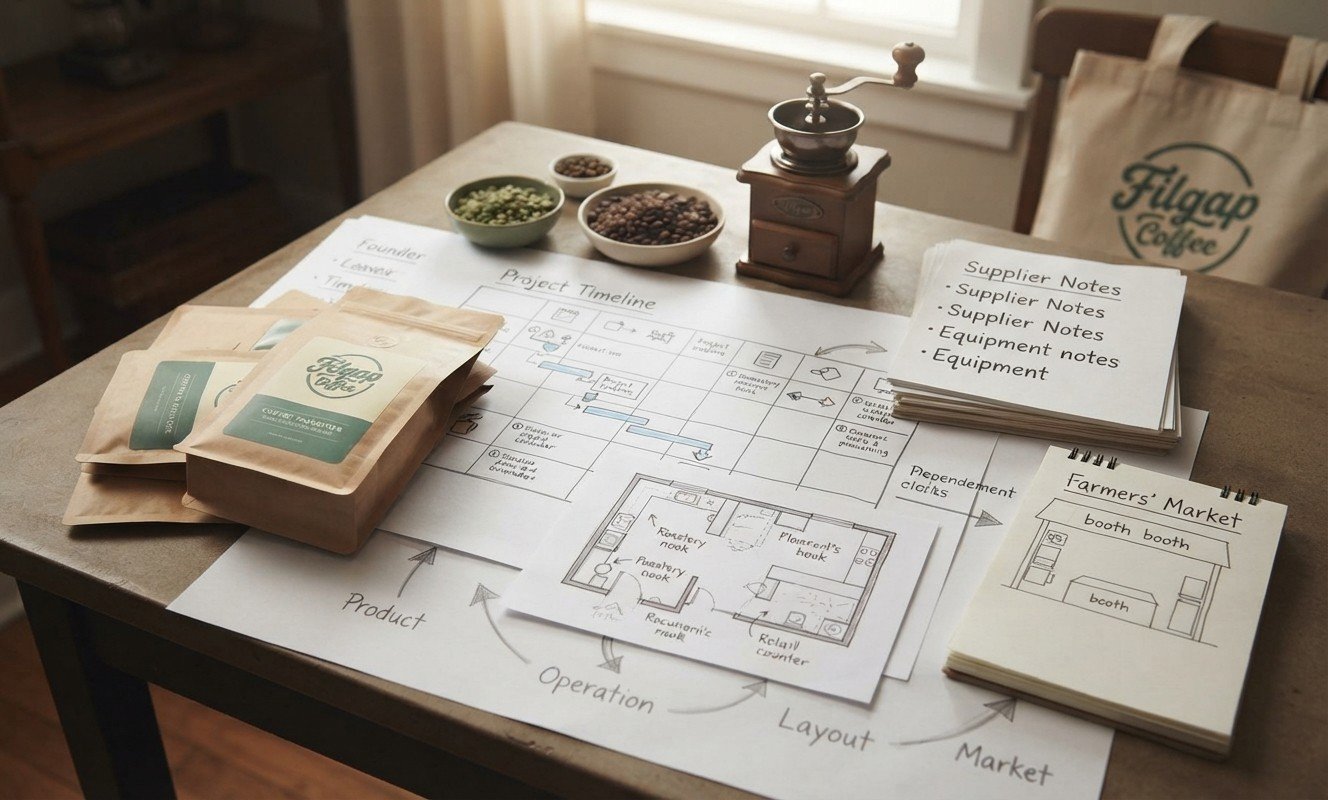
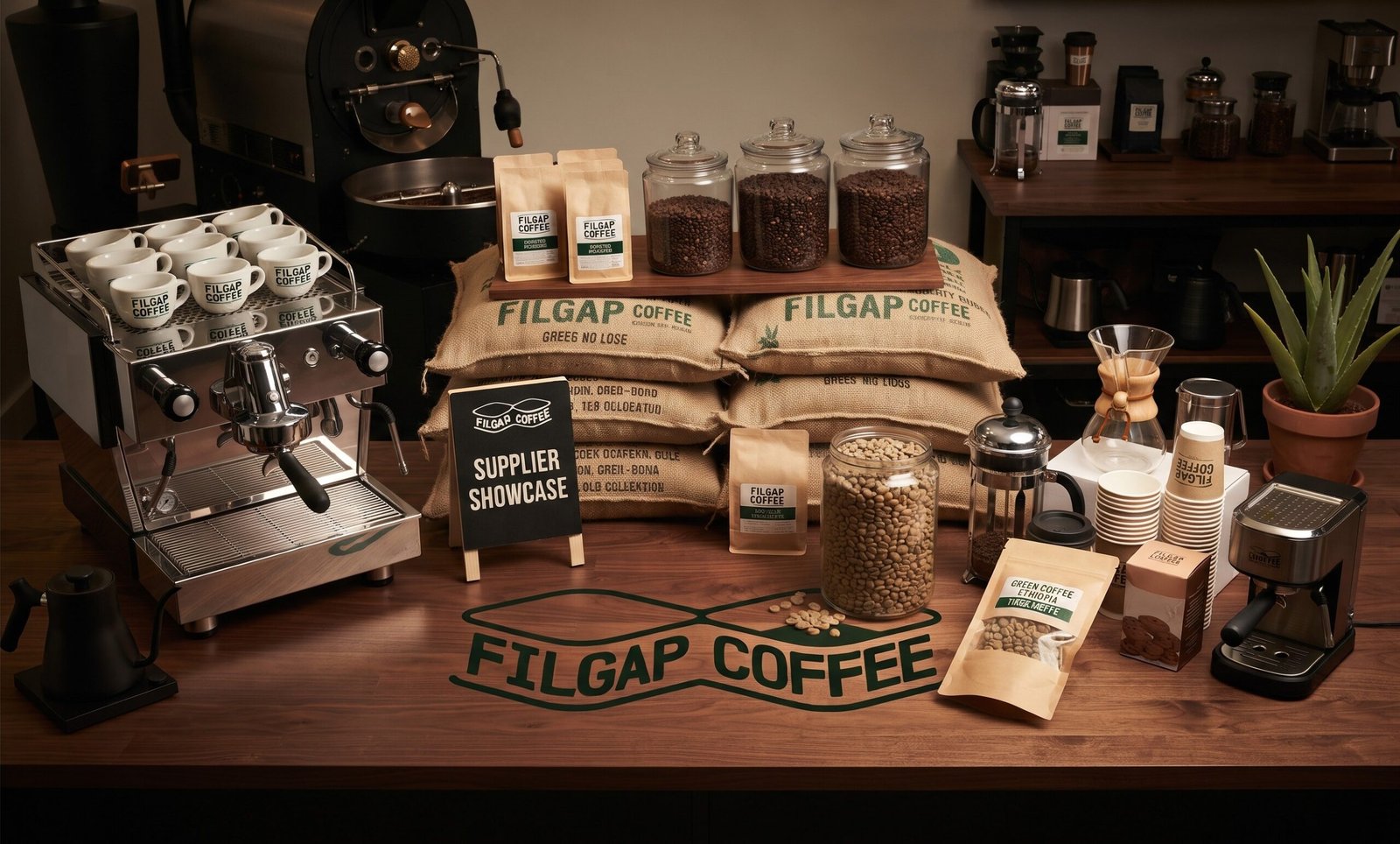
The supplier list in my 2024 Filgap business plan was long.
I was planning a much larger café at the time, so I tried to work out where almost everything could come from: green coffee, milk, tea, food ingredients, frozen products, packaging, cleaning supplies, linens, cups, merchandise and more.
The company names were only part of it. I wanted to understand how the supply side of the business could actually work in Squamish. I looked at price, delivery, payment terms and other conditions because all of those things eventually affect how a shop operates.
The Filgap I am planning now is much smaller.
Filgap Coffee is taking shape as a small-batch roastery in Squamish, and the Farmers’ Market comes before any permanent tasting room. I do not need a restaurant-sized supply network before I sell my first bags of coffee.
Green coffee is an obvious priority. Packaging is another one. There will be other things I need, but many of them can probably be bought locally in small quantities at the beginning.
So the list is shorter now.
That does not necessarily make the decisions easier.
Inventory is money
When I was thinking through suppliers again, I kept coming back to price.
A small business cannot ignore it. If two suppliers can provide something of comparable quality, I am going to care about which one gives me a competitive price. Especially before the business has any real scale, unnecessary cost matters.
At the same time, I have never liked looking at unit price by itself.
A supplier may give me a better price if I order a larger quantity. Freight per unit may improve too. Then I have to pay for all of that product, find somewhere to put it and wait until the business actually uses it.
That inventory is money I have already spent.
I have always thought about inventory that way.
If I buy too little, I may pay more or run out. If I buy too much, I may save on the unit cost but leave cash sitting on a shelf when I need it somewhere else.
For a small business, I think this becomes a different calculation for almost every item.
Something that I can easily buy around Squamish does not need the same inventory strategy as something that comes from another country. If I can replenish an item quickly, smaller and more frequent purchases may make sense while I learn what the actual demand is.
The Keurig-compatible capsule product I want to develop is a good example of the other situation.
If the particular component I want is in the United States, bringing in very small shipments every few weeks may not make economic sense. I might eventually decide to buy six months of supply at once. It might be a year. I have not done that calculation yet.
Before I decide, I would have to think about:
- how much cash goes out at once,
- how much room the material takes,
- how quickly I expect to use it,
- how difficult it is to reorder,
- and what happens if my sales estimate is wrong.
I also would not want to store packaging indefinitely simply because the price looked attractive at a larger quantity.
There probably will be items where a large import is the sensible choice. Others may be better purchased close to home in small quantities, even if the price per unit is a little higher.
Local matters to me here too. Filgap is a Squamish business, and if two options are reasonably close in quality, service and cost, I would prefer to work with another local business. I like the idea of local businesses supporting one another.
But the rest of the numbers still have to work.
At this stage of the business, I cannot pay dramatically more for something simply so I can say it came from nearby. Sometimes proximity itself has practical value — shorter replenishment, easier communication, smaller orders — and sometimes it may not be enough to overcome the difference.
I have to look at the item.
Green coffee is a different kind of decision
People sometimes ask me where I am going to buy my coffee beans.
It sounds like a simple question.
I think there is sometimes an image that a small roaster chooses a country, buys coffee from a farm there and somehow a container arrives in Squamish.
For a roaster my size, I expect the reality to involve green-coffee importers or traders that already handle coffees from different origins and make them available from warehouses in North America.
Different suppliers will have different coffees. One may have an Ethiopian lot I like. Another may have the Brazil I want. Another may focus on a different range of coffees altogether.
I do not expect one company to have every coffee Filgap will ever want.
That is why I can imagine working with several green-coffee suppliers rather than trying to put everything through one.
Green coffee also feels different from buying something ordinary and interchangeable.
There is more trust involved.
At the beginning, I can ask for a sample. I can roast it. I can taste it and compare it with other coffees. That is important, but it is still the beginning of the relationship.
When I actually order coffee, I learn more.
Does what arrives match what I understood I was buying? Does the quality make sense compared with what I evaluated? Is the information about the coffee clear? What happens when I come back later looking for another lot?
Then I order again.
Over time, I start to understand how that supplier works, and they start to understand the kind of coffee I am looking for.
That accumulated experience matters to me.
I would rather have a few green-coffee suppliers I know and trust than a long spreadsheet full of companies I have never really dealt with.
Price still matters. If I can negotiate a reasonable price, I will.
With green coffee, though, I can see the relationship becoming more valuable than saving a small amount on one purchase. Access to coffees I want, reliable information and confidence in the people I am buying from may matter much more over time.
A backup depends on what is being supplied
I used to think a lot about backup suppliers when I was operating larger businesses, but I do not think a small Filgap can realistically prepare two complete suppliers for everything.
The alternatives are different depending on the item.
If I run out of milk one morning in a future tasting room, I can buy milk from a supermarket in Squamish. I will probably pay more, so I would not want to make a habit of it, but the business can keep going.
A custom printed coffee bag is another matter.
If I have developed a bag with a supplier and that shipment is delayed, I cannot simply call another printer and receive the same finished package the next day. There is artwork, material, printing and production involved. Maintaining a second packaging company with an identical product waiting in the background may not be very practical either.
In that situation, forecasting and ordering early may be more useful than pretending there is an instant substitute.
Green coffee is different again.
If a particular lot sells out, another trader may not have the exact same coffee. The alternative may be a different coffee that still works for Filgap rather than an identical replacement from another supplier.
So when I think about backup, sometimes I am really asking a simpler question:
If the normal supply stops, what will I actually do?
For some everyday ingredients, the answer may be another supplier nearby. For a customized item, it may be more inventory and more lead-time margin. For green coffee, it may mean enough relationships and enough flexibility in the coffee lineup that one unavailable lot does not stop the business.
Lead time is part of that thinking.
If a supplier normally tells me four weeks, I would be uncomfortable building my entire inventory plan around exactly four weeks with no room for anything to go wrong.
Production time can change. Shipping can change. There may also be periods when many customers are ordering at once.
I would rather leave some margin before something critical is almost gone.
Before opening, some suppliers need to be real
There is also a difference between finding a supplier and actually having one.
If I find a company online and get a quotation, I still think of them as a candidate.
A sample gets me closer.
The first order changes things.
That is when I see how the transaction actually works.
Packaging is something I would especially want to see physically before making a meaningful order. A design on a monitor can look different once it is printed. The colour can feel different. The material matters. I have spent a lot of time testing packaging before, and I would not want to skip that step.
Green coffee obviously needs its own kind of testing because I need to roast and taste it.
Other supplies may not require nearly that much work.
Once I place a real order, other questions finally have real answers too. Did the product arrive when expected? Was the invoice right? Was communication easy? If there was a problem, how was it handled?
That experience is difficult to get from a quotation.
If I were one month away from opening a permanent Filgap space, I would want the critical part of the supplier system beyond the candidate stage.
The main products have been tested. I understand what I am buying and roughly what it costs. I know how to order it. I have a realistic idea of the lead time. The opening inventory is either there or arriving early enough that I still have some room to solve a problem.
I would not need every future supplier finalized.
If I have not decided to sell a particular food item, I do not need its supplier yet. Merchandise could wait. Future products could wait.
Green coffee and the packaging needed to sell it cannot.
Payment terms also start to matter more when cash is limited.
The old supplier table I made included payment conditions because receiving something now and paying later can help cash flow. A new small business does not always get that choice. Some equipment has to be paid for before it ships, and some suppliers may require payment before releasing an order.
At the beginning, sometimes I simply have to work with the terms available to me.
If the relationship grows and better terms become possible later, that has real value.
The supplier is also deciding whether they want to work with me
This is the part I used to talk about with employees quite often.
We are all busy.
The supplier is busy too.
They are not waiting all day for our phone call. They have many customers, many orders and their own problems to solve.
I used to ask employees to think about what happens when two customers need something at roughly the same time.
One sends a clear request, provides the information the supplier needs, respects the lead time and is generally easy to work with.
The other sends incomplete information, changes things repeatedly, forgets to order and then suddenly asks the supplier to turn a one-month job into three weeks.
People are people.
If everything else is similar, who are you naturally more willing to help?
I still believe that matters.
For me, building a supplier relationship includes trying to be a good customer.
That means:
- sending the right information,
- giving people enough time,
- paying when I said I would,
- and dealing reasonably with problems when they happen.
If a supplier tells me the lead time is one month, I should not create an emergency after three weeks and behave as though they caused it.
I do not expect special treatment in return. I simply know from experience that business is still done by people, and over time people remember whether working with you is straightforward or exhausting.
The supplier gets to know us. We get to know them.
Then, someday, there may be a real problem. Maybe I genuinely need something faster. Maybe there is a shortage and they know I have been looking for a particular coffee. Maybe there is one thing they can do to make the situation easier for me.
That is a very different phone call when there is already a good relationship behind it.
I would rather make that call to someone I have treated properly for years than to a company where our entire relationship has been trying to save the last few cents on every invoice.
That way of thinking has not changed for Filgap.
The actual supplier list may be much shorter than the one I made in 2024. In some ways, that makes each relationship more important.
Price, cash and inventory will still matter. Some things will be easy to buy nearby, while others may have to travel much farther. Some supplier relationships may stay fairly transactional. With green coffee, I expect trust to grow slowly through repeated experience.
I do not have every answer yet.
Before Filgap opens, I want enough of those answers to know that when I need coffee, packaging or another critical item, I understand where it is coming from — and I have done my part to make that supply relationship work.