
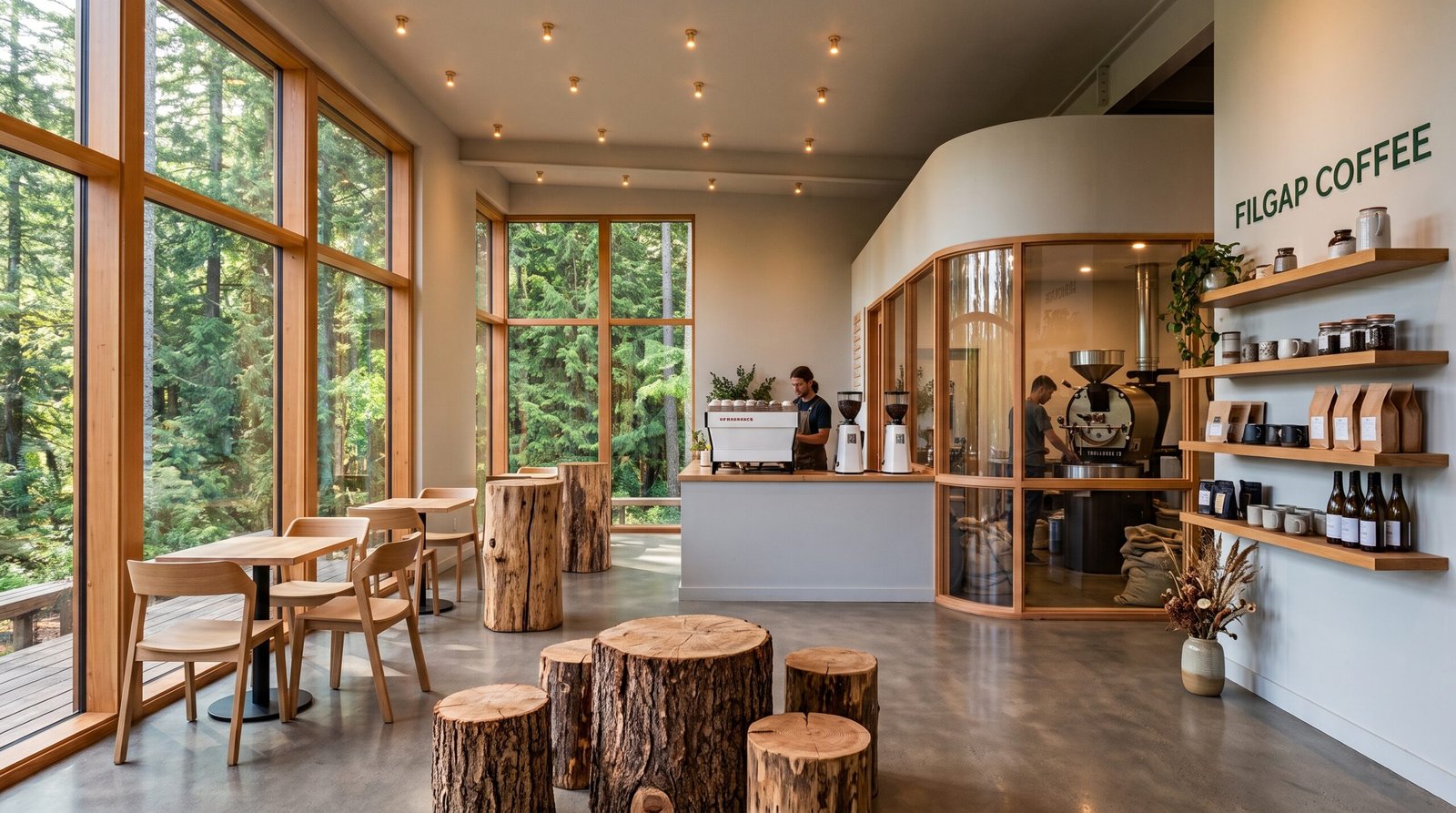
When I picture a future Filgap Coffee space, it is usually morning.
There are green trees outside the windows. Bags of coffee are easy to see when you walk in. Somewhere behind them is the roasting machine that made what is inside those bags.
People are drinking coffee. Some are talking with each other. Someone might be asking a question about a bean or how it was roasted. The room feels open, but not large. It feels organised without feeling formal.
That is roughly where the picture starts.
I do not know the exact floor plan yet. I do not know the square footage, the address or how many seats it should have. Those details matter, but I think they come later.
The first question is simpler.
What should this place actually be for?
Coffee has to remain the reason for the room
I do not want to build a restaurant that happens to serve good coffee.
I want to build a place where coffee is still the main reason the room exists.
That matters more than it may sound.
A coffee business can become complicated quite quickly. You add one food item because customers are hungry. Then another because it pairs well with coffee. Then breakfast makes sense. Lunch starts to look like an opportunity. Each addition may be reasonable on its own.
Eventually, though, the thing you started with can become harder to see.
I would like Filgap to resist that as much as possible.
The future space I imagine is first a small roastery. Whole beans are an important part of what people come for. The tasting room exists beside that work, giving people a place to try the coffee, sit down for a while and understand a little more about what they are drinking.
There will probably need to be something small to eat. Coffee does not have to exist in isolation. A simple snack or something that pairs naturally with a cup could make sense.
But I do not want the food operation to become the centre of the business.
That boundary may be harder to maintain in real life than it is to write down now. Still, I think it is worth defining before the pressure to add more begins.
I want people to see where the coffee is made
The roasting machine is not something I picture hidden in a back room.
Part of that is practical. If Filgap is selling roasted coffee, I like the idea that people can see where it is being made.
But there is more to it than freshness.
How something is made can tell you a lot about the people making it.
You can see whether a work area is organised. You can see whether someone is paying attention. You can sometimes sense how seriously the work is being treated without anyone needing to explain it.
I think that matters.
A brand can say that it cares about quality. It can put words such as craft, passion or attention to detail on a wall.
I would rather let people see some of the work.
The roasting machine itself will not prove that the coffee is good. That still has to happen in the cup. But I think the process, and the attitude toward that process, can build a kind of trust that is difficult to create with marketing language alone.
It can also attract the people who are interested in coffee in a similar way.
Some customers may not care how the coffee was roasted. That is completely fine.
Others will look behind the bags, notice the machine and start asking questions.
I would like there to be room for both.
A place people choose to meet
The other part of the picture has less to do with coffee equipment.
I want people to meet there.
Not because Filgap tells people it is a “community space,” but because one day someone in Squamish simply says:
“Let’s meet there.”
That would mean more to me.
I imagine people sitting with good coffee and talking. Maybe the coffee gives them a little energy, or a little inspiration. Maybe somebody becomes curious about what they are drinking and asks the barista a question. Maybe two friends simply need somewhere comfortable to catch up.
The room should make those things easy.
I do not picture it primarily as a place where someone sets up a laptop in the morning and occupies the same table for the entire day.
There is nothing wrong with working in a café. I have done it too.
But the rhythm I imagine for this particular room has a little more movement in it. People arrive, meet, drink coffee, talk, ask questions, leave, and make space for somebody else to do the same.
A place can feel active without feeling rushed.
That is closer to what I have in mind.
Small enough, but not too small
Then the practical side begins.
If the goal is to give people a comfortable place to meet, more space sounds better.
More space also means more rent.
Move farther away and the rent may improve, but accessibility can get worse. And if the point is to create somewhere people can meet easily, making the place inconvenient to reach starts to work against the idea.
That is the balance I have not solved yet.
Space, rent and accessibility are connected.
A large, inexpensive room in the wrong location may be less useful than a smaller room that fits naturally into people’s lives.
At the same time, a space can be too small. If people feel that they should leave as soon as their coffee is finished because someone is waiting for the table, it would be difficult to create the kind of relaxed conversation I am imagining.
There is probably a middle ground.
Finding it will require much more than looking at attractive commercial listings. It will mean understanding how many people the business actually needs to serve, how often seats turn over, what rent the coffee operation can support and how people in Squamish would realistically get there.
That is a later problem.
For now, I know that “bigger” is not the goal.
The right size is.
What Squamish feels like to me
When I think about the visual side of the space, I keep coming back to the place where Filgap is being built.
Squamish is green to me.
For much of the year, trees fill the view. In winter, white appears through snow and the mountains. The water can move somewhere between green and blue depending on the weather and the light.
Those colours have stayed with me.
I also like natural materials and spaces with daylight. Wood, glass, simple surfaces and enough visual space for the room to feel calm all make sense to me.
But I do not want to design a room by collecting things that look “Squamish.”
I would rather the connection come from how the space feels and works.
Relaxed. Natural. Easy to enter.
Organised, but not precious.
A place where someone who knows very little about specialty coffee can walk in without wondering whether they know enough to order.
Coffee can become complicated very quickly. The room does not need to make it feel more complicated.
Before drawing a floor plan
Thinking about the space this way has made me realise that floor plans probably come later than most people expect.
Before deciding where the bar goes or how many tables fit in a room, I would want to answer a few more basic questions.
- What is the main reason this business needs a physical space?
- What should customers actually be able to do there?
- Which parts of the work should they be able to see?
- What does the menu need to support, and at what point does it start changing the business itself?
- How much space can the business realistically afford without forcing it into a location that people will not want to reach?
- And perhaps the hardest question: What do I not want this place to become?
That last question may be as useful as all the others.
It is easy to add things.
It is harder to protect the reason the place existed in the first place.
The details can change
I am still a long way from choosing the final room.
The size may change. The layout probably will. The menu will need testing. The economics may force decisions that I cannot see yet.
That is fine.
A dream does not become more useful by pretending all of its details are already settled.
For now, the picture is simple enough.
Coffee on the shelves. A roasting machine behind it. Green outside the windows. A room that is comfortable but not oversized. Something small to eat. People tasting coffee, asking questions and talking with one another.
And someday, maybe somebody in Squamish says to a friend:
“Let’s meet at Filgap.”
If that happens naturally, I think the room will be doing what I hoped it would do.