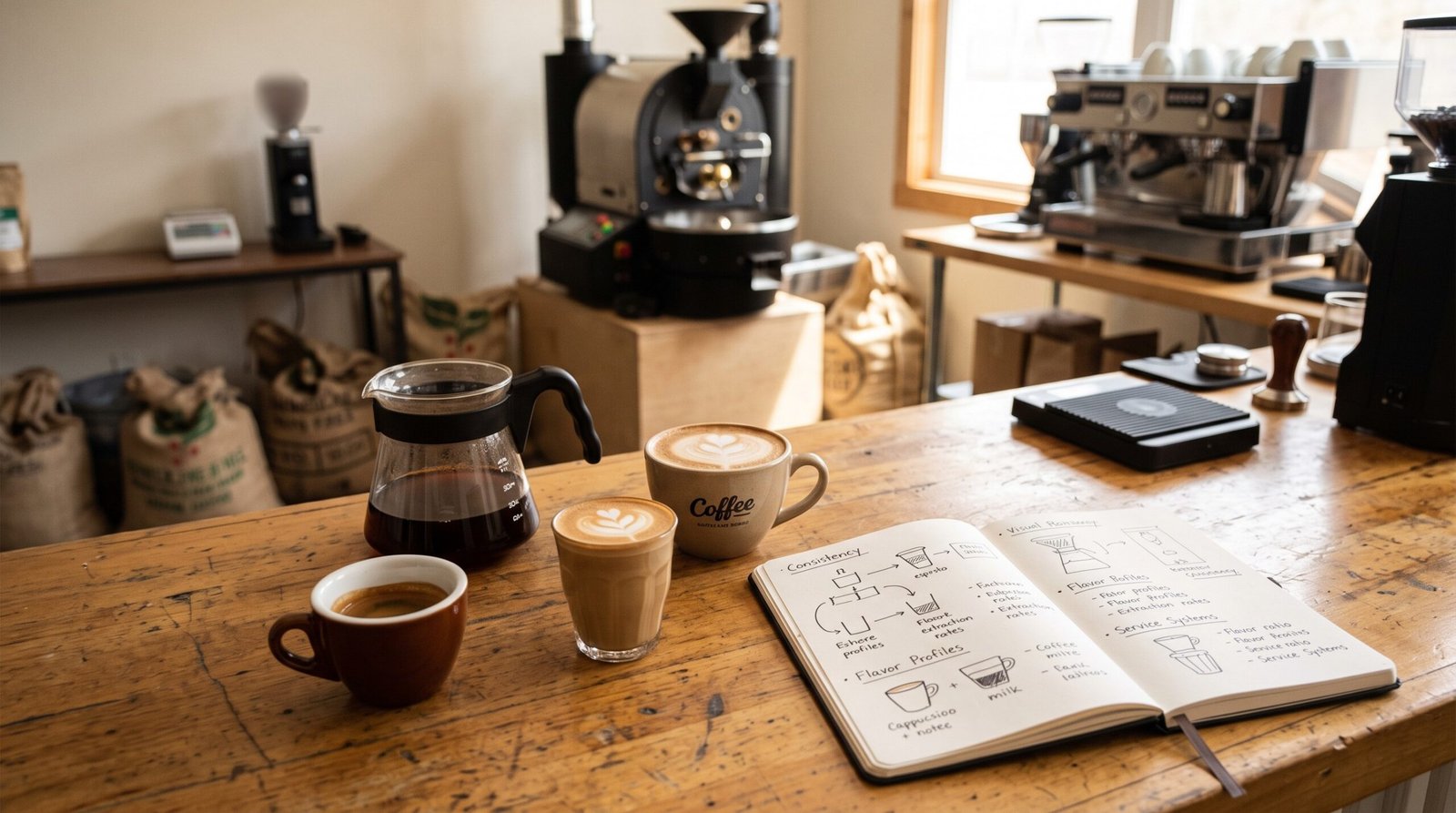
If I had to make the first beverage menu for Filgap tomorrow, I think I would start with one espresso.
One signature blend.
That sounds very simple, especially for a roastery. You might expect a roastery to have several espresso choices, maybe a house blend, a single origin, perhaps something darker for people who prefer a stronger roast.
I can imagine all of those things. I am just not sure I would start there.
The reason is partly coffee and partly business.
If I have one espresso and sell 100 portions of it, that coffee is moving. If I have two and the same sales are divided between them, each one moves more slowly. Add a third coffee and now there are three coffees to dial in, three coffees to manage, and three inventories whose freshness I have to watch.
If the tasting room is busy one day, this becomes a different conversation. With enough volume, more choice is possible.
At the beginning, I would rather know that one coffee is working properly.
The signature blend I have in mind is closer to a medium roast. I want sweetness, body, and enough character that it still tastes like coffee when milk is added. I do not see myself having a separate house coffee for espresso and another one just for milk drinks. At least not now.
There is another possibility I have thought about. In Canada, there are people who are used to a more developed, stronger roast profile. I have seen cafés offer that alongside a lighter or medium-style coffee, and there may be a reason to do something similar here.
Would that be more useful than a rotating single-origin espresso?
I do not know.
This is exactly the kind of decision I would rather make after seeing who is actually buying the coffee.
What I am fairly sure about is that I do not want to put three coffees on the bar at the beginning just to make the operation look more sophisticated.
Then come the drink names
Once the espresso is decided, the menu starts getting more complicated.
Espresso itself is important to me. When it is extracted well, you can taste the coffee very directly. It is a small drink, it gives you the caffeine you want, and after a meal I personally think it can be one of the nicest ways to drink coffee.
A lot of people do not drink espresso that way, of course.
So there will be an Americano or another black coffee based on espresso, and then the milk drinks.
This is where I do think the names have a purpose.
A macchiato and a latte are clearly not the same experience. Neither are a cappuccino and a flat white. The amount of milk changes, the texture changes, and the balance between the coffee and milk changes.
But somewhere between macchiato, piccolo, cortado, cappuccino, flat white and latte, I also start wondering how many distinctions a customer really needs to see on one menu.
Coffee people may enjoy those differences. Regular customers also tend to know what they like. Someone who always drinks a flat white usually does not need to reconsider the whole menu every morning.
At the same time, somebody who has never thought about the difference between a cortado and a piccolo should still be able to walk in and order comfortably.
I do not have the final list yet.
What I want to avoid is adding names just because they exist in specialty coffee. If two drinks are on the board, there should be enough difference that I can explain it simply and the customer can actually experience it.
That seems more useful to me than trying to prove how many coffee terms we know.
Size is harder than it looks
Cup size is one area where what I like and what customers are used to may be different.
For milk drinks, I like something around eight ounces. With a normal espresso recipe, I find that size gives me a balance I enjoy. I can still taste the coffee clearly, and there is enough milk to add sweetness and texture.
The market has moved toward larger drinks.
Twelve ounces is common. Sixteen ounces is common. In some places, the sizes keep going well beyond that.
I understand why people want them. More coffee feels like more value, and people get used to carrying a larger drink.
But from the coffee side, it is not as simple as using the same espresso and adding more milk.
The drink gets weaker.
You can try extracting more liquid from the same coffee, but that changes the extraction and flavour too. Or you add another shot, which changes the cost.
So now a size decision has become a recipe decision and a pricing decision.
I suspect Filgap would have two sizes for many milk drinks. Maybe there will be a third in some cases. I would have to test it.
I just do not see myself continuing to make drinks larger if, at some point, I no longer like the way the coffee tastes in them.
That is probably one place where I would be willing to disappoint a small number of customers rather than make a drink I do not believe is good.
Customers still need choices
None of this means I want a rigid bar where customers are told there is only one correct way to drink coffee.
People have real needs.
Some do not drink dairy. Oat milk is already an obvious one to consider, and depending on demand there may be almond or soy as well.
Decaf is important. Some people are sensitive to caffeine or simply do not want it later in the day.
Extra shots are normal.
Hot and iced drinks both matter.
People also like sweetness. I am not opposed to syrup or sweet drinks just because they are not the way I personally drink coffee.
What I do not think is necessary is turning every possible adjustment into a printed menu option.
Temperature is an example. I would rather have a normal preparation standard and then, if somebody asks for a hotter drink, make the adjustment for them.
The same could apply to sweetness.
That feels more natural to me than giving the customer a menu that looks like a form to complete.
You need some standards or the operation becomes very difficult to control. But hospitality also means listening when somebody has a reasonable preference.
Finding that line will probably take some experience.
I have made menu language harder than it needed to be before
In a previous coffee business, we had a drink we called a Lungo.
We did not call it an Americano.
There was a reason for that. We had developed a specific recipe and wanted the drink to become part of the identity of the brand.
From our side, it made sense.
From the customer side, many people walked in looking for the word Americano.
They could not find it.
Then somebody had to explain what a Lungo was.
We did that over and over.
Eventually people learned it. The coffee was good, customers came back, and the name became familiar. But it took a long time. My memory is that it was more like two or three years than a few months.
I do not regret it. Actually, I think there was value in creating something distinctive and teaching customers about it.
But I learned that customer education takes time.
It also uses staff time.
If I introduce an unfamiliar term at Filgap, I want there to be a good reason for asking people to learn it.
There is no prize for making a menu more difficult.
At the same time, I do like it when a customer asks a coffee question.
If somebody asks, “What is the difference between a flat white and a cappuccino?” I do not see that as a problem.
That can be a nice conversation.
People often begin with coffee as something ordinary. Then at some point they notice that one coffee tastes sweeter, another one feels stronger, or a smaller milk drink lets them taste something they did not notice in a big latte.
That curiosity is good.
I want the menu to be easy enough that nobody feels foolish ordering from it, but I also want the people working there to be able to talk about coffee when somebody wants to know more.
Filter coffee is still an open question for me
I would like the future tasting room to show more than one way of experiencing coffee.
Espresso and filter coffee are different.
Even with the same coffee, the brewing method can show you something different in the cup.
From the point of view of a roastery, that is interesting.
The practical question is how to do it.
Filter brewing can be very consistent if the equipment, recipe and training are good. Manual pour-over can also be done well.
But it changes the workflow.
If you decide from the beginning that pour-over is part of the service, you can design the bar around it and train people accordingly.
If you build an espresso bar first and later decide to squeeze pour-over into it, that can be much harder.
I have not decided which way Filgap would go.
It may be batch brew. It may include pour-over. Perhaps the scale of the tasting room will make that choice fairly obvious later.
This is one of the things I would rather leave unresolved now than put an answer in a business plan because the empty box makes me uncomfortable.
The part I am less willing to compromise on
Whatever ends up on the menu, consistency matters a lot to me.
This comes from the way I have always thought about coffee.
A recipe is useful. Training is useful. Good equipment helps. Clean equipment is basic.
But at the end, you still have to taste the coffee.
Coffee changes. The environment changes. Equipment behaves differently over time. A barista needs to notice those things and make adjustments.
So when I say I want a drink to be consistent, I do not mean repeating exactly the same physical action forever.
I mean the customer should receive the result we intended.
That becomes harder every time the menu gets bigger.
Every additional drink is another recipe that has to be understood and reproduced. Every milk option or size adds another variation. A signature drink may look interesting on paper, but if it becomes unreliable during a busy service, that is a real problem.
This is probably why I keep coming back to the idea of starting relatively simply.
Not permanently simple.
Just simple enough that we can learn what is working.
I would like the first Filgap menu to have a clear espresso, a sensible range of black and milk drinks, enough options for people who do not drink dairy or caffeine, and some room to try things.
There may be a signature drink.
There may be seasonal drinks.
There may eventually be another espresso.
I expect the menu to change.
What I do not want is to decide now that Filgap needs all of those things on day one.
When the tasting room finally exists, the customers will tell us things that planning cannot.
They will order the same drink every week.
They will ignore something I thought was clever.
They will ask for something I did not expect.
The bar will get busy and show us where the workflow is weak.
Some of those lessons will probably change my mind.
That is fine.
For now, I think I know enough to start with one coffee and build outward from there.