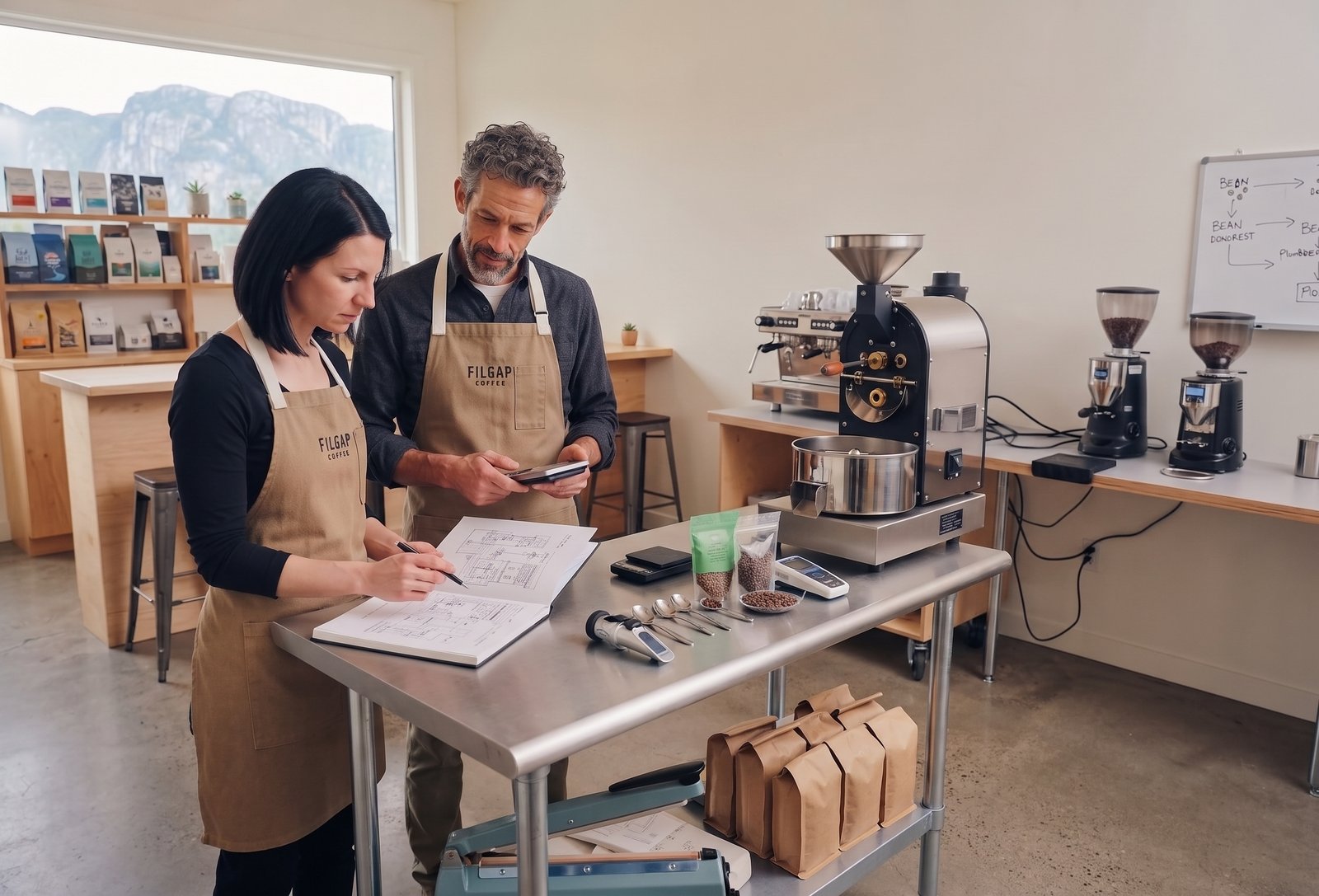
When I look back at the equipment list in my 2024 Filgap business plan, there is a lot on it.
Espresso equipment, grinders, automated brewing equipment, blenders, food equipment, soft serve, refrigeration, a roaster and packaging equipment.
The obvious explanation is that the menu was much broader then. More products needed more machines.
That was true.
But I was thinking about something else at the same time.
I was thinking about who would actually work there.
When I looked around food-and-beverage businesses in Squamish, I often saw experienced people working alongside younger or less-experienced employees.
I was going to be a new independent business. I could not assume that every person I hired would already be a trained coffee professional. I also could not assume that somebody I trained well would stay with me for years.
At the same time, I wanted the coffee to be good.
That was the problem I was trying to solve.
If I reduced the old equipment list today, the core would be much smaller: a roaster, basic quality-control and measuring tools, an espresso machine, grinders, scales, water treatment, and the equipment needed to handle and package the coffee.
Other machines would need to prove why they belong.
I did not want quality to depend on one person
Coffee still needs skill.
I do not think equipment changes that.
Somebody has to taste the coffee, notice when something changes, understand the machine and know when the result is moving away from where it should be.
But I also do not want a customer to get very good coffee on Tuesday because one particular barista is working, and something noticeably different on Thursday because somebody else is behind the machine.
Over the years I became interested in equipment partly for that reason.
Coffee equipment has developed quickly. Some machines can control parts of the process more precisely than they used to. They can remove some repetitive variation, make certain jobs easier and help people repeat a result.
When I evaluated new equipment in the past, I often asked whether someone with less experience could still produce something reasonably close to the standard we wanted.
I also looked at productivity. Sometimes a machine made a type of product possible that would otherwise be difficult to produce commercially.
I spent a lot of time researching those machines. I did not accept every new idea simply because it was new.
That way of thinking has stayed with me.
What has changed is that Filgap no longer needs all the products I imagined in 2024.
So some of the machines can disappear too.
If I start with an empty room, the roaster comes first
That part is easy.
Filgap is being built as a small-batch roastery, so the roasting machine is not optional in the permanent space I imagine.
After that, though, I start thinking about surprisingly small things.
Scales.
Ways to record and compare what I am producing.
Tools for checking the green and roasted coffee.
Coffee is something I ultimately judge by tasting it. I do not want numbers to replace that.
But when I am producing coffee rather than simply drinking it, I want some measurements too.
If one batch looks or tastes different from another, I want more than my memory of what happened yesterday.
Over time, measurements such as moisture, roast colour, weight and roast data can give me another reference point.
I still have to taste.
The numbers help me ask better questions about what I am tasting.
Then I need to make the coffee into something people can drink
For me, that means espresso.
I know that an espresso machine is not technically required to evaluate coffee. I could brew filter coffee and learn plenty from it.
But espresso has been important in the way I have thought about coffee for a long time.
I want it in a future Filgap tasting room.
So now the list begins to form.
- A roaster.
- An espresso machine.
- A good espresso grinder.
- Scales.
- Water treatment.
- And another grinder for customers who buy whole beans and want them ground for whatever brewing method they use at home.
Already, I am reminded that buying one machine rarely means buying only one machine.
The espresso machine needs suitable water.
It needs a grinder.
The production side needs measuring and packaging tools around the roaster.
The system starts appearing around the equipment.
Consistency is where I am willing to spend money
If I had to give one reason for paying more for commercial coffee equipment, consistency would probably come first.
But even that depends on how busy the business is.
If I make one drink and then wait five minutes before the next order, the equipment is not under much pressure.
A busy hour is different.
Drink after drink has to come out while the machine keeps working.
That is when temperature stability, recovery, reliability and capacity begin to matter much more.
I want the twentieth drink to be reasonably close to the first.
That can justify better equipment.
It does not mean every expensive feature has value for Filgap.
A machine can do twenty clever things. If I need six of them, the other fourteen are not automatically worth paying for.
I am less interested in the longest specification sheet than I am in whether the machine can repeatedly do the work I actually need.
I would not treat the grinder as an accessory
I pay a lot of attention to grinders.
The grinder changes the coffee before the espresso machine has a chance to do anything with it.
For the Filgap setup I imagine now, there are at least two different grinding jobs.
One is espresso production.
The other is grinding whole beans for a customer who wants to take the coffee home.
Those need different capabilities, so I expect at least two grinders for those purposes.
That does not mean I want five grinders lined up on the counter from opening day.
If I later have a second espresso coffee, decaf or another coffee that needs its own grinder, I can add one because there is an actual reason.
High volume can change the answer as well.
At very high volume, I would watch how the grinder behaves through sustained use—grind setting, temperature, speed and the espresso coming from it.
If one grinder stopped giving us the consistency we wanted under that workload, then another production grinder could become a sensible investment.
I do not think I need to solve that problem before it exists.
I cannot afford a backup for every failure
It would be comforting.
A second espresso machine in case the first one fails.
Another grinder.
Another brewer.
Another everything.
The problem is that commercial equipment is expensive, and a small business can spend a lot of money preparing for emergencies that may never happen.
So before backup equipment, I think about maintenance.
Some things need attention every day.
Others need periodic deeper cleaning and inspection.
Water matters because scale and water chemistry affect equipment as well as coffee.
Parts wear out.
A machine gives warning signs sometimes if somebody is paying attention.
I would rather build maintenance into the operation from the beginning.
That does not eliminate breakdowns.
Eventually something will fail.
Then I want to know who services the equipment, whether parts are available, what I can reasonably maintain myself and what requires a technician.
That information belongs in the purchase decision, not in a folder I look for after the machine stops working.
Automation only interests me when it solves a problem
This is probably where my thinking could sound contradictory.
I like equipment that can make quality more repeatable with a team that has different levels of experience.
But I do not automatically want more automation.
If a machine reduces a real source of inconsistency, saves repetitive labour or allows us to make something well that would otherwise be difficult to produce repeatedly, I am interested.
If it mostly duplicates work we can already do, I am less interested.
The old Filgap plan included more specialised equipment because the menu required more production systems.
The current plan is smaller.
That changes the answer.
A highly automated machine might be excellent equipment and still be an unnecessary purchase for Filgap.
Batch brewing is one place where I can still see a machine earning its space
I can make good coffee manually.
That is not really the issue.
The question changes when I have to make the same product repeatedly.
Can another person make it the same way?
Can we do it again tomorrow?
What happens if demand doubles?
How much attention does each batch take away from something else?
Those are commercial questions, not just brewing questions.
That is why I still expect batch brewing to be part of the equipment I consider. I am also exploring how that kind of brewing might fit into a future concentrated-coffee product.
That process is not finalized yet.
What matters more to me here is the reasoning.
A machine becomes useful when repetition, consistency or labour makes the manual method a poor fit for the actual business.
I do not want to buy the kitchen before I decide the food
This is much easier for me now than it was in 2024.
If the eventual menu needs an oven, then I can evaluate an oven.
If it needs a grill, then I can evaluate a grill.
If Filgap can operate well with food that requires very little preparation equipment, I would rather not build a kitchen just because many coffee shops have one.
I expect the answer to depend partly on what happens before the permanent space exists.
If people in Squamish respond strongly to the coffee and a future tasting room attracts more people and more kinds of visits, some supporting food may make sense.
Then the equipment decision follows.
I do not want it the other way around.
The roasting machine is only the large, obvious part
I have already thought about how visible I want the roaster to be.
But the less dramatic equipment around it matters too.
Green coffee has to be weighed and handled.
Roasted coffee has to be checked.
It has to be packed and sealed.
Inventory needs somewhere appropriate to live.
The equipment needs cleaning.
I also want to build a useful record of what happens from batch to batch rather than rely only on visual memory.
Roast-colour measurement is one example. There are tools available to make that comparison more repeatable than simply looking at the beans.
Whether every measurement tool belongs in Filgap on day one is still something I would decide against its cost and usefulness.
But I want the production side to have enough measurement that I can learn from what I make.
The roaster may be what customers notice. It is not the entire roastery.
I am careful with the word capacity
It is tempting to buy a bigger machine because I hope the business will grow.
The roaster makes me particularly cautious about that idea.
I am currently thinking somewhere around a 3 kg-class machine for a future Filgap space.
That is still a working assumption, not a final specification.
And even saying “3 kg” does not tell me enough.
Different roasters with similar headline capacities can have very different usable batch ranges and different production rates.
I need to know the smaller batches the machine can handle well as much as the largest.
If sales are still modest, I do not want the equipment encouraging me to roast more coffee than I need simply because I bought too much capacity.
I would rather roast according to demand and keep the coffee moving.
At the same time, a smaller batch does not necessarily mean low daily production if the machine can roast efficiently and repeatedly.
So I would look at both sides.
What can it produce when Filgap is busy?
And what can it sensibly produce while Filgap is still small?
For me, both are capacity questions.
I would check service before I buy now
This becomes much more important after owning equipment for a while.
A machine can have excellent specifications.
Then something goes wrong.
- Can somebody service this particular brand in British Columbia?
- Will the technician come to Squamish?
- Are common parts available in Canada?
- Do I have access to good manuals and technical support?
- Can normal cleaning and maintenance be done without turning it into a major project?
I would want answers before choosing the machine.
A piece of equipment that makes excellent coffee but becomes difficult to own whenever one part fails is a different machine from the one I thought I bought.
For a small operation, downtime becomes expensive very quickly.
I still end up back at the coffee
This is the uncomfortable part.
I know I do not need every machine.
I know I should not buy capacity only because I hope to grow.
I know a feature has no value simply because it is technically impressive.
And I know maintenance and service can matter as much as the purchase price after opening.
But I also know myself.
When I can taste the difference between the result I want and the result a piece of equipment can give me, I find it difficult to ignore that.
I keep looking for equipment that can produce the quality I want, do it consistently and work in the business I can realistically operate.
Often that equipment costs more than I wish it did.
Then I have to decide whether the difference is worth the money.
I have had to make that decision many times before.
I do not expect Filgap to make it any easier.