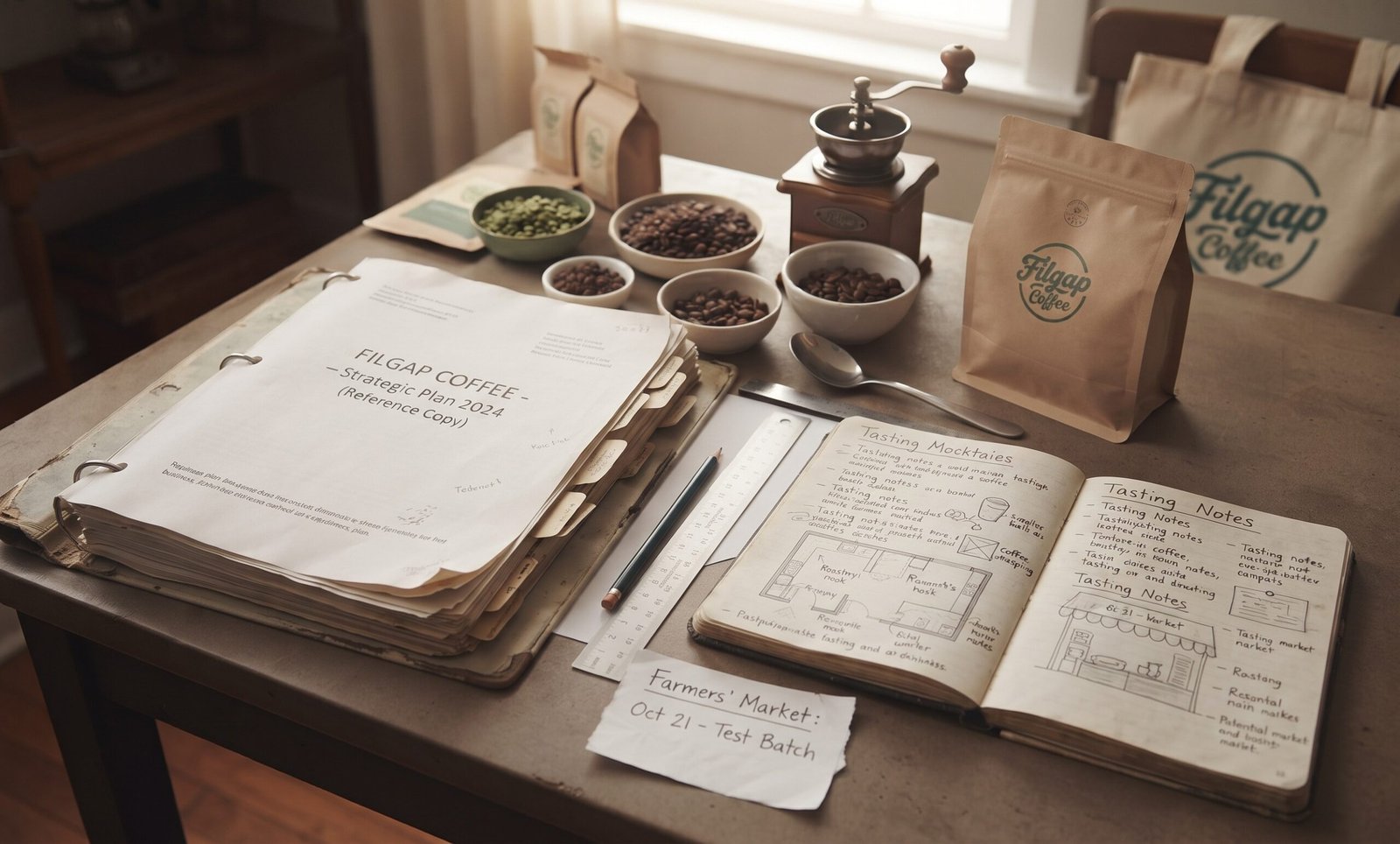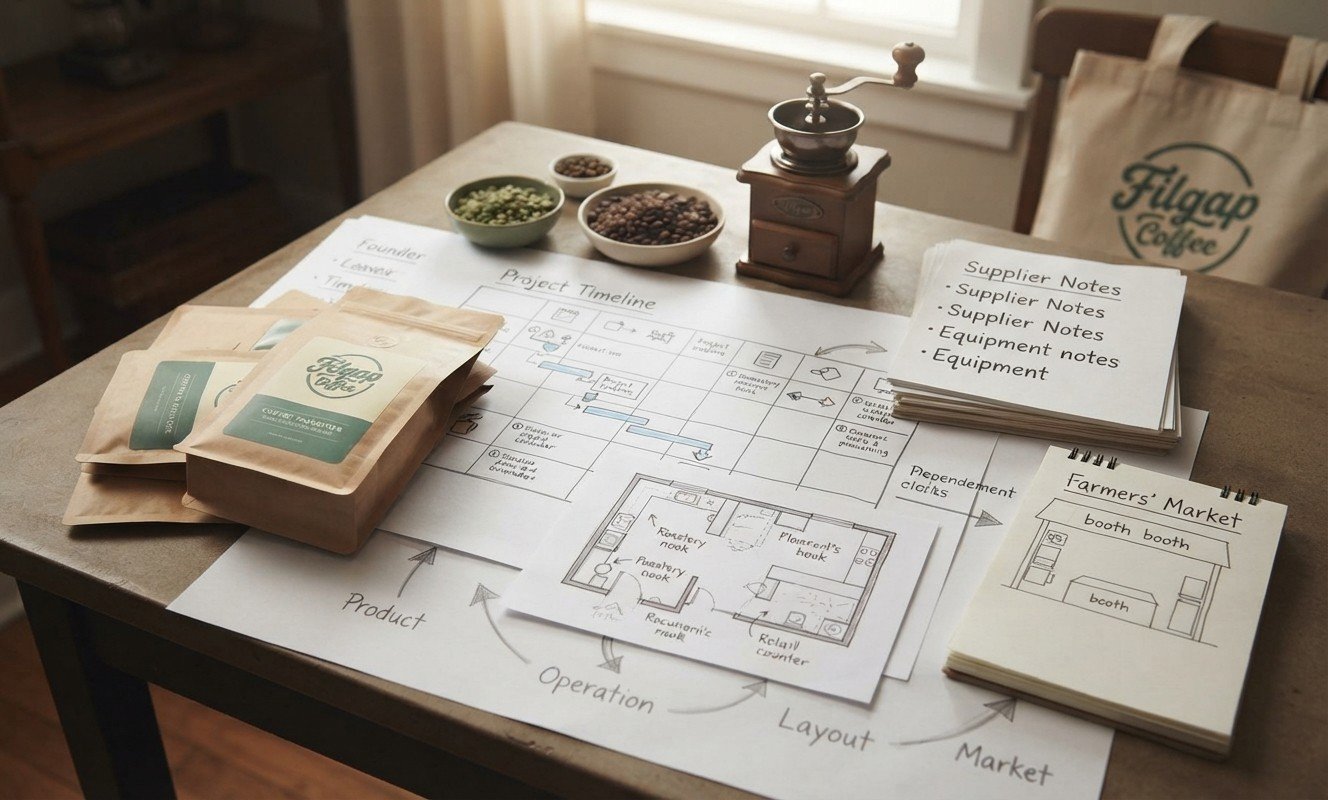

The staffing section in my 2024 Filgap business plan looked like the staffing section of a real café company.
I had managers, baristas, kitchen staff, roasting, marketing, delivery and other work in mind. Altogether, the plan imagined roughly 12 to 16 full-time and part-time people.
That number made more sense for the business I was imagining then. It was a much larger café model, with a broader menu, more customer service and more things happening at the same time.
If I copied that organization chart into Filgap today, it would make very little sense.
There is no revenue yet. Before the business earns money, almost every staffing decision is also a decision about where scarce cash should go.
For me, that changes the starting question.
I do not want to decide that a coffee business needs three people, or five people, and then find jobs for them. I want to understand the work first.
- What actually has to happen?
- What can one person do at different times?
- What has to happen at the same time?
- And where does another person really become necessary?
Before I hire, I have to decide where the money goes
Right now there are things I already know I have to spend money on.
I cannot build a coffee roaster myself, so I have to buy the roasting equipment. I also want more objective ways to look at roast quality, which means there are smaller testing and measuring tools I may need. After roasting, I still have to brew the coffee the way customers will drink it—espresso, filter coffee and other normal preparations—so there is basic equipment around that too.
Those expenses sit very close to the product. They are hard to avoid.
Then there is work I simply should not pretend I can do professionally.
Design is the clearest example for me. I have ideas, and because I own the brand I usually have a strong view about what I want something to communicate. But having a direction is not the same as being able to turn it into good finished design. If I care about the packaging and the visual expression of the brand, I need a designer for that work.
Accounting and tax work are a little different.
I could study more and do more of it myself. The problem is that I am also trying to roast, test, package, buy supplies, prepare for the market and build the business. At some point the question is not whether I am capable of learning one more thing. It is whether learning that thing is the best use of the time I have.
I can already see professional business tax reporting as something I would rather hand to somebody whose work it actually is.
The website and social media have gone the other way so far.
They are important enough that I do not want to leave them undone. They are not areas where I started with much experience either. But handing the whole thing outside at the level I would want could become expensive very quickly, so I have been learning and building them myself.
That is probably closer to what staffing looks like in a very small business than the organization chart I once made. A few things have to be bought. A few things genuinely need a professional. Then there is a large middle area where the owner keeps asking, can I reasonably do this myself for now?
One person can do many jobs until the timing stops working
The Farmers’ Market gives me some flexibility because roasting and selling are naturally separated.
I am not going to take the roaster to the market and operate it there. I can roast beforehand, prepare the coffee, and then go to the market and sell it. One person can do both because those jobs happen at different times.
A future roastery and tasting room is different.
I have said before that I want the roaster to be part of the room. I want customers to see coffee being roasted while they are there. For me, that is part of the presentation of the product, not just something interesting to look at.
I think about a good sushi counter.
When you sit at the counter, you see the chef making the food. You see the movement, the organization, the cleanliness and the care in the process. The preparation itself becomes part of how you understand what you are eating.
That is close to what I like about visible roasting.
I could design a future shop around one person. I could serve customers during opening hours and roast after the doors close. From a labour point of view, that would be simpler.
But if the reason I put the roaster in the room is that I want the process to be visible, then only running it when nobody is there defeats part of the idea.
Once roasting and customer service have to happen at the same time, the staffing question changes. The person roasting cannot also be fully available to greet people, answer questions, sell whole-bean coffee and make drinks every minute.
That is more useful to me than starting with a number of employees.
Sometimes the amount of work is manageable, but the timing of the work is not.
The first person I hire would probably be strong with people
If I imagine the first person working with me, I still do not immediately think about a formal job title.
I think about hospitality.
I want somebody who notices people, welcomes them naturally and is comfortable having a conversation. Somebody who smiles easily because that is how they are with people, not because a training manual says to smile at the customer.
I have managed people for a long time, and I think some parts of customer service can be trained very well. Procedures can be taught. Product knowledge can be taught. Coffee skills can be improved.
The basic attitude toward people is harder.
If somebody genuinely likes dealing with customers, that gives me something useful to build on. If that person is also willing to learn how Filgap wants to work, I would value that very highly in an early hire.
Experience is useful, but I have seen another side of experience too.
Someone can arrive with very good technical skills and very fixed habits. If what they learned somewhere else does not match what we are trying to do, the question becomes whether they can adjust.
That is why I would not automatically choose the person with the longest coffee résumé. A good foundation, hospitality and flexibility may be more useful to a small business than deeper experience that comes with no room to change.
A small team and a larger company should not be built the same way
When the business is small, I want people who can move between jobs.
There may not be enough barista work for one person to stand at the machine all day. Packaging may be heavy one day and light the next. Customer traffic changes. There will be cleaning, restocking and other work around all of it.
A small operation has to be flexible.
If the business grows, I would expect that to change. At some point, having somebody with deeper responsibility and expertise in one area becomes more useful.
I think of a business growing a little like a child growing up.
You do not keep putting the same clothes on a child from infancy through the teenage years. The size changes, but so do the needs. Food changes. What the child can do changes. The kind of support they need changes.
A business is similar. What works when a few people are covering almost everything may be a bad structure later.
For me, the difficult part is not understanding that specialization will eventually happen. It is recognizing when the business has actually reached that point.
Hiring too early and hiring too late both create problems
A new employee does not become fully useful the minute they walk through the door.
That sounds obvious, but it matters when a business is growing.
If a new store is opening or the workload is about to increase, recruiting and training have to happen before all of that extra work arrives. The person needs time to understand the work and become comfortable in it.
But if I hire too early, I am paying for labour before I really have the work or revenue to support it.
I remember this being one of the difficult parts of expansion. You are trying to put people in place early enough that the existing team is not overwhelmed, but not so early that you are carrying unnecessary labour for too long.
When staffing is too thin, people get tired. Then other things begin to slip. Mistakes become easier. Cleaning, checking and management points can weaken because everyone is dealing with whatever feels most urgent at that moment.
Having too many people does not automatically solve the problem either.
As an organization grows, work overlaps. Responsibilities can become unclear. Communication itself becomes work. One person doing ten units of useful work does not mean ten people automatically produce one hundred.
That experience has made me cautious about saying, “We are busier, so we need another person,” without looking at the way the work is being done first.
Maybe we do need another person. Or maybe the process is poorly organized and we are about to add another person into the same poor process.
I would rather ask that question before I hire.
I would want the business to give me a reason
The money still matters first.
I need to know what the business is selling, what it costs to operate and whether there is room to carry another employee. If the room is not there yet, then hiring early becomes an investment decision because I may still need training time before the workload arrives.
I do not have a fixed formula for that today.
I can imagine practical signals, though.
Suppose the Farmers’ Market goes much better than expected. I am explaining coffees, answering questions, taking payments and trying to help several people at once. If customers are waiting because I cannot give them reasonable attention anymore, another person starts to solve a real problem.
A permanent space would create different signals. Peak periods may make it obvious that somebody needs to stay with customers while somebody else is roasting. Or production and packaging may begin falling behind because the customer-facing side keeps taking over the day.
Those are more useful signals to me than an organization chart.
I would still be careful around the opening period because the way the business works will probably change once I see it operating for real. Something I thought required another person may turn out to be fixable through a better process. Something I thought I could easily keep doing myself may take far more time than expected.
So how many people does a small coffee business really need?
For Filgap, I do not know yet.
At the beginning, it will probably be mostly me, with outside professionals used where their skill or my time makes that the sensible choice. If the Farmers’ Market creates more customer demand than I can handle properly, that may be the first reason to add help. A future roastery and tasting room will create a different answer because production and hospitality may need to happen at the same time.
I expect the answer to change as the business changes.
What I do not want to do is hire people because the old business plan says a coffee company should have certain positions. I would rather see the work, improve the way we do it, and let the business show me where another person is actually needed.