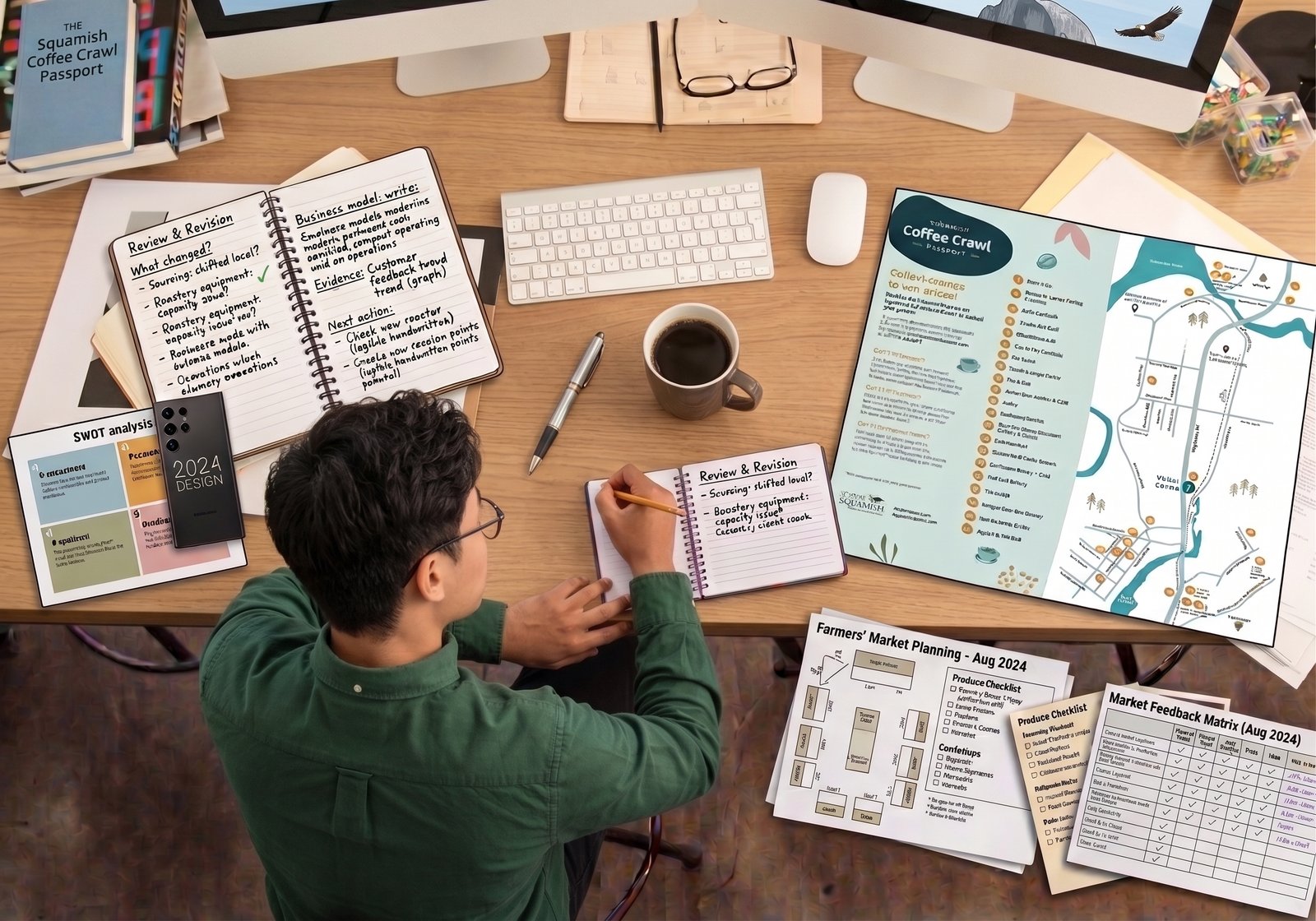
In 2024, I made a SWOT analysis for Filgap Coffee.
It looked like a proper SWOT analysis.
Four boxes.
Strengths.
Weaknesses.
Opportunities.
Threats.
Inside the boxes were things such as management experience, coffee excellence, a diverse menu, subscriptions, high start-up costs, population growth, competition and expensive commercial real estate.
It was tidy.
Looking at it again now, I think some of it was useful.
I also think I was too generous with myself in a few places.
That may be the more useful part to talk about.
Because the question is not whether I know what the letters in SWOT mean.
The question is:
Did anything I wrote in those four boxes actually change what I was going to do?
Some of my “strengths” did not exist yet
One item in the old SWOT was a diverse menu.
At the time, that made sense to me.
I was planning a fairly complete café. If customers came in during the morning, some would want breakfast with their coffee. At lunch, they might want something more substantial. If two people stayed for a few hours talking, eventually one of them might want a snack.
A coffee shop does not only serve people who arrive thinking:
I want excellent espresso and nothing else.
Customers have different reasons for being there.
So I thought the ability to offer a broad menu was a strength.
Technically, I could build one. I had enough experience to understand recipes, food operations and how different products could fit together.
But looking at the SWOT now, I do not think Diverse Menu belonged in the Strength box.
It was something I intended to do.
That is different.
The same problem appears elsewhere in the old analysis.
Coffee Excellence.
Subscription and Delivery.
Elegant Coffee Shop Environment.
All appeared as strengths in the 2024 plan.
But a future beautiful room is not a present strength.
A subscription service that does not yet have customers is not a strength.
And saying I intend to make excellent coffee does not prove that I can make it consistently enough for customers to trust it.
Those may be aspirations.
Capabilities under development.
Promises I hope to earn the right to make.
But a SWOT becomes less useful if I put everything I hope to become into the Strength box.
A real strength should survive a harder question
If I ask myself what Filgap genuinely has today, the list gets shorter.
That is probably healthier.
I do have experience running coffee businesses.
I have managed operations at a scale much larger than the small business I am planning now.
That experience helps.
But even that needs qualification.
Managing many stores and building one small local roastery are not exactly the same job.
The scale is different.
The work is more hands-on.
The customer relationship is different.
The founder is much closer to the product.
So I would call the experience a strength, but not an automatic answer.
There are also standards I know how to work toward.
I care about the raw material.
I want to start with good specialty-grade green coffee.
I want to find the point where each coffee tastes best to me rather than forcing every coffee into one fixed roast label.
Sweetness matters to me.
Then I want to reproduce that result as consistently as possible and manage the coffee with the freshness I have been talking about throughout this series.
But even here, I need to be careful with the word strength.
The standard is real.
The discipline and intention are real.
Commercial consistency still needs to be demonstrated.
If Filgap repeatedly roasts coffee to the standard I want, blind tastings support it, customers buy it, and they come back because the next batch meets the same expectation, then consistency becomes evidence.
Until then, it is a capability I am building.
That distinction may sound overly cautious.
I think it is useful.
The weaknesses were trying to tell me something
The old SWOT also said:
High Initial Investment.
That one was not imaginary.
The original Filgap model required a substantial space, construction, equipment, seating and a much broader operation. The same SWOT also identified difficulty securing suitable leases and rising retail rents as a threat.
So the warning was already on the page.
Yet I was still planning the large café.
That is interesting to me now.
Why did I keep going?
Because at the time, I thought the larger café was part of the solution.
If you want different kinds of customers to use the space throughout the day, a broad menu makes sense.
If people stay for two or three hours, food makes sense.
If you want the café to function as a gathering place, space makes sense.
And once you commit to that space, you need enough sales to support it.
The logic was not irrational.
The problem was that each decision made the next decision larger.
- Large room.
- Higher rent.
- More customers needed.
- Broader menu.
- More equipment.
- More operating complexity.
- More people.
- More sales required.
The SWOT identified the cost problem.
I had not yet allowed that weakness to challenge the solution itself.
That is the difference between identifying a weakness and actually using it.
A warning that changes nothing is not much of a warning
Commercial real estate is probably the clearest example.
Finding an accessible ground-floor space for a new independent coffee business can be difficult.
The better locations can be expensive.
Older locations may require significant renovations.
And a landlord considering a new brand has every reason to think about tenant risk.
I knew much of that before.
But now the consequence is different.
Instead of saying:
Real estate is a threat, so I need to negotiate harder.
I can also ask:
Do I need the lease yet?
That question changes the strategy.
If I can start smaller, roast, sample, learn from customers, sell through the Farmers’ Market and build actual demand before committing to a permanent location, then part of the real-estate risk can be delayed.
It does not disappear.
But I may arrive at the lease discussion with a real customer base rather than only a projection.
That is a SWOT item doing something useful.
It changed the sequence.
A diverse menu can also become a weakness
This is another place where my thinking has changed.
A broad menu once looked like protection.
More choices.
More customer occasions.
Higher average transactions.
Today I also see the other side.
A menu creates an identity very quickly.
When a business first opens, customers begin deciding what kind of place it is almost immediately.
Changing that later can be surprisingly difficult.
Employees do the same thing.
If someone joins because they believe they are working in a serious coffee-focused business and the operation gradually becomes breakfast, lunch, desserts, ice cream and everything else, the business may eventually become something different from what they joined.
Operations have to change.
Training changes.
Equipment changes.
Inventory changes.
The identity changes.
I learned in earlier businesses that first impressions of what a brand is can become very sticky.
That makes me much more careful now.
The question is no longer:
How many customer needs can I cover?
It is:
What do I want people to understand Filgap is from the beginning?
Right now, the answer needs to begin with coffee.
That makes menu complexity something to manage carefully rather than an automatic strength.
Opportunities are especially easy to exaggerate
The old SWOT listed population growth, demand for quality, fresh-bean opportunities, indoor community space and expansion potential among its opportunities.
Some of those are useful observations.
Squamish has grown.
Commercial coffee demand clearly exists.
Freshness remains an area I personally believe is worth exploring.
But other items need more discipline.
Take community space.
I still believe a comfortable place for people to meet would be valuable.
That does not mean the market has proven that a large Filgap community café is economically viable.
Or consider an espresso-focused coffee concept.
I may believe there is room for one.
But people already get coffee every day from businesses that apparently work for them.
My belief that something would be better does not automatically turn it into an opportunity.
An opportunity should exist outside my own enthusiasm.
That seems obvious when I write it now.
It is surprisingly easy to blur the two when building a business plan.
Threats are everywhere
I do not remember every threat I wrote in 2024 without going back to the document.
That may itself say something.
Competition.
Rent.
Staffing.
Construction.
Market saturation.
There will always be threats.
I could probably fill several pages with them.
A new competitor.
Coffee prices.
A recession.
A bad location.
A landlord problem.
Equipment failure.
Customers changing habits.
The list can become endless.
At some point, listing threats stops being strategy and starts becoming anxiety.
What matters more to me now is whether the threat is specific enough to change a decision.
For example:
Competition is not very useful.
But:
A local business develops the same freshness-led proposition and customers clearly prefer their solution.
is something I can think about.
High rent is vague.
But:
The expected sales at this location would require an occupancy cost that leaves too little room to maintain product quality and healthy operations.
can change a lease decision.
Specific threats create choices.
Generic threats mostly fill boxes.
The most useful part of SWOT may be underneath the four boxes
The 2024 business plan did not stop at the four categories.
It also tried to connect them to strategies.
Promote subscriptions.
Improve customer interactions.
Build community partnerships.
Negotiate leases.
Operate leanly.
Continue updating the business plan.
Some of those ideas still make sense.
Some do not fit the current model anymore.
Market Menu Variety, for example, no longer feels central to what I am trying to build. Other ideas, such as subscriptions, customer relationships, lease discipline and updating the plan as conditions change, still have a place.
That may be the real purpose of the exercise.
Not:
What are my strengths?
But:
What do my strengths allow me to do?
Not:
What are my weaknesses?
But:
What do they require me to change?
Not:
What opportunities exist?
But:
Which one deserves an experiment?
Not:
What threats exist?
But:
Which decision would reduce my exposure before the threat becomes a problem?
Those questions lead somewhere.
A SWOT needs a date
If I make another SWOT for Filgap, I would put a date on it.
SWOT — August 2026.
Not because the month is important.
Because the analysis will expire.
The 2024 business plan assumed a full café opening first, a broad menu, a substantially larger operation, and even longer-term expansion beyond the local market.
The current path is different.
Build the brand.
Learn.
Roast on a small scale.
Sample locally.
Listen.
Move into Farmers’ Market sales.
Watch what people actually buy.
Develop the commercial operation gradually.
A SWOT written for the old model cannot simply be moved over to the new one.
The strengths are different.
The weaknesses are different.
Even the meaning of the same threat can change.
A SWOT is a snapshot.
It should probably have an expiry date in my head.
The weaknesses I would write today are practical ones
If I wrote the internal side of the SWOT today, one weakness would be obvious.
Filgap does not yet have a permanent retail location.
That means customers cannot simply walk in whenever they need coffee.
If Farmers’ Market sales become the first regular commercial channel, availability is tied to a particular day and place.
That creates another problem.
What happens when a regular customer needs coffee on Wednesday?
How do they order?
Where do they pick it up?
What happens if the product they want sells out at the market?
How do I communicate with customers between market days when there is no permanent counter connecting us?
Those are real weaknesses of the early model.
And unlike a vague statement such as limited distribution, they lead directly to things I need to design:
pre-ordering,
pickup,
inventory reservation,
online communication,
possibly local delivery later,
and eventually subscription.
That is the kind of weakness I want in a SWOT.
One that creates a to-do list.
I would add an evidence column now
If I used SWOT again, I do not think four boxes would be enough.
Beside every item I would add:
Evidence
For example:
Strength:
Strong coffee-business management experience.
Evidence:
Previous operating and management experience.
Fair enough.
But:
Strength:
Consistently excellent roasting.
Evidence:
Not commercially demonstrated yet.
That changes the language immediately.
Or:
Opportunity:
Some Squamish customers may value fresher local whole-bean coffee.
Evidence:
My own buying experience, conversations and observations.
Missing evidence:
Meaningful paid repeat purchase.
Now I know what I need to learn next.
The evidence column prevents a confident-looking box from turning a hope into a fact.
Then I would add two more columns
After evidence, I would add:
Decision
and
Next Action
Suppose the item is:
Threat: Permanent retail occupancy costs may be too high for the early business.
Evidence:
Actual local commercial conditions and the economics of the original larger model.
Decision:
Do not make a permanent store the first market test.
Next action:
Validate demand through lower-fixed-cost channels first.
Now the SWOT is doing something.
Or:
Weakness: Customers do not have a permanent place to buy Filgap whenever they want it.
Decision:
A Farmers’ Market-only model is not enough if repeat purchasing grows.
Next action:
Design preorder and pickup before the inconvenience becomes a customer problem.
That is far more useful to me than putting Distribution Limitations into a red box.
A SWOT I would actually use
If someone asked me how to make SWOT more useful for a small business, I would still begin with the traditional four categories.
But for every item, I would ask:
Is it real today?
Or am I describing something I hope to build?
Is it internal or external?
Can I control it?
What is the evidence?
Not the story. The evidence.
How specific is it?
Could this item actually change a decision?
What decision follows?
Do I stop something, start something, delay something or test something?
What happens next?
Who does what?
And I would probably highlight anything that has been sitting in the SWOT for months without affecting a single decision.
That item may not belong there.
Or I may not be taking it seriously enough.
The question I would put below all four boxes
I still think SWOT can be useful.
I would use it again.
But I no longer think completing the four boxes means the work is finished.
For Filgap, the interesting part began when I returned to an old SWOT years later and realized that some strengths were plans, some opportunities were hopes, and some weaknesses had been warning me about the business model all along.
The analysis became useful when I finally allowed those warnings to change the plan.
So if I made another SWOT tomorrow, I would put one question underneath the entire page:
So what am I going to do differently because of this?
If I cannot answer that, I may have completed a SWOT.
I probably have not done much strategy.