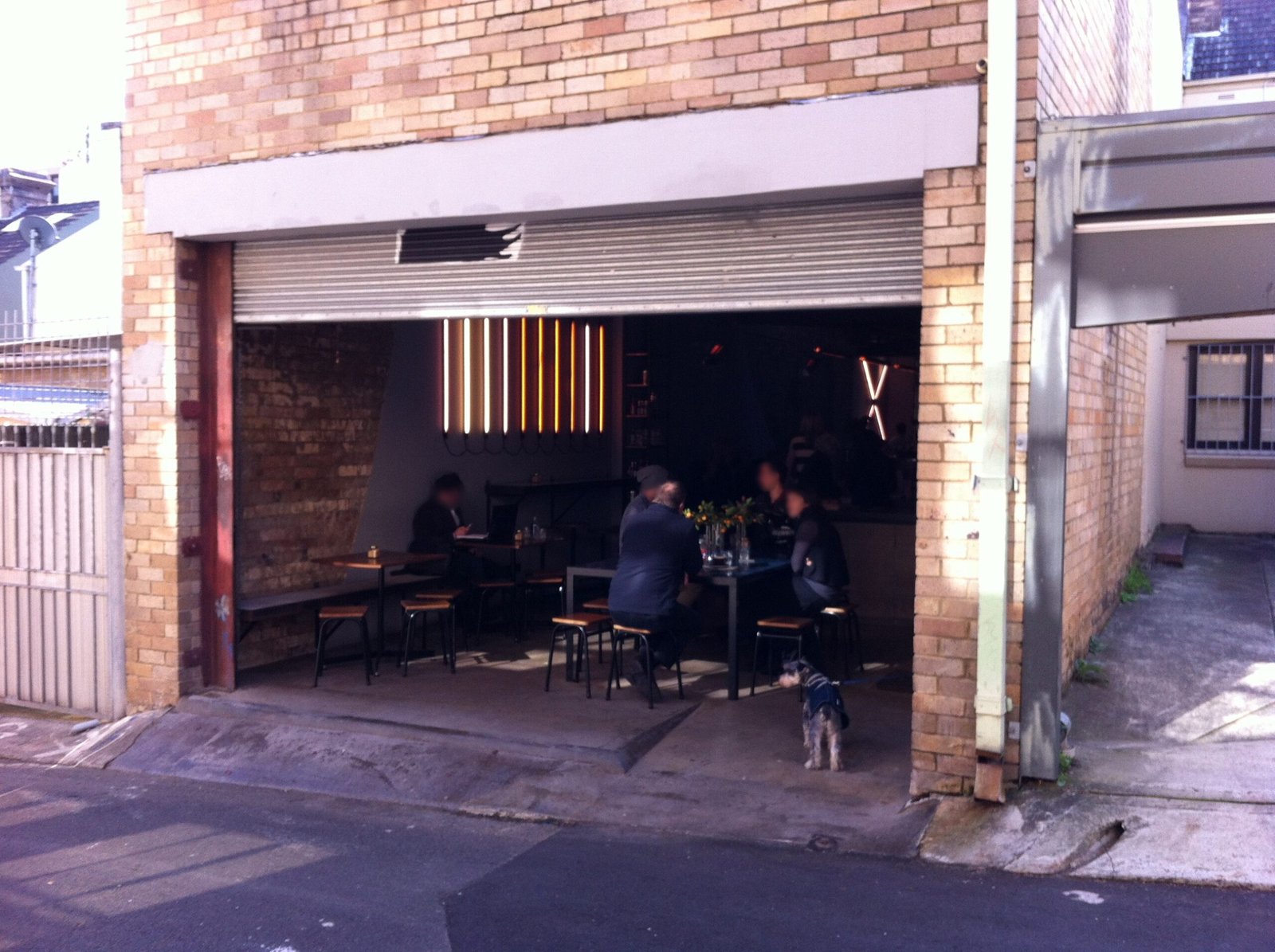
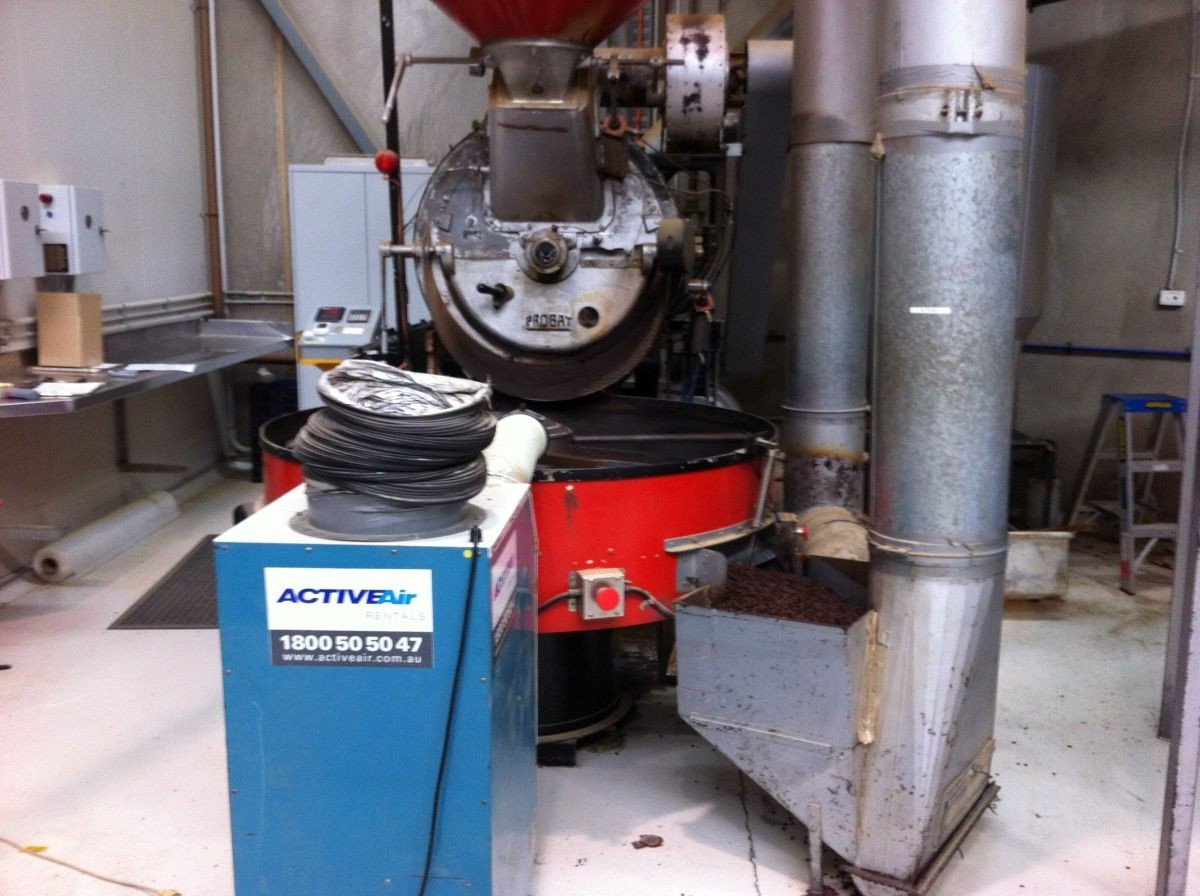
The first thing I notice when I look at these photographs now is how old some of the equipment looks.
There is a large, heavily used PROBAT roaster, surrounded by ducts, hoppers, pipes and equipment that had clearly been added or modified over time. If I stopped at the wide photographs, I could probably describe the factory as old or rough and move on.
But that is not what interests me when I look at the photographs closely.
I photographed an extra cooling setup beside the roaster. I photographed the underside of the cooling tray. I photographed a thermometer, a brush, an Agtron roast analyzer, a grinder, a scale and temperature and humidity instruments. I also photographed operating sheets posted around the production area.
At the time, I was visiting partly because of Instaurator himself. He was the founder of Espressology and the author of The Espresso Quest, and I wanted to understand how an experienced roaster worked.
Looking back now, I think some of the smallest details in the photographs may be more useful than the large machine I went there to see.
Field visit: 2012
Location: Sydney, Australia
Context: A roasting facility then being managed and operated by Instaurator, founder of Espressology
Research focus: Cooling, measurement, maintenance and repeatability around a commercial coffee roaster
I no longer remember the facility’s exact operating name. Caffe Coffee branding appears in some photographs, but I do not have enough evidence to identify the facility by that name. I am therefore describing only what I know from the visit and the photographs.
The roaster was only the obvious part
A large commercial roaster naturally dominates the room.
This one was old. I do not know its exact year, and I do not want to guess from its appearance now. What I remember more clearly is that nobody treated its age as a reason to expect poor coffee.
As I went through the photographs again, I started looking less at the machine itself and more at what had been changed around it. Measuring tools were kept near the processes they were checking. Parts of the equipment had been adapted. Written procedures were visible around the production area.
That changed the question for me.
Instead of wondering whether the roaster was modern, I started wondering why each of those smaller things was there.
Cooling did not stop being important when the beans left the drum
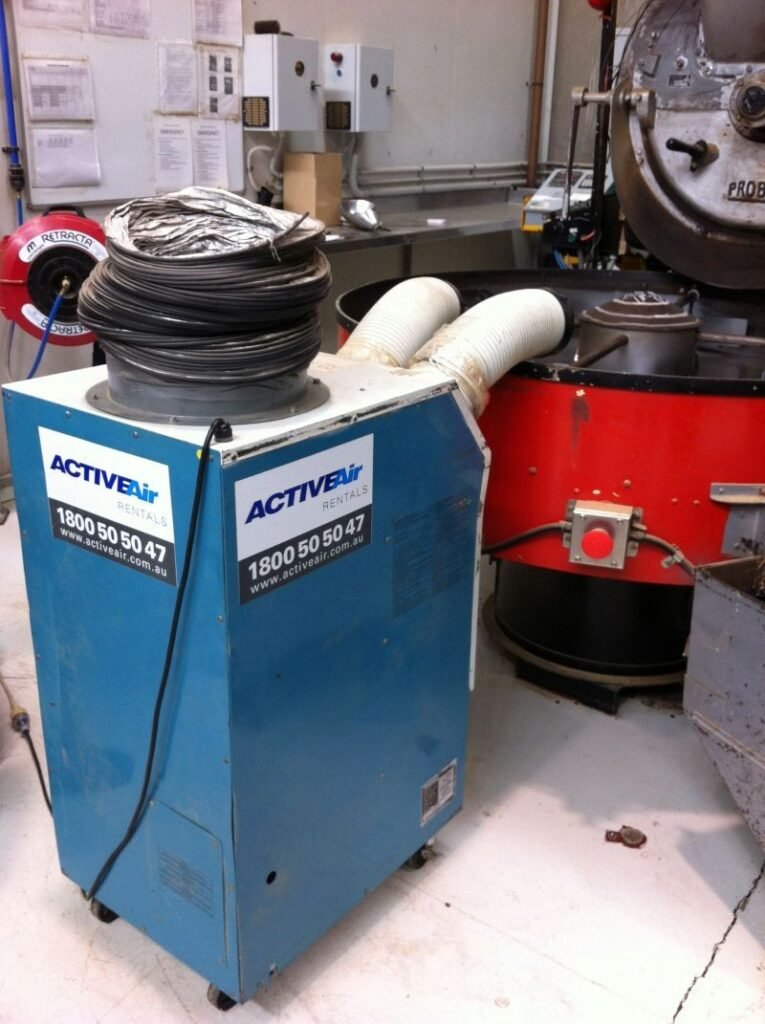
One photograph shows what looks like a separate air-conditioning or cold-air unit positioned beside the cooling system.
My understanding at the time was that it was used when the surrounding air was warm and they wanted more control over how quickly the roasted coffee cooled.
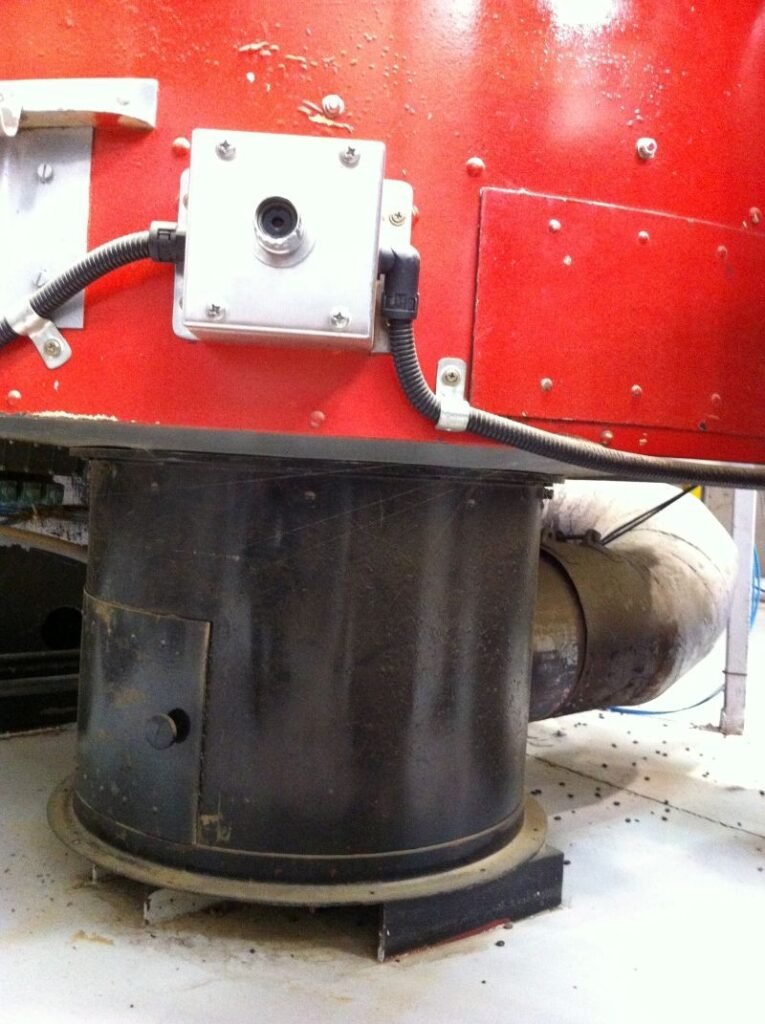
Another photograph shows a modification beneath the cooling tray. As it was explained to me, part of the original lower structure had been changed so the suction could work more directly through the area where cooling was needed.
I cannot reconstruct the engineering from these photographs, and I do not need to. What matters to me is that someone had looked at the cooling performance, decided the existing arrangement could work better, and modified it.
The detail made sense to me because the beans do not suddenly lose all of their heat when the roaster door opens.
I think of it a little like cooking a steak. You remove a steak from the heat and it continues to cook for a while from the heat already inside it. Coffee is obviously not steak, but the analogy helped me think about the problem: once the roast has reached the point you want, you do not want residual heat continuing to change the coffee longer than necessary.
The beans themselves are shown turning through the cooling tray in another photograph.
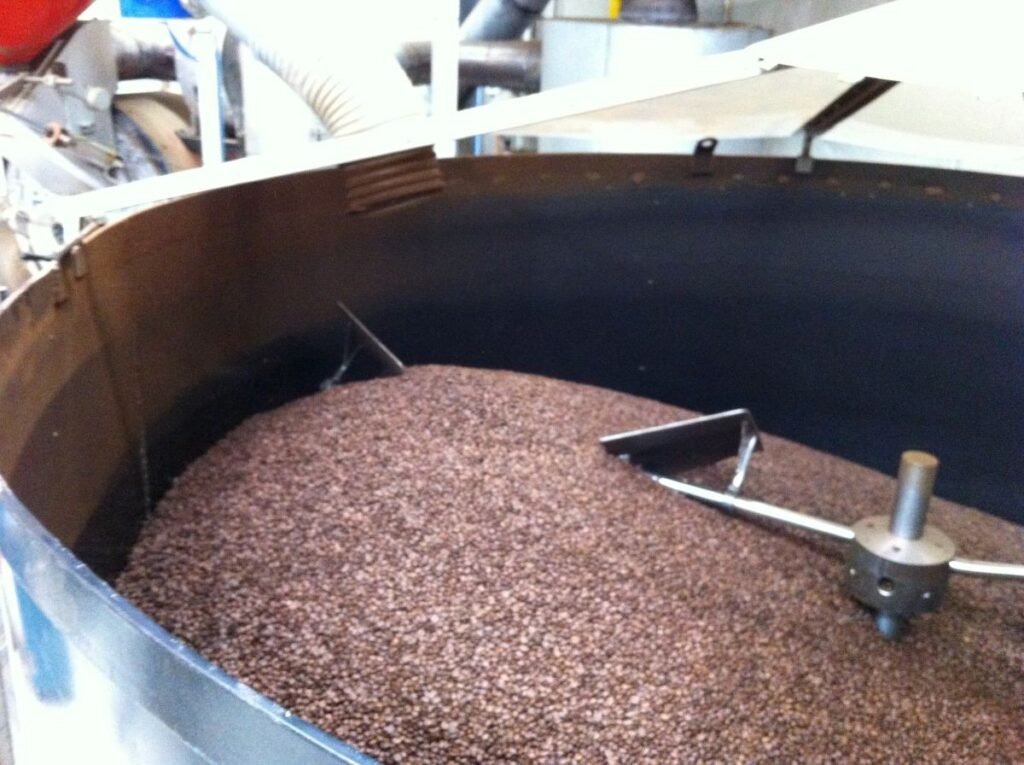
Cooling has its own airflow, mechanical condition and cleanliness. Those conditions can change.
The process was also checked rather than simply left to a familiar amount of time.
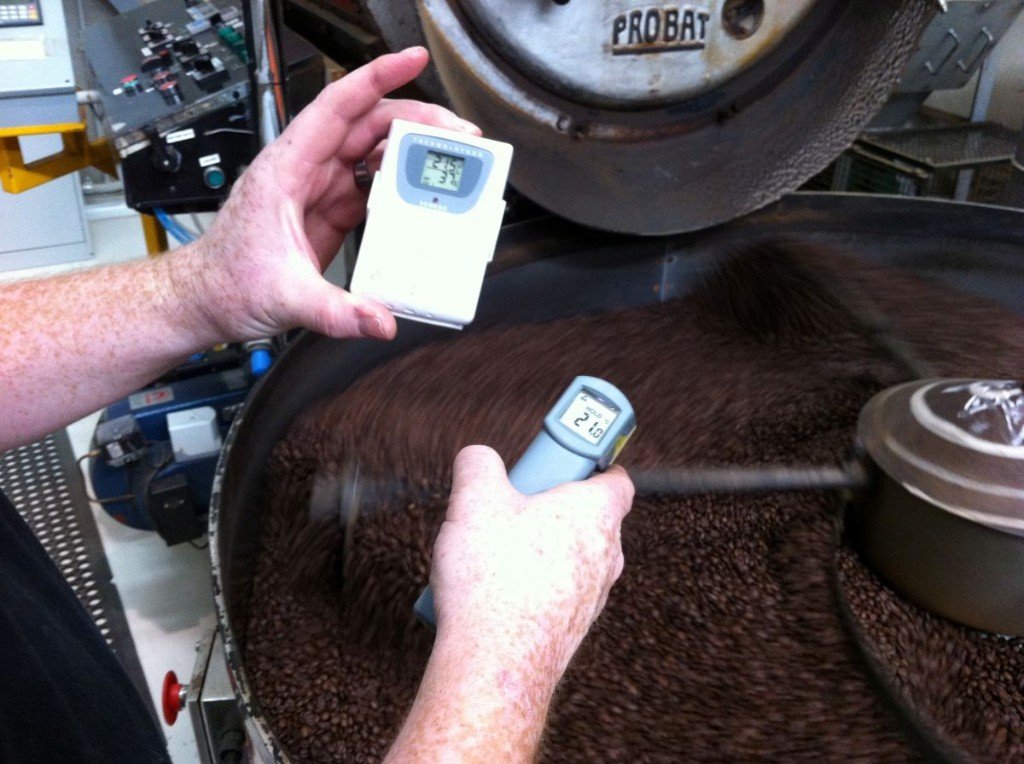
One photograph shows the temperature of the coffee being checked after cooling, at around room temperature.
That was one of the details that stayed with me. The operator did not simply assume that the beans should be cool by then. There was a number to look at.
The brush beside the cooling area makes more sense in the same context.
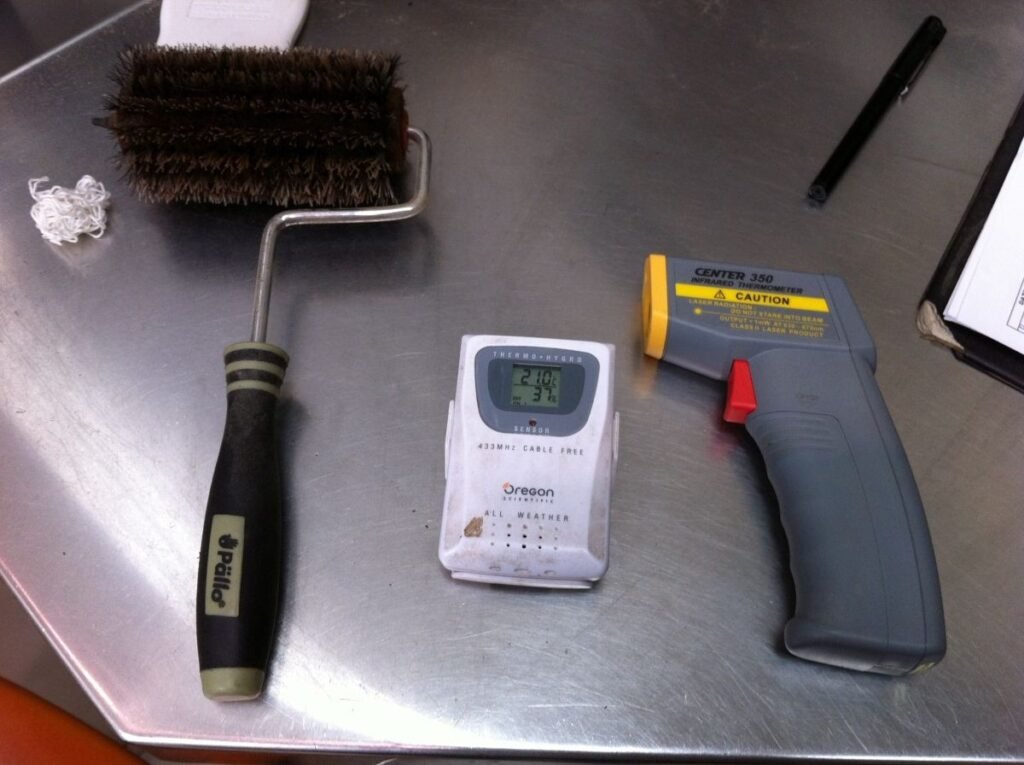
Cooling trays depend on air moving through many small openings. During repeated production, those openings do not necessarily stay perfectly clean. Coffee residue can gradually restrict them and change the airflow.
I have seen a larger roasting operation where many of the cooling-tray holes had become partly blocked. The tray was being cleaned, but not often enough to keep the airflow as open as it could have been.
That made the brush look different to me.
It was not simply there to make the machine look clean. Keeping the air path open was part of keeping the cooling condition usable from batch to batch.
Measuring what you want to repeat
The same attitude appeared in the quality-control area.
There was equipment for monitoring temperature and humidity around the roasting environment. A photograph cannot tell me exactly how every reading affected every roast decision, and I would be going too far if I claimed that.
What the photographs do tell me is that the surrounding conditions were considered worth measuring.
The roast-analysis station was more deliberate again.
The Agtron analyzer sat inside a dark enclosure. Beside it was a grinder, and close by were a scale and the tools needed to prepare samples.
I remember noticing the enclosure because the measurement itself was being treated carefully. I took the setup as another attempt to reduce unnecessary variation around a reading they wanted to compare repeatedly.
As I remember the routine, both whole beans and ground coffee were measured.
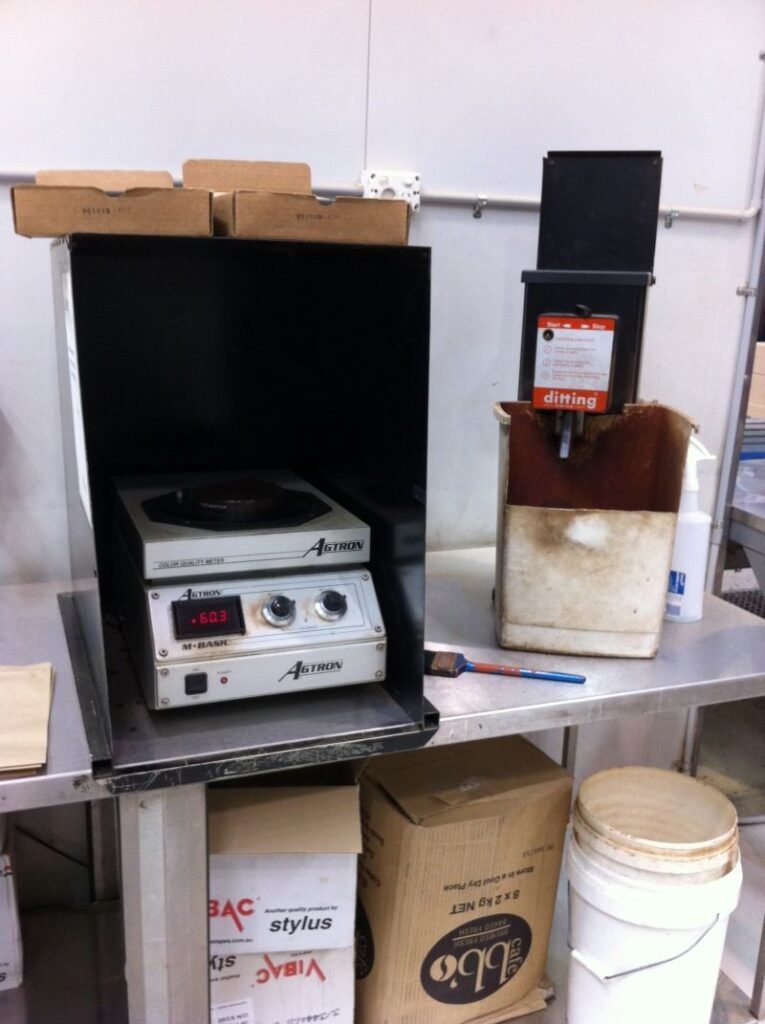
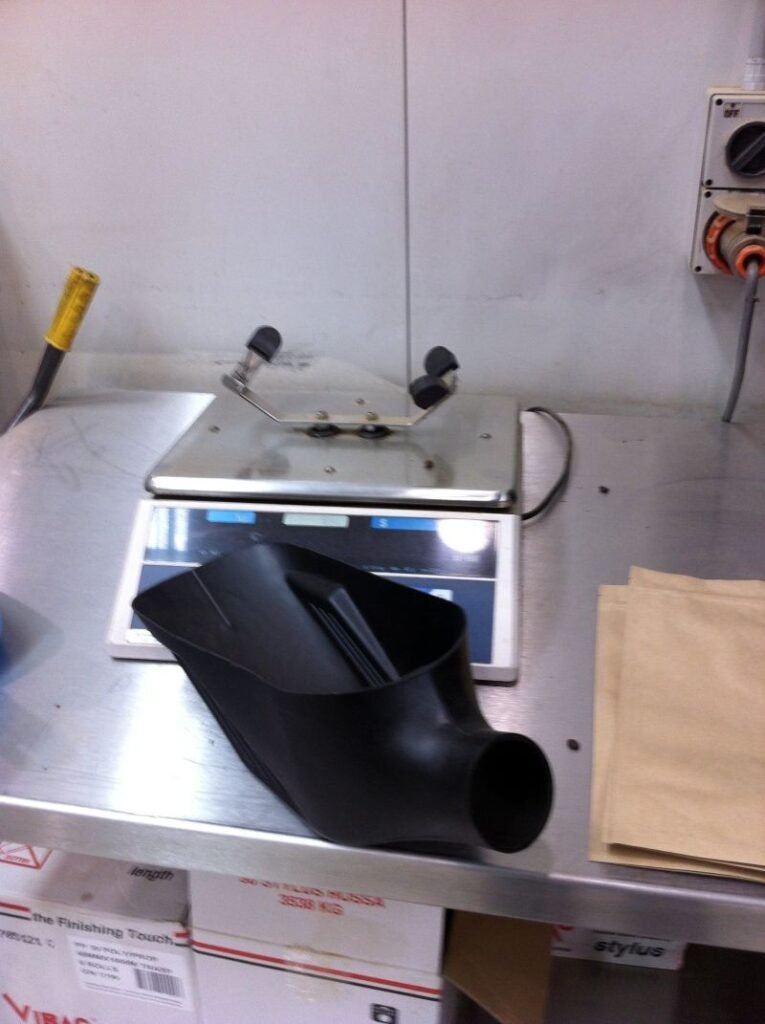
Again, I am less interested in the brand of instrument than in the way the station was arranged.
The analyzer was there. The grinder was there. The scale was there. The sample container had a stable place to sit.
A sample had to be prepared and measured in a repeatable way if the number was going to mean anything from one batch to the next.
These are small things, but that is exactly what interested me.
Some of the most important knowledge was written on the wall
I photographed a number of production documents during the visit.
I am not going to reproduce blend formulas, customer information, supplier details or other internal material from them. That information is not necessary for the point of this article.
What interests me now is the range of things that had been written down.
There were production routines and roast information. There were schedules. There were quality-control records. There were emergency instructions, including procedures for dealing with problems such as a roaster fire or loss of power.
The operation was not relying only on somebody experienced being present and remembering what to do.
Some of that knowledge had been turned into instructions that other people could follow.
That matters in a roasting business because one good batch does not prove very much. The harder problem is producing the result again, then doing it again when another person is working, when conditions change, when equipment needs cleaning or when something goes wrong.
The written sheets were not interesting because they looked professional.
They were interesting because they showed what the operation had decided was important enough to make repeatable.
The process continued beyond the cooling tray
The physical production flow also continued from roasting and cooling toward transfer and packaging.
I remember it as a fairly continuous process rather than a series of disconnected jobs.
When I first reviewed these photographs, I was tempted to attach a specific time target to that memory and say the coffee was packaged within a certain number of minutes after roasting.
I do not think the photographs allow me to turn that into a general rule.
They do support the broader observation that the factory had thought about what happened to the coffee after the roast, not only what happened inside the drum.
That distinction matters.
A roast can be controlled carefully and still be followed by inconsistent cooling, handling or packaging.
For me, this is another reason the roaster itself is only part of the system.
What I would take from this into a much smaller roastery
The factory I visited and the small-batch roastery I am building in Squamish are very different in scale.
That makes the comparison more useful in some ways.
I do not need to copy a large industrial transfer system or packaging line simply because I once saw one working there. Those are solutions for a different production scale.
But the underlying questions do not disappear when the roastery gets smaller.
If cooling changes from batch to batch, will I know?
If airflow changes because equipment is becoming dirty, what tells me?
If I am comparing roast development, am I preparing the sample consistently enough for the comparison to mean anything?
If temperature and humidity turn out to matter to a particular process, am I recording them because they help me make a decision, or simply because I own the instruments?
And if something goes wrong, is the response written down or only in my head?
Those are much more useful questions for me than whether the roasting machine is new.
The machine matters. Of course it does.
But when I look back at this old factory now, what I remember most is the attention being paid to everything around it.
Consistency was not sitting inside one machine. It was being built around it.
Sources and context
This article is based primarily on my photographs and observations from the 2012 visit. For background on Instaurator and Espressology, see BeanScene’s profile of the company. The Espresso Quest was published in 2008, and a contemporary excerpt and introduction is available from CoffeeGeek. For technical background on the Agtron instrument shown in the photographs, see Agtron’s M-BASIC II information and operating manual.