There are a lot of ways to describe coffee: Arabica, specialty coffee, single origin, a cupping score, light roast, medium roast, dark roast.
All of those things can tell you something. But none of them, by themselves, can tell me whether a coffee is good.
In the end, I keep coming back to a much simpler question: How does it taste?
That sounds obvious, but coffee can become technical very quickly. There are roast curves, temperatures, extraction numbers, grind settings and scores. I think those things matter. I have spent a lot of time working with them, and I expect to keep doing that with Filgap.
I just do not think the numbers are the final answer. They help me understand what is happening. The cup tells me whether it worked.
The cup is the final test
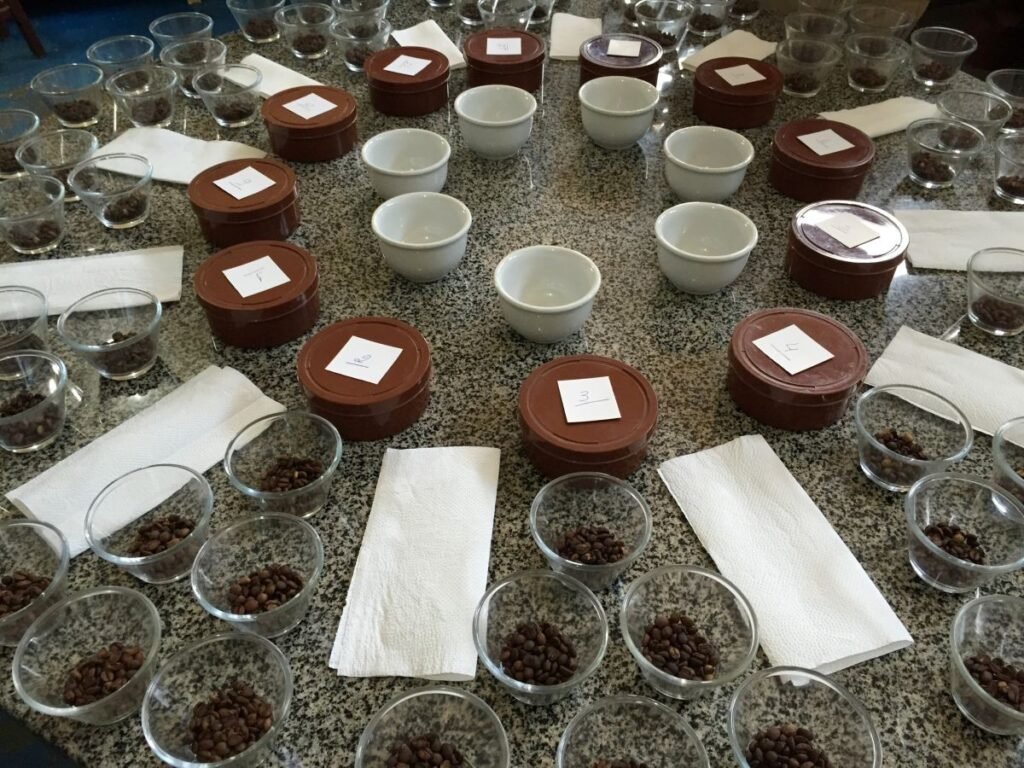
Tasting coffee well is a skill. That is something I learned a long time ago, and it is something I still take seriously.
When I taste coffee carefully, there are really a couple of different questions in my mind. What is actually in this cup? What am I tasting? And then, do I think it is good?
Those questions are related, but they are not exactly the same.
Learning to recognise sweetness, acidity, mouthfeel, aroma, cleanliness and aftertaste takes practice. So does learning to describe what is there without immediately confusing it with what you personally prefer.
Without that practice, it can be surprisingly difficult to know what your own coffee is doing. You can follow the same roast profile as yesterday, see numbers that look right and repeat a recipe carefully, and the coffee still may not taste the way you intended.
That is why I do not want Filgap to become too attached to a number simply because the number is easy to measure. I want to measure things, record them and use them.
But then I want to taste the coffee.
What can this coffee become?
I also do not want to begin with a roast label and work backwards.
I am not interested in deciding that every coffee should be roasted light, or that every Filgap coffee has to reach exactly the same roast level because that is our style.
Different coffees arrive with different characteristics. Origin matters. Variety matters. Processing matters. And the green coffee itself changes from one lot to another.
So the question I would rather start with is: What can this coffee become?
Then I can ask how to roast it so that the good things already there become easier to taste.
For the coffees I tend to enjoy, that usually means enough development for sweetness and balance to come through. In practice, many of the coffees I am interested in may end up somewhere around what people would call a medium roast.
But medium roast is not really the philosophy. It is more often where I end up while trying to get somewhere else.
I tend to look for a subtle sweetness in coffee. I do not mean sweetness like adding sugar to a drink. Coffee is much quieter than that.
Sometimes the sweetness may remind me of chocolate. Sometimes fruit, caramel or something harder to name. If you taste coffee often, those differences can become quite distinct. Someone who does not may simply experience all of those things together as a coffee that tastes good.
I think that is fine too.
I also care a lot about cleanliness. I like a cup where the flavours feel clear rather than muddy, and I like the finish to feel clean after I swallow it. I do not enjoy coffee that leaves a rough or unpleasant feeling in my mouth.
Acidity can be part of a very good cup. I am not trying to remove it. For me, it works best when it belongs with the sweetness and the rest of the coffee instead of taking over everything else.
And I generally like some body. Not every coffee needs to feel heavy, and brewing changes the way mouthfeel comes across, but I usually prefer a cup with enough weight to feel balanced.
These are preferences. They are part of the way I taste coffee, and I do not expect everyone to like exactly the same thing.
Roasting is not where the job ends
For a long time, I have thought about coffee quality as a chain.
A coffee can begin with very good green beans and still lose something later. Roasting can develop what is good in it, or it can hide it. What happens after roasting matters too.
Packaging matters. Storage matters. Grinding, water and brewing matter.
So I do not really think the roaster’s job ends when the beans come out of the machine.
Filgap does not have a café right now, which means I cannot control the final preparation. Once someone takes our whole-bean coffee home and brews it at home, their grinder, water, brewer and technique all become part of what happens next.
I still think we have some responsibility for that part of the journey.
If there is a way of brewing a coffee that helps it show itself better, I want to be able to explain that. If a product needs to be prepared or used in a particular way, the information that comes with it should help.
I cannot make the final cup for everyone. But I can try to make it easier for someone to get a good one.
Why freshness matters to me
This is also why I keep coming back to freshness.
For Filgap, freshness is not only a date printed on a bag. Coffee keeps changing after it is roasted, and how it is packaged, stored, ground and eventually brewed affects what makes it into the cup.
I do not think there is one universal number that explains the perfect freshness window for every coffee and every brewing method.
Personally, though, I prefer the distance between roasting and drinking to be fairly short. That preference affects how I want Filgap to work.
I would rather roast closer to when the coffee is actually going to be used than build a large inventory and let it sit.
That is one of the practical reasons small-batch roasting makes sense for us.
A large roaster can make excellent coffee. A small roaster can make terrible coffee. The size of the machine does not decide quality.
For Filgap, the advantage is more practical. Smaller batches let me carry several coffees without having to produce a large quantity of every one at the same time. I can pay closer attention to what is actually being used, and when we need more, I can roast again.
For a small local roastery preparing for its first Farmers’ Market season, that matters. It makes freshness easier to manage.
Being in Squamish helps too because the path between roasting and the person drinking the coffee can be short.
That is why the words we use for Filgap — Fresh coffee. Small batches. Squamish. — are connected in my mind.
Small batches make it easier for us to roast closer to demand. Being local shortens the path. Together, those choices make the kind of freshness I want much more practical.
Consistency does not mean putting the process on autopilot
There is another side to this. If coffee changes and the conditions around it change, how do you stay consistent?
For me, consistency does not mean doing exactly the same thing every day without thinking.
There are too many variables for that. Green coffee changes over time. Conditions around the roaster change. Equipment behaves differently. Producers develop new processing methods, and brewing equipment and techniques keep changing too.
Even when the goal stays the same, the way of getting there may need to move.
At the same time, consistency cannot mean everybody doing whatever they feel like doing. There has to be an intended result, and the job is to understand the variables well enough to keep moving toward that result.
Sometimes that means repeating what worked yesterday. Sometimes it means changing something.
If I change something, I want to understand why.
That is also why I do not think experience gives anyone permission to stop learning.
I spent many years in the coffee business before Filgap.
But when I came back to coffee in Squamish and began working directly with roasting again, there was still a lot for me to learn.
There still is.
Coffee farming and processing continue to change. New coffees will come in. Equipment and techniques will change. I will taste things I have not tasted before.
And once people start drinking Filgap coffee, their responses will become part of what I learn from as well.
That does not mean customer preference and careful coffee evaluation are the same thing. They answer different questions, and I think both can tell me something useful.
I do not expect to reach a point where I can say I know coffee completely. Even after all these years, that would feel strange to me.
I would rather keep tasting, paying attention, and changing something when the coffee gives me a reason to.
For now, that is probably the simplest way I can explain what good coffee means to Filgap.